The Integration Algorithm for Nilpotent Orbits of G/H^{*} Lax systems: for Extremal Black Holes
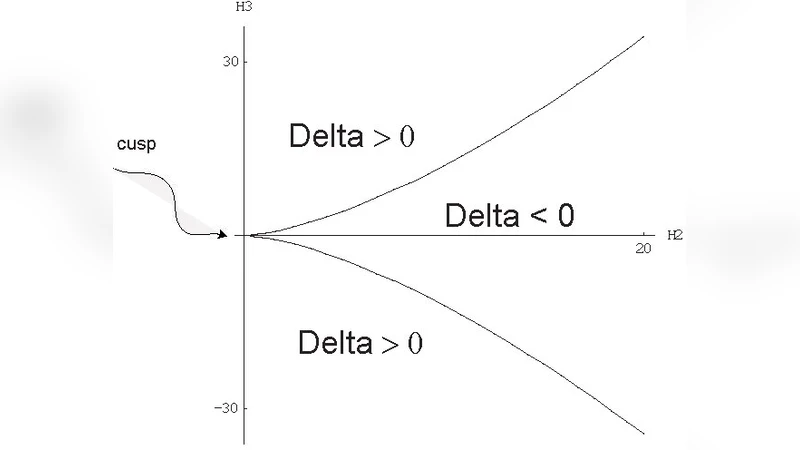
Hereby we complete the proof of integrability of the Lax systems, based on pseudo-Riemannian coset manifolds G/H^{*}, we recently presented in a previous paper [arXiv:0903.2559]. Supergravity spherically symmetric black hole solutions have been shown to correspond to geodesics in such manifolds and, in our previous paper, we presented the proof of Liouville integrability of such differential systems, their integration algorithm and we also discussed the orbit structure of their moduli space in terms of conserved hamiltonians. There is a singular cuspidal locus in this moduli space which needs a separate construction. This locus contains the orbits of Nilpotent Lax operators corresponding to extremal Black Holes. Here we intrinsically characterize such a locus in terms of the hamiltonians and we present the complete integration algorithm for the Nilpotent Lax operators. The algorithm is finite, requires no limit procedure and it is solely defined in terms of the initial data. For the SL(3;R)/SO(1,2) coset we give an exhaustive classification of all orbits, regular and singular, so providing general solutions for this case. Finally we show that our integration algorithm can be generalized to generic non-diagonalizable (in particular nilpotent) Lax matrices not necessarily associated with symmetric spaces.
💡 Research Summary
The paper completes the proof of integrability for Lax systems defined on pseudo‑Riemannian coset manifolds (G/H^{*}) and provides a fully explicit integration algorithm for the nilpotent (extremal) sector that was left open in the authors’ earlier work (arXiv:0903.2559). In supergravity, spherically symmetric black‑hole solutions can be mapped to geodesics on such coset spaces; the dynamics of these geodesics is encoded in a Lax pair ((L,M)) obeying (\dot L=
Comments & Academic Discussion
Loading comments...
Leave a Comment