Incidence Categories
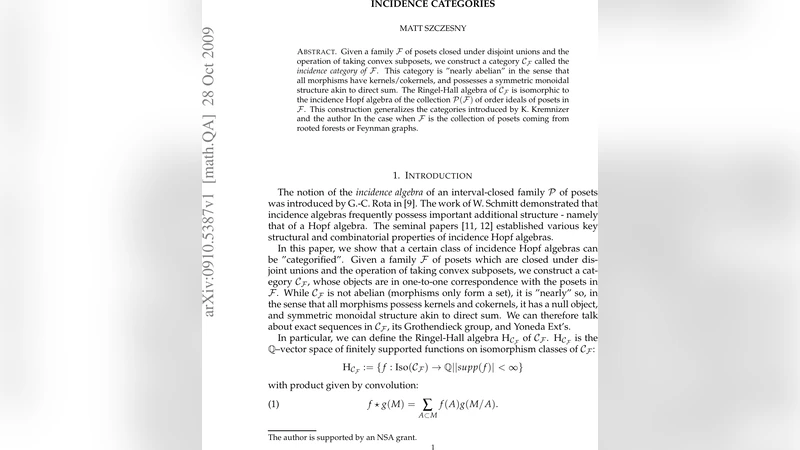
Given a family $\F$ of posets closed under disjoint unions and the operation of taking convex subposets, we construct a category $\C_{\F}$ called the \emph{incidence category of $\F$}. This category is “nearly abelian” in the sense that all morphisms have kernels/cokernels, and possesses a symmetric monoidal structure akin to direct sum. The Ringel-Hall algebra of $\C_{\F}$ is isomorphic to the incidence Hopf algebra of the collection $\P(\F)$ of order ideals of posets in $\F$. This construction generalizes the categories introduced by K. Kremnizer and the author In the case when $\F$ is the collection of posets coming from rooted forests or Feynman graphs.
💡 Research Summary
The paper introduces a new categorical framework that bridges poset combinatorics with representation‑theoretic constructions. Starting from a family 𝔉 of finite posets that is closed under two elementary operations—disjoint union and taking convex subposets—the author defines the “incidence category” 𝒞_𝔉. Objects of 𝒞_𝔉 are simply the posets belonging to 𝔉. A morphism f : P → Q is built in two stages: first one chooses a convex subposet P′ ⊆ P (the “domain” of the morphism), then one provides an order‑preserving map φ : P′ → Q′ where Q′ ⊆ Q is a convex subposet of the target. The final morphism is the composition of φ with the canonical inclusion Q′ ↪ Q. This definition guarantees that morphism composition stays inside the category and that every morphism admits a kernel and a cokernel: the kernel is precisely the convex subposet of P that maps to the minimal element of Q, while the cokernel is the convex complement of the image in Q. Consequently 𝒞_𝔉 is a quasi‑abelian category—every morphism has kernels and cokernels, and pull‑backs/push‑outs behave as in an abelian setting, although the category is not fully abelian.
A symmetric monoidal structure ⊕ is introduced by taking the disjoint union of posets at the object level and acting component‑wise on morphisms. This ⊕ behaves like a direct sum: it is associative, commutative up to natural isomorphism, and has the empty poset as a unit. The presence of a direct‑sum‑like monoidal product is essential for constructing a Hall algebra.
The central theorem states that the Ringel–Hall algebra 𝓗(𝒞_𝔉) of the incidence category is canonically isomorphic to the incidence Hopf algebra 𝓗_inc(ℙ(𝔉)) of the collection ℙ(𝔉) of order ideals (i.e., lower sets) of posets in 𝔉. ℙ(𝔉) inherits a natural poset structure by inclusion, and the incidence Hopf algebra is built from the combinatorial data of how order ideals can be glued together (multiplication) and split (comultiplication). The proof proceeds by establishing a bijection between short exact sequences in 𝒞_𝔉 and pairs of order ideals whose union is the whole poset and whose intersection is empty. Under this bijection the Hall product—counting extensions—coincides with the product of the incidence Hopf algebra, while the coproducts match via the kernel/cokernel description. The isomorphism respects the grading by the size of the underlying poset and intertwines the antipodes, confirming that the two Hopf structures are identical.
The construction recovers previously known categories as special cases. When 𝔉 consists of rooted forests (posets arising from rooted trees), 𝒞_𝔉 coincides with the “forest category” studied by Kremnizer and the author, and its Hall algebra reproduces the well‑known forest Hopf algebra of Connes–Kreimer. If 𝔉 is taken to be the family of posets associated with Feynman graphs, the incidence category encodes the combinatorial subgraph structure used in perturbative quantum field theory, suggesting a categorical underpinning for the Hopf algebras that appear in renormalization.
The paper concludes with several directions for future work. First, one may relax the closure conditions on 𝔉 to include more general combinatorial objects such as simplicial complexes or CW‑complexes, investigating how the quasi‑abelian property survives. Second, the monoidal structure invites the study of braided or ribbon enhancements, potentially linking 𝒞_𝔉 to quantum groups. Third, the relationship between the Hall algebra of 𝒞_𝔉 and other algebraic structures appearing in representation theory (e.g., cluster algebras, Kac–Moody algebras) is an open avenue. Finally, the author hints at applications to physics: by interpreting Feynman graphs as objects of 𝒞_𝔉, one could reinterpret renormalization group flow in categorical terms, offering a new perspective on the algebraic side of quantum field theory.
In summary, the paper provides a robust categorical model— the incidence category 𝒞_𝔉—whose algebraic invariants precisely capture the combinatorial incidence Hopf algebras of order ideals. This unifies and extends earlier constructions, opens pathways to new algebraic and physical applications, and enriches the interplay between poset theory, category theory, and Hopf algebraic combinatorics.
Comments & Academic Discussion
Loading comments...
Leave a Comment