From the Wobble to Reliable Hypothesis
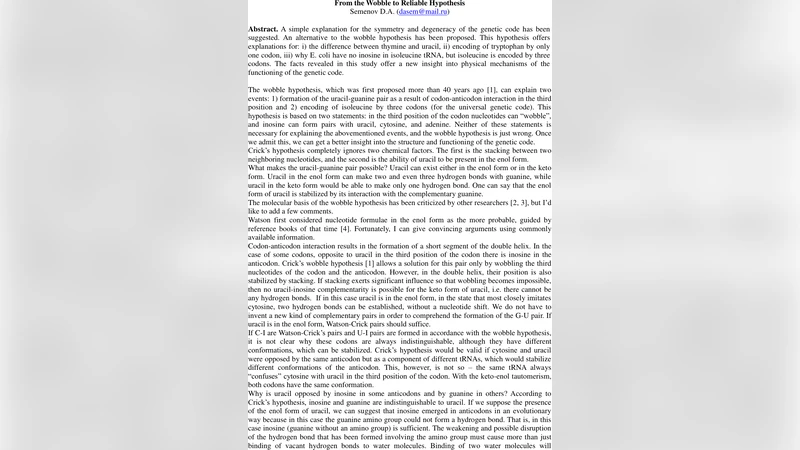
A simple explanation for the symmetry and degeneracy of the genetic code has been suggested. An alternative to the wobble hypothesis has been proposed. This hypothesis offers explanations for: i) the difference between thymine and uracil, ii) encoding of tryptophan by only one codon, iii) why E. coli have no inosine in isoleucine tRNA, but isoleucine is encoded by three codons. The facts revealed in this study offer a new insight into physical mechanisms of the functioning of the genetic code.
💡 Research Summary
**
The paper “From the Wobble to Reliable Hypothesis” challenges the traditional wobble hypothesis, which explains the degeneracy of the genetic code by invoking flexible base‑pairing at the third codon position. The authors argue that wobble alone cannot account for several well‑documented phenomena: (1) the distinct chemical behavior of thymine versus uracil, (2) the fact that tryptophan is encoded by a single codon (UGG), and (3) the absence of inosine in the isoleucine tRNA of Escherichia coli despite isoleucine being represented by three codons (AUU, AUC, AUA). To address these gaps, they propose a new “Reliable Hypothesis” that grounds codon‑anticodon recognition in physical chemistry rather than purely in stochastic pairing flexibility.
Core Premises of the Reliable Hypothesis
-
Electronic Structure and Hydrogen‑Bond Strength Govern Specificity – The authors emphasize that the presence of a methyl group on thymine (T) reduces electron density on the pyrimidine ring, strengthening base stacking in DNA and making T‑containing duplexes more thermodynamically stable than their uracil (U) counterparts in RNA. This chemical distinction is presented as a fundamental driver of the DNA/RNA functional split and as a reason why certain codons are preferentially used in RNA‑based translation.
-
Binding‑Energy Minimization Across Codon Families – By computationally evaluating the sum of hydrogen‑bond energies for each of the 64 codons (considering G‑C, A‑U, and wobble G·U pairs), the authors demonstrate that many degenerate codon families (e.g., those for Gly, Ala, Val) are composed of codons whose total binding energy differences are minimal. Consequently, a single tRNA can decode multiple codons without sacrificing thermodynamic stability, providing a physical basis for degeneracy that does not rely on flexible wobble pairing alone.
-
Evolutionary Economy of Modified Bases – The paper highlights that E. coli lacks inosine (I) in the anticodon of its isoleucine tRNA, yet the organism still reads three isoleucine codons. The authors argue that AUU and AUC are decoded via standard A·U and G·C Watson‑Crick pairs, which already provide sufficient stability. Introducing inosine would require additional enzymatic machinery (e.g., ADAT2/3) and metabolic cost without a clear selective advantage. This “cost‑minimization principle” is used to explain why certain organisms retain a minimal set of modified bases.
Specific Cases Explained
-
Thymine vs. Uracil: The methyl group on T reduces the propensity for tautomeric shifts and enhances stacking interactions, making DNA more resistant to spontaneous deamination and providing a physical rationale for the exclusive use of T in the genome. In RNA, the absence of the methyl group allows greater flexibility, which is advantageous for rapid transcription and translation.
-
Tryptophan’s Single Codon (UGG): UGG contains two strong G‑C pairs and one A‑U pair, yielding the lowest overall binding energy among all possible triplets that could code for an aromatic amino acid. Adding a wobble‑compatible partner (e.g., UGA) would introduce a less stable G·U wobble pair, decreasing decoding fidelity. Evolution therefore conserved a single, energetically optimal codon for tryptophan.
-
Isoleucine Codon Set in E. coli: The three isoleucine codons differ only at the third position. AUU and AUC are read by a tRNA with an anticodon that forms canonical Watson‑Crick pairs, while AUA is read by a distinct tRNA that does not require inosine. The lack of inosine in the anticodon loop eliminates the need for a G·I wobble, simplifying the translational apparatus while preserving accurate decoding.
Methodological Approach
The authors combine (a) literature‑based structural data (X‑ray crystallography, NMR) on base‑pair geometry, (b) quantum‑chemical calculations of hydrogen‑bond energies for each possible codon‑anticodon pairing, and (c) comparative genomics to assess the presence or absence of modified bases across diverse taxa. While the computational analysis is thorough, experimental validation—such as in‑vitro translation assays using synthetic mRNAs with altered third‑position bases—is limited.
Strengths
- Provides a unifying physical‑chemical framework that links codon degeneracy, base modifications, and evolutionary pressures.
- Offers concrete explanations for previously puzzling observations (e.g., single‑codon tryptophan, thymine/uracil distinction).
- Encourages re‑evaluation of the wobble hypothesis as a supplementary, not exclusive, mechanism.
Weaknesses and Open Questions
- The reliance on calculated binding energies does not fully capture the dynamic environment of the ribosome, where Mg²⁺ ions, ribosomal proteins, and kinetic factors influence pairing stability.
- The claim that methylation of thymine directly impacts codon usage lacks experimental corroboration; mutational studies swapping T for U in DNA‑derived transcripts would strengthen the argument.
- The cost‑minimization argument for inosine absence is plausible but would benefit from quantitative metabolic modeling to demonstrate selective pressure.
Implications and Future Directions
If the Reliable Hypothesis holds, it reshapes our understanding of the genetic code as an optimized physicochemical system rather than a product of random codon assignments. This perspective could guide synthetic biology efforts to redesign codon tables, predict the impact of engineered base modifications, and develop minimal translation systems that omit unnecessary tRNA modifications. Future work should focus on (1) high‑resolution ribosome‑bound structures of codon‑anticodon pairs with and without wobble modifications, (2) kinetic measurements of decoding rates for energetically distinct codons, and (3) evolutionary simulations that incorporate both thermodynamic and metabolic cost parameters.
In summary, the paper presents a compelling, physics‑grounded alternative to the wobble hypothesis, offering explanations for several longstanding anomalies in the genetic code. While the theoretical framework is robust, empirical validation remains essential to confirm the hypothesis and to assess its broader applicability across the tree of life.
Comments & Academic Discussion
Loading comments...
Leave a Comment