Electrically Charged Strange Quark Stars
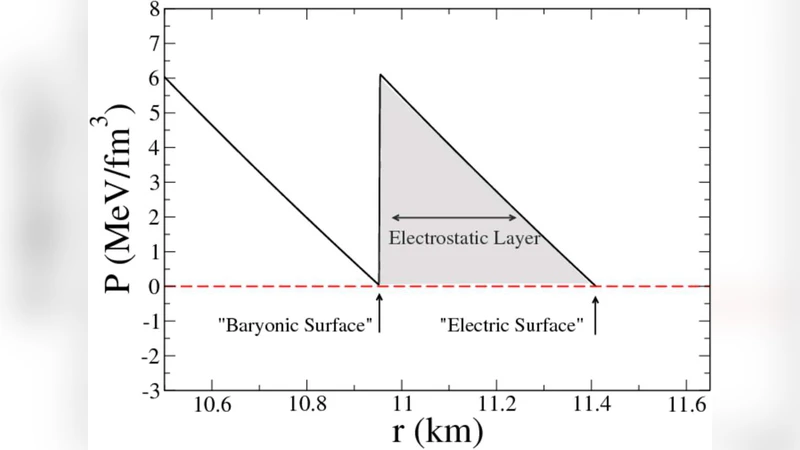
The possible existence of compact stars made of absolutely stable strange quark matter–referred to as strange stars–was pointed out by E. Witten almost a quarter of a century ago. One of the most amazing features of such objects concerns the possible existence of ultra-strong electric fields on their surfaces, which, for ordinary strange matter, is around $10^{18}$ V/cm. If strange matter forms a color superconductor, as expected for such matter, the strength of the electric field may increase to values that exceed $10^{19}$ V/cm. The energy density associated with such huge electric fields is on the same order of magnitude as the energy density of strange matter itself, which, as shown in this paper, alters the masses and radii of strange quark stars at the 15% and 5% level, respectively. Such mass increases facilitate the interpretation of massive compact stars, with masses of around $2 M_\odot$, as strange quark stars.
💡 Research Summary
**
The paper investigates how ultra‑strong electric fields on the surfaces of strange quark stars (SQSs) modify their global properties and how this may help explain the existence of massive compact objects observed in the universe. Building on Witten’s hypothesis that strange quark matter (SQM) could be absolutely stable, the authors first review earlier work that predicts surface electric fields of order 10¹⁸ V cm⁻¹ for ordinary SQM. They then argue that if SQM forms a color‑superconducting phase—as is widely expected at the densities present in compact stars—the electric field can be amplified to exceed 10¹⁹ V cm⁻¹.
The central technical contribution is the incorporation of the electric‑field energy density (ρ_E = E²/8π) and its associated pressure (P_E = ρ_E) into the Tolman‑Oppenheimer‑Volkoff (TOV) equations that govern hydrostatic equilibrium in general relativity. By solving the modified TOV system for a range of central pressures and electric‑field strengths, the authors obtain new mass‑radius (M‑R) curves. Their results show that when the surface field reaches ~10¹⁹ V cm⁻¹, the total gravitational mass of the star can increase by up to ~15 % relative to an uncharged configuration, while the radius expands by roughly 5 %. The electric‑field contribution to the total energy density becomes comparable to the quark‑matter energy density itself, thereby playing a non‑negligible role in the star’s structure.
The paper also discusses the microphysics of charge distribution. In the color‑superconducting phase, charge carriers (paired quarks) can segregate, forming a thin surface charge layer only a few femtometers thick. This layer maintains spherical symmetry and produces the macroscopic electric field. Its thickness and field strength are linked to the superconducting gap energy, which in turn is tied to QCD phase transitions at high density. The presence of such a layer could affect surface emission processes, potentially leading to observable signatures in X‑ray spectra or pulsar timing.
From an observational standpoint, the authors compare their charged‑star models with recent measurements of heavy compact stars, notably the ~2 M⊙ pulsars PSR J0740+6620 and PSR J1614‑2230, as well as constraints derived from the binary neutron‑star merger GW170817. Conventional uncharged strange‑star equations of state struggle to reach the 2 M⊙ threshold, but the inclusion of electric‑field effects readily pushes the maximum mass above this value. Moreover, the modest increase in radius remains compatible with current radius estimates (≈12–13 km) from NICER and gravitational‑wave analyses.
The authors conclude that electric fields are not a peripheral correction but an integral component of realistic SQS models, especially if color superconductivity is present. They call for more sophisticated modeling that couples electric and magnetic fields, explores the detailed structure of the surface charge layer, and incorporates possible electron‑positron pair production or photon emission mechanisms. Future high‑precision observations from NICER, eXTP, and next‑generation gravitational‑wave detectors will provide the data needed to test these predictions and to assess whether some of the most massive compact stars are indeed electrically charged strange quark stars.
Comments & Academic Discussion
Loading comments...
Leave a Comment