The Peter Principle Revisited: A Computational Study
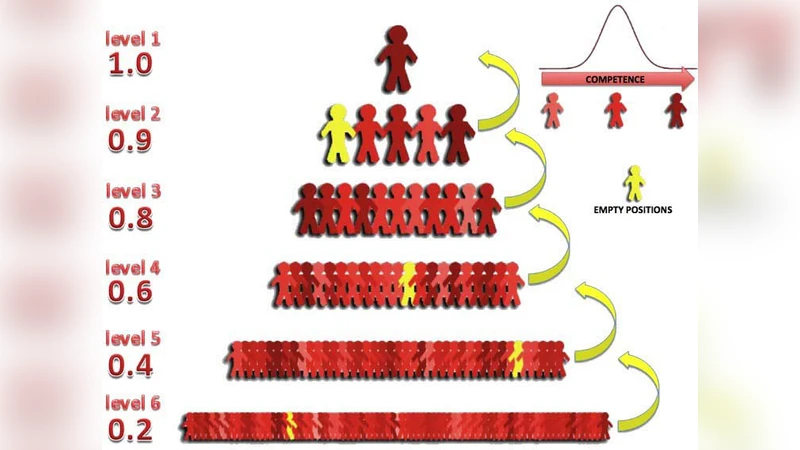
In the late sixties the Canadian psychologist Laurence J. Peter advanced an apparently paradoxical principle, named since then after him, which can be summarized as follows: {\it ‘Every new member in a hierarchical organization climbs the hierarchy until he/she reaches his/her level of maximum incompetence’}. Despite its apparent unreasonableness, such a principle would realistically act in any organization where the mechanism of promotion rewards the best members and where the mechanism at their new level in the hierarchical structure does not depend on the competence they had at the previous level, usually because the tasks of the levels are very different to each other. Here we show, by means of agent based simulations, that if the latter two features actually hold in a given model of an organization with a hierarchical structure, then not only is the Peter principle unavoidable, but also it yields in turn a significant reduction of the global efficiency of the organization. Within a game theory-like approach, we explore different promotion strategies and we find, counterintuitively, that in order to avoid such an effect the best ways for improving the efficiency of a given organization are either to promote each time an agent at random or to promote randomly the best and the worst members in terms of competence.
💡 Research Summary
The paper revisits the Peter Principle—“every employee rises to his or her level of maximum incompetence”—by constructing an agent‑based computational model of a hierarchical organization. The authors assume two key conditions: (1) promotions are merit‑based, i.e., the best performers are selected for advancement, and (2) the skill set required at a new level is independent of the competence demonstrated at the previous level, reflecting the common situation where tasks at different tiers are fundamentally distinct. Under these assumptions, each agent is assigned an initial competence drawn from a normal distribution. When an agent is promoted, its competence is re‑sampled (no transfer of previous skill), thereby embodying the “incompetence” transition.
Three promotion policies are examined: (i) “Best‑only” promotion, where the highest‑competence agent in a given tier is always promoted; (ii) “Random” promotion, where a candidate is chosen uniformly at random; and (iii) a “Mixed” policy that alternates promotion of the highest‑ and lowest‑competence agents. The organization is modeled as a five‑level hierarchy; at each simulation step agents perform tasks, contributing to a global efficiency metric defined as the weighted sum of competences across all levels. The simulation runs for 10,000 iterations per policy, and average efficiencies are recorded.
Results show that the Best‑only policy yields a rapid early increase in efficiency because top performers occupy higher‑impact positions. However, as promotions continue, the best agents are repeatedly moved upward, leaving each lower tier populated by increasingly incompetent individuals. Consequently, after a transient peak, overall efficiency collapses dramatically—a clear manifestation of the Peter Principle. In contrast, the Random policy maintains a more uniform competence distribution across tiers. Although its initial efficiency is lower than the Best‑only approach, it stabilizes at a higher long‑term level because no tier becomes saturated with incompetent staff. The Mixed policy performs slightly better than pure randomness: by periodically promoting the lowest‑competence agents, it prevents the systematic accumulation of incompetence while still allowing the most capable individuals to remain in critical positions.
From a game‑theoretic perspective, the organization faces a classic “principal‑agent” dilemma. The promotion mechanism (the principal’s incentive) rewards individual ambition but, given the independence of required skills across levels, creates a negative externality that harms collective performance. The authors argue that the Peter effect is unavoidable when merit‑based promotion is coupled with skill discontinuity, but its impact can be mitigated by introducing stochastic elements into the promotion process.
Policy implications are significant: organizations that rely solely on performance‑based upward mobility may inadvertently degrade their own effectiveness over time. Incorporating random or mixed promotion schemes can preserve a healthier competence balance and sustain higher overall productivity. The paper concludes by suggesting future work that integrates empirical corporate data, models partial skill transfer between levels, and explores cultural or learning mechanisms that could further influence the dynamics of competence evolution in hierarchical structures.
Comments & Academic Discussion
Loading comments...
Leave a Comment