Cardy algebras and sewing constraints, I
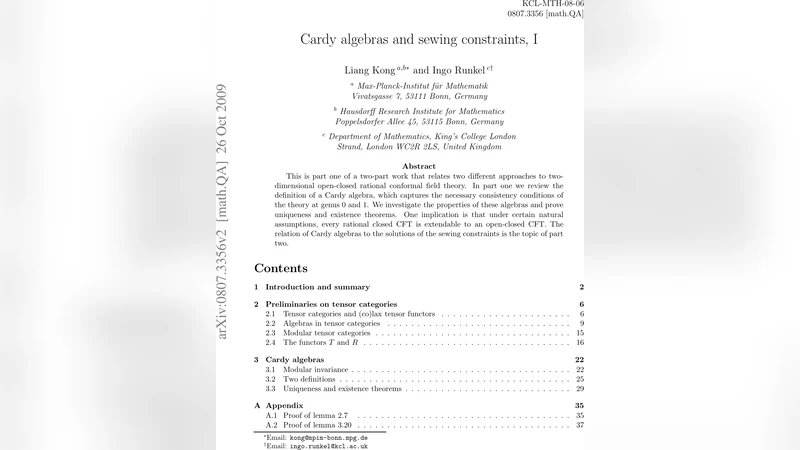
This is part one of a two-part work that relates two different approaches to two-dimensional open-closed rational conformal field theory. In part one we review the definition of a Cardy algebra, which captures the necessary consistency conditions of the theory at genus 0 and 1. We investigate the properties of these algebras and prove uniqueness and existence theorems. One implication is that under certain natural assumptions, every rational closed CFT is extendable to an open-closed CFT. The relation of Cardy algebras to the solutions of the sewing constraints is the topic of part two.
💡 Research Summary
The paper “Cardy algebras and sewing constraints, I” establishes a rigorous algebraic framework—called a Cardy algebra—that captures the consistency conditions of two‑dimensional open‑closed rational conformal field theory (OC‑CFT) at genus zero and genus one. The authors begin by reviewing two complementary approaches to rational CFT: the modular tensor category description of closed theories and the sewing‑constraint formalism for open‑closed theories. They argue that a unified language is needed to relate the algebraic data of the closed sector to the boundary data of the open sector, and they propose Cardy algebras as the bridge.
A Cardy algebra consists of three pieces of data. First, a closed algebra (A) is a special symmetric Frobenius algebra in a modular tensor category (\mathcal{C}). This object encodes the bulk operator product expansion, the three‑point functions on the sphere, and the torus one‑point trace that implements modular invariance. Second, a boundary algebra (B) lives in a (\mathcal{C})-module category (\mathcal{M}) and is itself a Frobenius algebra; it describes the open‑string sector, the boundary fields, and the composition of boundary operators. The authors impose natural conditions on (B) – separability, haploidity (a single simple unit), and compatibility with the (\mathcal{C})-action – which guarantee a minimal and well‑behaved set of boundary states. Third, a Cardy map (\iota: A \to B \otimes B^{*}) intertwines the closed and open sectors. The map must satisfy the Cardy condition, an equation that forces the multiplication and comultiplication of (A) to be compatible with the tensor‑product structure on (B) and its dual. Physically, this condition expresses the equality of the closed‑string channel and the open‑string channel for a cylinder with one bulk insertion, i.e. the open‑closed consistency at genus zero.
The core of the paper is a set of structural theorems about Cardy algebras. The uniqueness theorem states that, under the standard finiteness assumptions (the category (\mathcal{C}) is finite, semisimple, and modular) and assuming (A) is a special symmetric Frobenius algebra, any two Cardy algebras with the same closed algebra (A) are isomorphic. In other words, once the bulk theory is fixed, the admissible boundary data are uniquely determined up to isomorphism. The proof proceeds by showing that any two candidate boundary algebras (B) must be Morita equivalent as (A)-modules and that the Cardy map is forced by the Frobenius structures.
The existence theorem complements the uniqueness result. It demonstrates that for any such closed algebra (A) one can construct a boundary algebra (B) and a Cardy map (\iota) satisfying all required axioms. The construction uses the internal Hom objects in the module category (\mathcal{M}): one sets (B = \underline{\mathrm{Hom}}_{\mathcal{C}}(M,M)) for a suitable simple object (M) of (\mathcal{M}). The Frobenius structure on (B) is induced from that of (A) via the module action, and the Cardy map is given by the canonical evaluation and coevaluation morphisms. This shows that every rational closed CFT can be extended to an open‑closed theory, provided the natural separability and haploidity conditions are satisfied.
Beyond existence and uniqueness, the authors explore several important consequences. They prove that Cardy algebras are stable under tensor products and under Morita equivalence, which mirrors the physical expectation that different boundary conditions related by a change of basis describe the same underlying theory. They also verify that the Cardy condition automatically enforces modular invariance of the torus one‑point function and crossing symmetry of the sphere four‑point function, thereby reproducing the genus‑0 and genus‑1 sewing constraints in a purely algebraic language.
The paper concludes with a discussion of how these results set the stage for Part II, where the authors will relate Cardy algebras to the full set of sewing constraints, including higher‑genus surfaces. By translating the geometric gluing conditions into algebraic identities satisfied by the Cardy data, they aim to provide a complete categorical classification of rational open‑closed CFTs.
In summary, this work introduces Cardy algebras as a concise, categorical formulation of the open‑closed consistency conditions at low genus, proves that they exist uniquely for any rational closed theory, and demonstrates that they encode the same information as the traditional sewing constraints. The results give a powerful new tool for constructing and classifying rational OC‑CFTs and lay the groundwork for a full equivalence between algebraic and geometric approaches.
Comments & Academic Discussion
Loading comments...
Leave a Comment