Lattice modulation spectroscopy of strongly interacting bosons in disordered and quasi-periodic optical lattices
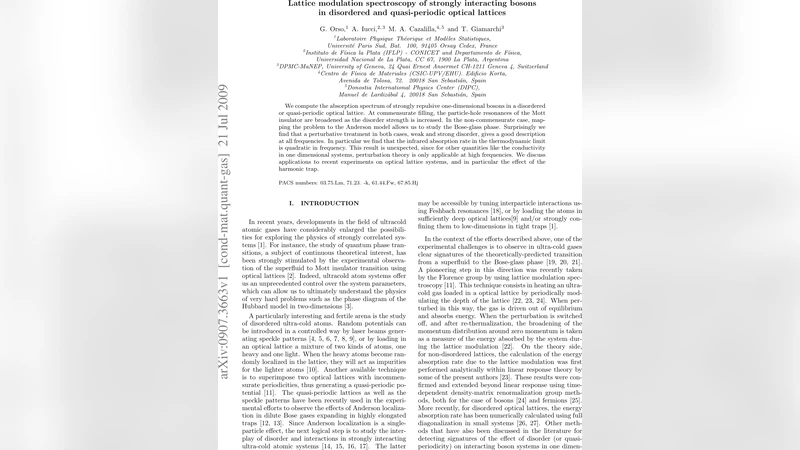
We compute the absorption spectrum of strongly repulsive one-dimensional bosons in a disordered or quasi-periodic optical lattice. At commensurate filling, the particle-hole resonances of the Mott insulator are broadened as the disorder strength is increased. In the non-commensurate case, mapping the problem to the Anderson model allows us to study the Bose-glass phase. Surprisingly we find that a perturbative treatment in both cases, weak and strong disorder, gives a good description at all frequencies. In particular we find that the infrared absorption rate in the thermodynamic limit is quadratic in frequency. This result is unexpected, since for other quantities like the conductivity in one dimensional systems, perturbation theory is only applicable at high frequencies. We discuss applications to recent experiments on optical lattice systems, and in particular the effect of the harmonic trap.
💡 Research Summary
The paper investigates the linear‑response absorption spectrum of a one‑dimensional Bose gas with strong on‑site repulsion when the depth of the optical lattice is periodically modulated. The authors treat the system in the hard‑core limit, mapping it onto a spin‑½ XX model (or equivalently a non‑interacting fermion problem) and then introduce either a random on‑site potential (disorder) or a deterministic quasi‑periodic potential of the Aubry‑André type. Two filling regimes are considered.
At commensurate filling (unit filling) the ground state is a Mott insulator with a gap U set by the on‑site interaction. In the clean limit the lattice modulation couples directly to particle‑hole excitations at energy ≈U, giving a sharp resonance. Adding weak disorder broadens this resonance through first‑order perturbation theory; the broadened line shape is obtained analytically by averaging over the distribution of local energy offsets. As the disorder strength W increases further, the local site energies become widely distributed, the particle‑hole gap is effectively smeared, and the resonance evolves into a broad continuum. Remarkably, even for strong disorder the low‑frequency (infra‑red) absorption behaves as σ(ω)∝ω² in the thermodynamic limit. This quadratic law is derived by expanding the transition matrix elements to second order in the disorder potential and shows that, unlike the electrical conductivity of a 1D Luttinger liquid (where perturbation theory fails at low ω), the lattice‑modulation response remains perturbatively tractable at all frequencies.
For incommensurate filling the system is compressible and, in the presence of disorder, enters a Bose‑glass phase. By exploiting the exact mapping to non‑interacting fermions, the authors reduce the problem to the Anderson localization of single‑particle states. The absorption spectrum is then expressed in terms of the single‑particle density of states and the overlap of localized wavefunctions. Both the weak‑disorder regime (where the localization length is large) and the strong‑disorder regime (where states are tightly localized) are treated analytically. In both limits the same ω² infrared behavior emerges, confirming the universality of the quadratic law across the whole Bose‑glass region.
The quasi‑periodic case is studied by replacing the random potential with a cosine modulation of incommensurate wavelength. The Aubry‑André model exhibits a sharp localization transition at a critical amplitude λc=2J (J being the hopping). The authors show that the absorption spectrum reflects this transition: for λ<λc the spectrum retains a narrow Mott‑like peak, while for λ>λc the peak broadens dramatically and a new low‑frequency structure appears, signalling the onset of localized excitations.
Finally, the paper discusses realistic experimental conditions, in particular the presence of a harmonic trapping potential. The trap creates a spatially varying chemical potential, leading to coexistence of Mott‑insulating domains (at the trap centre) and Bose‑glass shells (towards the edges). By integrating the local absorption over the trap profile, the authors predict a composite spectrum consisting of a central sharp peak from the Mott core and a broad background from the surrounding glassy regions. They argue that by varying the trap curvature or the total atom number, experimentalists can tune the relative weight of the two contributions and thus directly test the theoretical predictions.
Overall, the work provides a comprehensive analytical framework for lattice‑modulation spectroscopy in strongly interacting bosonic systems with disorder or quasi‑periodicity. It demonstrates that perturbative calculations, surprisingly, remain accurate across the full frequency range, and it identifies a universal ω² infrared absorption law that distinguishes lattice‑modulation probes from conventional transport measurements. The results are directly relevant to current cold‑atom experiments and offer clear guidance for future studies of disorder‑driven quantum phases in optical lattices.
Comments & Academic Discussion
Loading comments...
Leave a Comment