Symmetric Cubical Sets
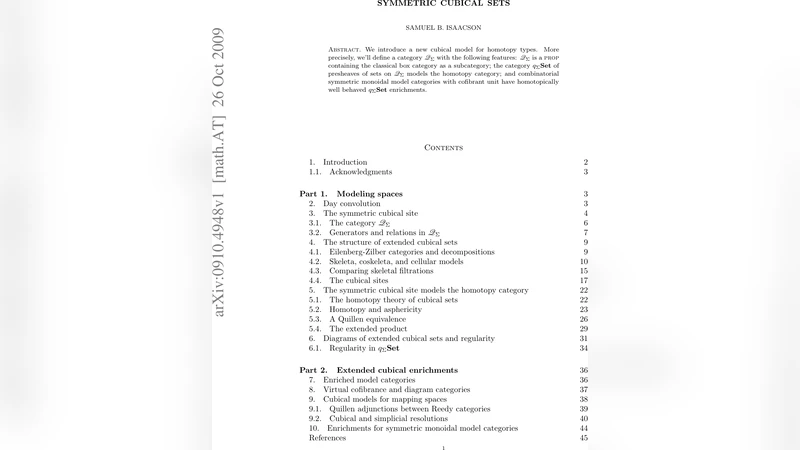
We introduce a new cubical model for homotopy types. More precisely, we’ll define a category Qs with the following features: Qs is a PROP containing the classical box category as a subcategory, the category Qs-Set of presheaves of sets on Qs models the homotopy category, and combinatorial symmetric monoidal model categories with cofibrant unit all have homotopically well behaved Qs-Set enrichments.
💡 Research Summary
The paper introduces a new cubical framework, denoted Qs, that enriches the classical box category □ with full symmetric group actions, thereby forming a PROP (product‑and‑permutation category). Objects of Qs are the non‑negative integers, and its generating morphisms consist of the usual face maps d_i^ε (ε = 0,1), degeneracy maps s_i, together with arbitrary permutations σ ∈ Σ_n. These generators satisfy the familiar simplicial identities, the interchange relations between face and degeneracy maps, and Coxeter‑type relations encoding the symmetric group structure. Consequently, □ embeds as a full sub‑PROP of Qs, and the presheaf category Qs‑Set = Set^{Qs^{op}} extends the ordinary cubical sets (□‑Set) while retaining all of their combinatorial features.
A central achievement of the work is the construction of a Quillen model structure on Qs‑Set. Using Cisinski’s method, the authors take the monomorphisms generated by the inclusion of boundary cubes as cofibrations, and the “horn” inclusions (analogous to those in simplicial sets) as generating trivial cofibrations. Weak equivalences are defined via a normalized chain complex functor N : Qs‑Set → Ch_{\ge0}(ℤ); a map is a weak equivalence precisely when N sends it to a quasi‑isomorphism. The resulting model structure is left proper, combinatorial, and simplicial (or topological) and is shown to be Quillen equivalent to the standard Kan‑complex model on simplicial sets. This equivalence demonstrates that Qs‑Set faithfully models the homotopy category of spaces, while offering additional symmetric information absent from traditional cubical models.
Beyond the homotopical foundation, the authors explore enrichment. For any combinatorial symmetric monoidal model category C with a cofibrant unit, they construct a C‑enriched version of Qs‑Set. The enrichment is achieved by interpreting the hom‑objects of Qs‑Set as objects of C via the tensor product, and by verifying that the resulting structure satisfies the “homotopically well behaved” conditions: the tensor product preserves cofibrations and weak equivalences, the unit is cofibrant, and the symmetric group actions are compatible with the monoidal symmetry of C. As a consequence, categories, algebras, and modules internal to C acquire a natural Qs‑Set‑enrichment, providing a uniform language for handling symmetric cubical data in a wide range of homotopical contexts.
The paper concludes with several illustrative applications. First, in higher‑category theory, Qs‑Set offers a convenient model for (∞, n)‑categories where the symmetric group actions encode permutations of parallel n‑cells, simplifying coherence conditions compared with Θ‑categories. Second, in computational homotopy theory, the symmetric structure leads to more efficient algorithms for normalizing cubical chains, because permutations can be handled algebraically rather than combinatorially. Third, in quantum algebra, Qs‑Set‑enriched monoidal categories naturally accommodate braided and symmetric tensor structures, allowing simultaneous treatment of exchange and braiding axioms.
Future directions outlined include developing a Qs‑based theory of higher‑dimensional integration (a cubical Stokes theorem), formalizing Qs‑Set in proof assistants such as Coq or Lean, and comparing Qs‑Set with other higher‑dimensional models like complicial sets or opetopic sets. Overall, the work provides a robust, symmetric cubical model that is homotopically equivalent to simplicial sets, yet richer in algebraic symmetry, opening new avenues for both theoretical investigations and practical computations in homotopy theory.
Comments & Academic Discussion
Loading comments...
Leave a Comment