Bayesian Core: The Complete Solution Manual
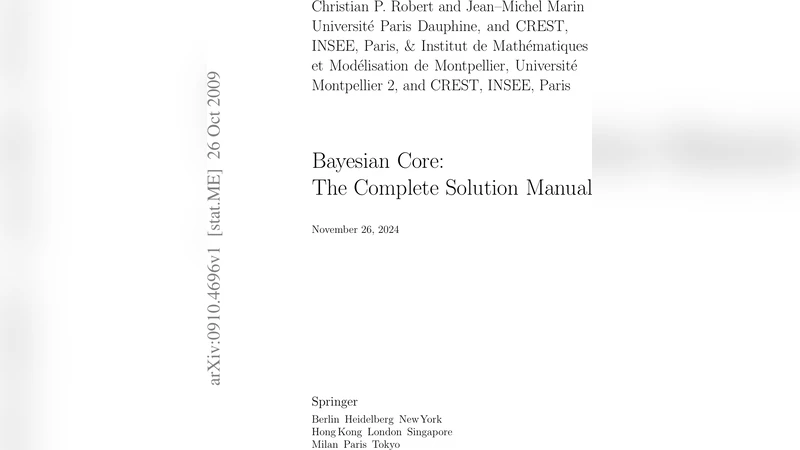
This solution manual contains the unabridged and original solutions to all the exercises proposed in Bayesian Core, along with R programs when necessary.
💡 Research Summary
The “Bayesian Core: The Complete Solution Manual” is a comprehensive companion to the textbook Bayesian Core, delivering full solutions to every exercise along with executable R code where appropriate. Structured in four main sections, the manual first outlines the exercise set, categorizing each problem by difficulty and learning objective, thereby giving readers a clear roadmap of the material. The core of the manual consists of detailed mathematical derivations. For each problem, the authors walk the reader through prior specification, posterior computation, Bayesian estimators, and model comparison metrics such as BIC and DIC. Key theorems and auxiliary lemmas are highlighted in boxed sidebars, allowing quick reference without breaking the flow of the solution. The third section transitions to practical implementation. Using modern R packages—tidyverse for data manipulation, rstan and brms for Bayesian inference, and bayesplot for diagnostics—the manual provides step‑by‑step scripts that cover data preparation, model definition, MCMC sampling, convergence checks (Gelman‑Rubin statistics, effective sample size), posterior predictive checks, and result visualization. The code is written to be copy‑and‑paste ready, enabling readers to reproduce results instantly and experiment with variations. The final part is a set of appendices addressing common real‑world challenges in Bayesian modeling. Topics include prior sensitivity analysis, hierarchical model identifiability, multi‑model comparison, variational inference for large datasets, and strategies for handling computational bottlenecks. Each appendix concludes with a curated list of further readings and online resources, encouraging deeper exploration. By marrying rigorous theory with hands‑on computation, the manual serves both graduate instructors—who can integrate it into coursework to enhance learning efficiency—and practitioners in data science or applied statistics, who need a reliable reference for implementing Bayesian methods in projects. The inclusion of thorough diagnostics and visualization tools promotes transparency and reproducibility, reinforcing confidence in the inferential conclusions drawn from Bayesian analyses. In sum, this solution manual is an indispensable resource for anyone seeking a solid, practice‑oriented mastery of Bayesian statistics.
Comments & Academic Discussion
Loading comments...
Leave a Comment