On the hardness of the noncommutative determinant
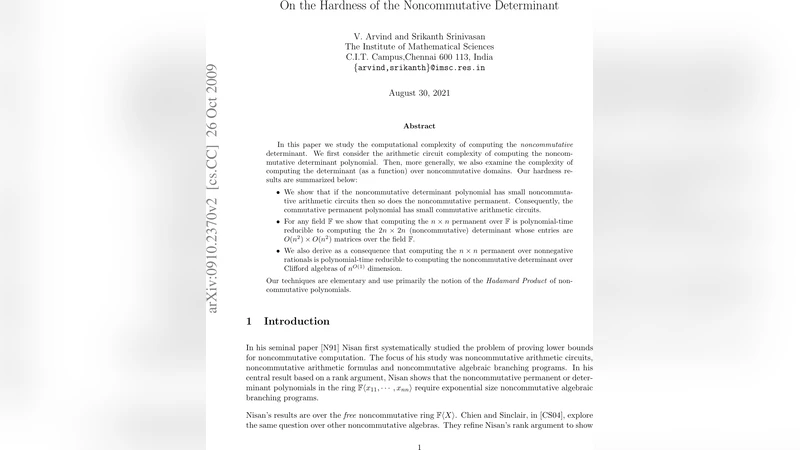
In this paper we study the computational complexity of computing the noncommutative determinant. We first consider the arithmetic circuit complexity of computing the noncommutative determinant polynomial. Then, more generally, we also examine the complexity of computing the determinant (as a function) over noncommutative domains. Our hardness results are summarized below: 1. We show that if the noncommutative determinant polynomial has small noncommutative arithmetic circuits then so does the noncommutative permanent. Consequently, the commutative permanent polynomial has small commutative arithmetic circuits. 2. For any field F we show that computing the n X n permanent over F is polynomial-time reducible to computing the 2n X 2n (noncommutative) determinant whose entries are O(n^2) X O(n^2) matrices over the field F. 3. We also derive as a consequence that computing the n X n permanent over nonnegative rationals is polynomial-time reducible to computing the noncommutative determinant over Clifford algebras of n^{O(1)} dimension. Our techniques are elementary and use primarily the notion of the Hadamard Product of noncommutative polynomials.
💡 Research Summary
The paper investigates the computational complexity of the determinant when the underlying algebra is non‑commutative. It begins by studying the arithmetic‑circuit complexity of the non‑commutative determinant polynomial and then extends the analysis to the problem of computing the determinant as a function over arbitrary non‑commutative domains. The authors establish three main hardness results.
First, they prove a reduction from the non‑commutative permanent to the non‑commutative determinant at the level of arithmetic circuits. Using the Hadamard product of non‑commutative polynomials, they show that if the determinant polynomial admits a small non‑commutative circuit, then the permanent polynomial of the same size also admits a small non‑commutative circuit. Since a small non‑commutative circuit can be simulated by a small commutative circuit, this immediately yields that a small commutative circuit for the permanent would follow from a small non‑commutative circuit for the determinant. Consequently, any super‑polynomial lower bound for the permanent automatically transfers to the determinant in the non‑commutative setting.
Second, the authors give an explicit polynomial‑time many‑one reduction from computing the n × n permanent over an arbitrary field F to computing a (2n) × (2n) non‑commutative determinant whose entries are O(n²) × O(n²) matrices over F. The construction builds a block matrix whose blocks encode the permanent’s monomials; the determinant of this block matrix expands to exactly the permanent value, with the non‑commutative order of multiplication preserving the necessary combinatorial structure. This reduction demonstrates that the determinant over non‑commutative matrix algebras is at least as hard as the permanent, reinforcing the belief that the determinant does not become easier when commutativity is dropped.
Third, the paper extends the reduction to Clifford algebras. By embedding the permanent computation over the non‑negative rationals into the determinant over a Clifford algebra of polynomial dimension (n^{O(1)}), they show that the permanent remains #P‑hard even when the determinant is evaluated in this richer non‑commutative algebraic setting. The Clifford algebra provides a natural non‑commutative framework with a basis that mimics the sign‑free behavior of the permanent while still supporting matrix multiplication.
The technical core of all three results is the use of the Hadamard product, which allows the authors to align the monomials of the determinant with those of the permanent without altering the order of non‑commuting variables. This tool yields clean, elementary constructions that avoid deep representation‑theoretic machinery.
Overall, the paper contributes a clear and unified picture: the non‑commutative determinant is computationally at least as hard as the permanent, both in the circuit‑complexity sense and in the algorithmic reduction sense. The results have several implications. They suggest that any breakthrough algorithm for the non‑commutative determinant would immediately collapse the permanent’s known #P‑hardness, which is widely believed to be impossible. Moreover, the reductions to block matrices and Clifford algebras open avenues for studying hardness in other non‑commutative structures, such as group algebras or quantum‑gate models. Finally, the elementary nature of the proofs makes the work accessible to researchers in algebraic complexity, non‑commutative algebra, and theoretical computer science, and it sets a foundation for future investigations into the fine‑grained complexity of non‑commutative linear algebraic operations.
Comments & Academic Discussion
Loading comments...
Leave a Comment