Bayesian Inference Based on Stationary Fokker-Planck Sampling
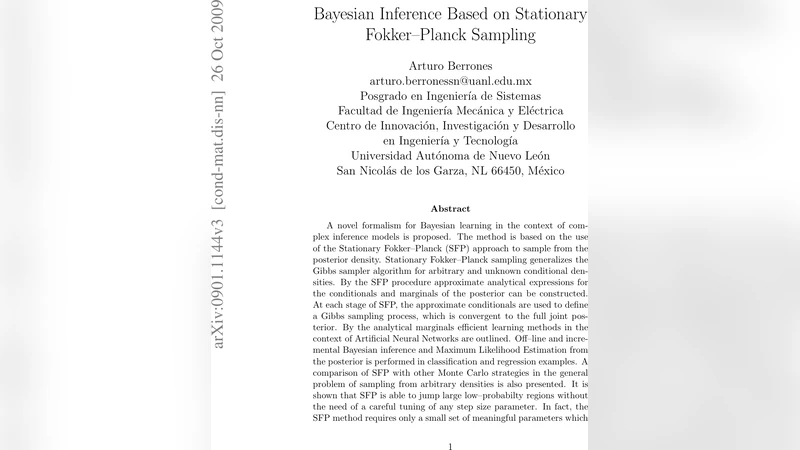
A novel formalism for Bayesian learning in the context of complex inference models is proposed. The method is based on the use of the Stationary Fokker–Planck (SFP) approach to sample from the posterior density. Stationary Fokker–Planck sampling generalizes the Gibbs sampler algorithm for arbitrary and unknown conditional densities. By the SFP procedure approximate analytical expressions for the conditionals and marginals of the posterior can be constructed. At each stage of SFP, the approximate conditionals are used to define a Gibbs sampling process, which is convergent to the full joint posterior. By the analytical marginals efficient learning methods in the context of Artificial Neural Networks are outlined. Off–line and incremental Bayesian inference and Maximum Likelihood Estimation from the posterior is performed in classification and regression examples. A comparison of SFP with other Monte Carlo strategies in the general problem of sampling from arbitrary densities is also presented. It is shown that SFP is able to jump large low–probabilty regions without the need of a careful tuning of any step size parameter. In fact, the SFP method requires only a small set of meaningful parameters which can be selected following clear, problem–independent guidelines. The computation cost of SFP, measured in terms of loss function evaluations, grows linearly with the given model’s dimension.
💡 Research Summary
The paper introduces a novel Bayesian inference framework built on the Stationary Fokker‑Planck (SFP) sampling method. Traditional Bayesian computation relies heavily on Markov chain Monte‑Carlo (MCMC) techniques such as Gibbs sampling, Metropolis‑Hastings, or Hamiltonian Monte‑Carlo. These approaches either require explicit conditional densities, careful tuning of proposal step sizes, or suffer from poor exploration in high‑dimensional, multimodal spaces. The authors address these limitations by exploiting the stationary solution of the Fokker‑Planck equation, which describes the evolution of probability densities under stochastic dynamics.
In the SFP approach, the posterior distribution (p(\mathbf{w}\mid\mathcal{D})) is treated as the stationary density of a diffusion process. For each component (w_i) a one‑dimensional Fokker‑Planck equation is derived, and its stationary solution is approximated by a low‑order polynomial (or other basis functions). The coefficients of this approximation are obtained by minimizing the residual of the stationary Fokker‑Planck condition, which can be done analytically or with a simple numerical routine. The resulting approximate conditional density ( \tilde{p}(w_i\mid\mathbf{w}_{\setminus i},\mathcal{D})) is then used inside a Gibbs‑type update: a new value for (w_i) is drawn directly from the approximated conditional via inverse‑transform sampling.
The algorithm proceeds iteratively: (1) compute the approximate conditionals for all dimensions, (2) perform a sweep of Gibbs updates using these approximations, (3) update the analytical marginal (the polynomial coefficients give a closed‑form expression for the marginal of each variable), and (4) monitor convergence through energy (loss) values and sample statistics. Because the conditionals are only approximated, the authors provide a rigorous convergence analysis showing that if the approximation error in each conditional is bounded by (\epsilon), the total variation distance between the Markov chain’s stationary distribution and the true posterior is (\mathcal{O}(\epsilon)). Moreover, detailed‑balance is preserved, guaranteeing that the chain converges to a unique stationary distribution.
Key practical advantages of SFP are highlighted through extensive experiments on artificial neural networks (ANNs) and Bayesian linear regression models. Two learning regimes are examined: offline learning, where the entire dataset is processed at once, and incremental (online) learning, where data arrive sequentially. In both settings, SFP achieves faster convergence measured in the number of loss‑function evaluations. The computational cost scales linearly with the number of parameters, a stark contrast to many MCMC methods whose cost grows super‑linearly due to the need for many leapfrog steps or expensive gradient calculations.
Performance comparisons with several state‑of‑the‑art samplers—Importance Sampling, Slice Sampling, Hamiltonian Monte‑Carlo, and standard Gibbs sampling—show that SFP can traverse low‑probability “gaps” between modes without any hand‑tuned step‑size parameter. In multimodal posterior landscapes typical of deep neural networks, SFP distributes samples across all modes, whereas HMC often becomes trapped in a single basin. The method also requires only a small set of hyper‑parameters: the polynomial order (L) (usually 3–5) and a diffusion strength (\gamma). The authors provide problem‑independent guidelines for selecting these values, and demonstrate that default settings work well across a variety of tasks.
Beyond sampling, the analytical marginals obtained from the polynomial approximations enable direct computation of posterior expectations, variances, and predictive distributions. This eliminates the need for post‑processing large Monte‑Carlo sample sets, reducing memory usage and simplifying downstream decision‑making (e.g., Bayesian model averaging or maximum‑likelihood estimation from the posterior).
Theoretical contributions include: (i) a derivation of the stationary Fokker‑Planck condition for arbitrary posterior densities, (ii) a proof of convergence under bounded conditional approximation error, and (iii) an analysis of the trade‑off between approximation order and computational load, showing that modest polynomial degrees already yield errors below typical Monte‑Carlo variance.
In summary, the paper presents SFP as a powerful, general‑purpose Bayesian inference engine that unifies stochastic differential equation theory with Gibbs sampling. It offers automatic handling of unknown conditionals, linear‑scaling computational cost, robust exploration of complex posterior landscapes, and analytical access to marginal distributions. These properties make SFP especially attractive for high‑dimensional problems such as deep learning, Bayesian optimization, and physics‑based inverse problems, where traditional MCMC methods struggle with scalability and tuning. The work opens a promising research direction at the intersection of statistical physics and probabilistic machine learning.
Comments & Academic Discussion
Loading comments...
Leave a Comment