Coalgebras, Chu Spaces, and Representations of Physical Systems
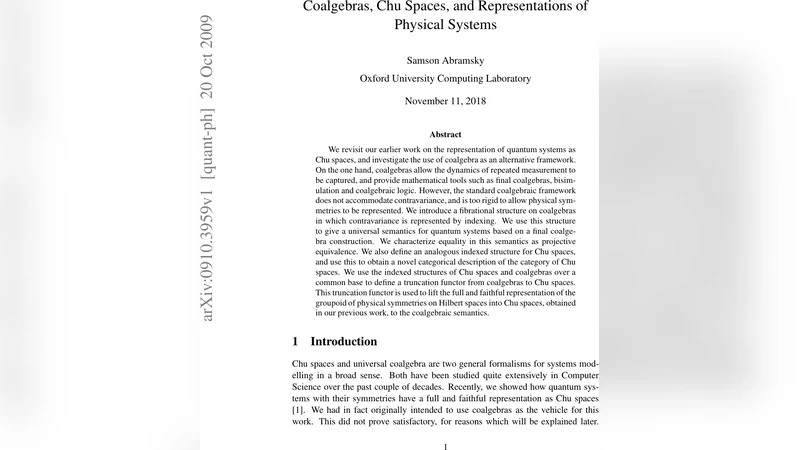
We revisit our earlier work on the representation of quantum systems as Chu spaces, and investigate the use of coalgebra as an alternative framework. On the one hand, coalgebras allow the dynamics of repeated measurement to be captured, and provide mathematical tools such as final coalgebras, bisimulation and coalgebraic logic. However, the standard coalgebraic framework does not accommodate contravariance, and is too rigid to allow physical symmetries to be represented. We introduce a fibrational structure on coalgebras in which contravariance is represented by indexing. We use this structure to give a universal semantics for quantum systems based on a final coalgebra construction. We characterize equality in this semantics as projective equivalence. We also define an analogous indexed structure for Chu spaces, and use this to obtain a novel categorical description of the category of Chu spaces. We use the indexed structures of Chu spaces and coalgebras over a common base to define a truncation functor from coalgebras to Chu spaces. This truncation functor is used to lift the full and faithful representation of the groupoid of physical symmetries on Hilbert spaces into Chu spaces, obtained in our previous work, to the coalgebraic semantics.
💡 Research Summary
The paper revisits the authors’ earlier work that represented quantum systems as Chu spaces and investigates whether coalgebraic methods can serve as a more expressive alternative. Chu spaces capture the static relationship between quantum states (objects) and measurement outcomes (attributes) by means of a binary matrix, allowing a simultaneous description of states and observables. However, they lack a natural way to model dynamics such as repeated measurements and state updates. Coalgebras, by contrast, describe systems through a transition function that maps each state to its observable behaviour; this makes them well‑suited for representing the sequential nature of quantum measurements. The authors point out that coalgebraic tools—final coalgebras, bisimulation, and coalgebraic logic—provide a canonical “universal” semantics, a notion of behavioural equivalence, and a logical language for reasoning about system properties.
A major obstacle is that the standard coalgebraic framework is covariant only; it does not accommodate contravariance, which is essential for representing the action of observers and for encoding physical symmetries (unitary and anti‑unitary transformations). To overcome this, the authors introduce a fibrational structure on coalgebras. They index coalgebras by a set of observers, and morphisms between indices induce re‑indexing of the underlying coalgebras. This indexing captures contravariant behaviour: changing the observer corresponds to pulling back the coalgebra along the index map. The same indexing idea is applied to Chu spaces, yielding an indexed family of Chu spaces that forms a fibrated category over the same base of observers.
Using the indexed coalgebraic setting, the authors construct a final coalgebra that aggregates all possible measurement histories of a quantum system. Equality in this final coalgebra turns out to be precisely projective equivalence of Hilbert‑space vectors, i.e., two state vectors are identified when they differ by a non‑zero scalar. This matches the standard physical notion that rays, not vectors, represent quantum states.
The paper then defines a truncation functor from the indexed coalgebra category to the indexed Chu‑space category. The functor forgets the dynamic transition structure and retains only the static state‑observable relation, thereby mapping each coalgebra to its underlying Chu space. Crucially, this functor preserves the action of the physical symmetry groupoid: the full and faithful representation of the groupoid of Hilbert‑space symmetries that the authors previously established for Chu spaces lifts unchanged to the coalgebraic semantics via the truncation functor. Consequently, the coalgebraic model inherits the same rich symmetry structure.
The contributions can be summarised as follows:
- Introduction of an indexed (fibrational) coalgebra framework that incorporates contravariance and accommodates physical symmetries.
- Construction of a universal final coalgebra for quantum systems, with behavioural equivalence identified as projective equivalence.
- Development of a parallel indexed Chu‑space structure and a truncation functor linking the two, allowing the previously known symmetry representation to be transferred to the coalgebraic setting.
These results provide a unified categorical semantics that simultaneously handles the static relational aspect of quantum theory (via Chu spaces) and its dynamic measurement process (via coalgebras). The approach opens new avenues for applying coalgebraic verification techniques, bisimulation‑based reasoning, and categorical logic to quantum information and computation, while preserving the essential symmetry properties that any faithful physical model must respect.
Comments & Academic Discussion
Loading comments...
Leave a Comment