Grothendieck topologies from unique factorisation systems
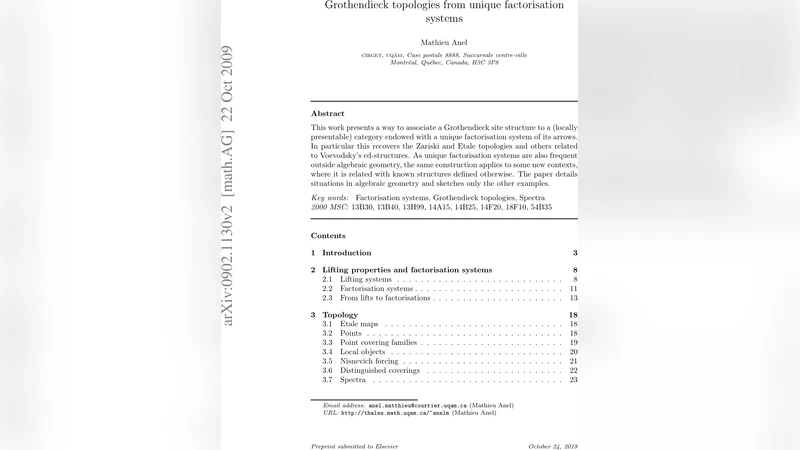
This work presents a way to associate a Grothendieck site structure to a category endowed with a unique factorisation system of its arrows. In particular this recovers the Zariski and Etale topologies and others related to Voevodsky’s cd-structures. As unique factorisation systems are also frequent outside algebraic geometry, a construction applies to some new contexts, where it is related with known structures defined otherwise. The paper details algebraic geometrical situations and sketches only the other contexts.
💡 Research Summary
The paper proposes a systematic method for constructing Grothendieck topologies on any category equipped with a unique factorisation system (UFS). A UFS consists of two classes of morphisms, L (the left class) and R (the right class), such that every arrow f can be written uniquely as f = m ∘ e with e ∈ L and m ∈ R, and L is orthogonal to R. The authors observe that the left class L naturally defines a notion of covering: a family {U_i → U} of L‑morphisms is declared a covering of U when the induced sieve generated by the family is maximal. Under the standard stability conditions (pull‑back closure of L, composition stability, and the existence of finite limits), the collection of such families satisfies the axioms of a Grothendieck topology. The resulting site (C, J_L) is called the L‑topology.
The core technical results are twofold. First, the authors prove that for any UFS satisfying the stability hypotheses, the L‑topology indeed forms a Grothendieck topology. Second, they give sufficient criteria for the L‑topology to be subcanonical: if every L‑morphism is a monomorphism and the associated points (objects representing stalks) are preserved, then representable presheaves are sheaves. This connects the abstract construction to familiar sheaf‑theoretic contexts.
A substantial part of the paper is devoted to examples that recover classical algebraic‑geometric topologies. In the opposite category of commutative rings, the (localisation, surjection) factorisation yields L‑morphisms that are precisely localisations; the induced L‑topology coincides with the Zariski topology. Replacing the factorisation by (étale, unramified) gives an L‑topology that matches the étale site. Moreover, by selecting factorisations that correspond to Voevodsky’s cd‑structures, the authors obtain the Nisnevich, cdh, and related topologies as special cases of their construction. In each instance, the point‑wise description of stalks aligns with the usual notion of geometric points or henselian localisations.
Beyond algebraic geometry, the paper sketches applications to several unrelated categories. In the category of graphs, the inclusion of a subgraph and graph isomorphisms form a UFS; the resulting L‑topology captures “open subgraph” coverings and reproduces the known graph‑topos. In logical model theory, extensions of theories and conservative embeddings give a UFS, and the L‑topology corresponds to the classically studied “conservative extension” topology on models. These examples illustrate that the construction is not limited to schemes but can be employed wherever a natural UFS exists.
The final section discusses future directions. The authors suggest investigating “virtual” UFS for categories lacking a genuine factorisation, extending the framework to higher‑categorical settings (∞‑topoi), and exploring connections with type theory and homotopy‑theoretic programming languages, where factorisation systems already play a central role. Overall, the paper provides a unifying categorical lens that both recovers known Grothendieck topologies and generates new ones, highlighting the deep interplay between factorisation properties and sheaf‑theoretic localisation.
Comments & Academic Discussion
Loading comments...
Leave a Comment