The Eilenberg-Watts theorem in homotopical algebra
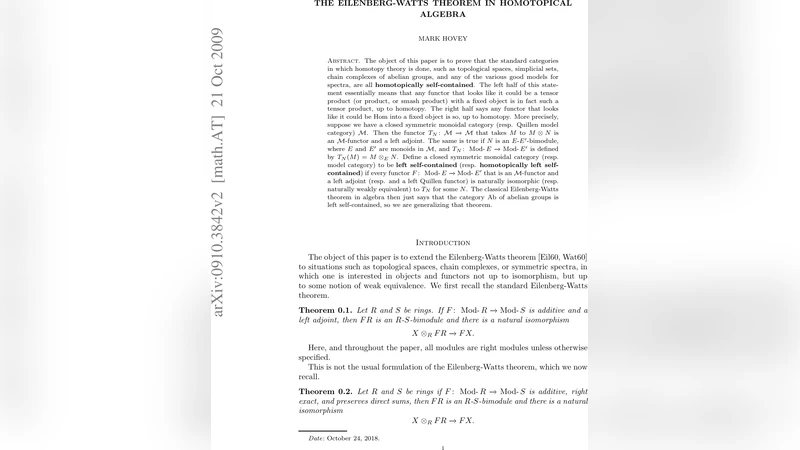
The object of this paper is to prove that the standard categories in which homotopy theory is done, such as topological spaces, simplicial sets, chain complexes of abelian groups, and any of the various good models for spectra, are all homotopically self-contained. The left half of this statement essentially means that any functor that looks like it could be a tensor product (or product, or smash product) with a fixed object is in fact such a tensor product, up to homotopy. The right half says any functor that looks like it could be Hom into a fixed object is so, up to homotopy. More precisely, suppose we have a closed symmetric monoidal category (resp. Quillen model category) M. Then the functor T_{B} that takes A to A tensor B is an M-functor and a left adjoint. The same is true if B is an E-E’-bimodule, where E and E’ are monoids in M, and T_{B} takes an E-module A to A tensored over E with B. Define a closed symmetric monoidal category (resp. model category) to be left self-contained (resp. homotopically left self-contained) if every functor F from E-modules to E’-modules that is an M-functor and a left adjoint (resp. and a left Quillen functor) is naturally isomorphic (resp. naturally weakly equivalent) to T_{B} for some B. The classical Eilenberg-Watts theorem in algebra then just says that the category of abelian groups is left self-contained, so we are generalizing that theorem.
💡 Research Summary
The paper establishes a homotopical analogue of the classical Eilenberg‑Watts theorem, showing that the standard categories used in homotopy theory—topological spaces, simplicial sets, chain complexes of abelian groups, and the various modern models for spectra—are all “homotopically self‑contained.” In this context, self‑containment means that any functor which looks like tensoring with a fixed object (or smashing, or taking a product) is, up to homotopy, genuinely of that form; likewise, any functor that looks like an internal Hom into a fixed object is, up to homotopy, an actual internal Hom.
The authors begin by fixing a closed symmetric monoidal category ( \mathcal{M} ) (or a Quillen model category) and defining two notions:
-
Left self‑contained: For monoids (E, E’) in ( \mathcal{M} ), any ( \mathcal{M})-functor (F : E\text{-Mod} \to E’\text{-Mod}) that is a left adjoint must be naturally isomorphic to the tensor‑with‑(B) functor (T_B(A)=A\otimes_E B) for some (E)–(E’) bimodule (B).
-
Homotopically left self‑contained: The same statement holds in the homotopical setting, i.e. when (F) is a left Quillen functor; the natural isomorphism is replaced by a natural weak equivalence.
The main theorem asserts that each of the “standard homotopy categories’’ satisfies the second condition. The proof proceeds in two stages. First, the authors treat a purely categorical situation: in any closed symmetric monoidal category, the category of modules over a monoid is generated by free modules, and any colimit‑preserving left adjoint out of such a module category is forced to be tensoring with a bimodule. This is the abstract Eilenberg‑Watts argument.
Second, they verify that the concrete homotopical categories of interest are model monoidal—their monoidal product is compatible with the model structure, and the unit is cofibrant. In such a setting, a left Quillen functor automatically preserves homotopy colimits, so the abstract argument applies “up to homotopy.” For spectra, the smash product provides a closed symmetric monoidal structure on the stable homotopy category; the authors show that any left Quillen functor between module categories over ring spectra is weakly equivalent to smashing with a suitable bimodule spectrum. Analogous arguments handle Top, sSet, and Ch(ℤ) using the usual cartesian product or tensor product of chain complexes.
The paper also checks that the classical Eilenberg‑Watts theorem for abelian groups is recovered when ( \mathcal{M}= \text{Ch}(\mathbb{Z})) and the monoids are ordinary rings. Thus the result genuinely generalises the algebraic theorem to a broad homotopical context.
Conceptually, the theorem confirms a long‑standing intuition: in a well‑behaved homotopical world, “linear” functors are precisely those given by tensoring (or smashing) with a bimodule, and “co‑linear” functors are given by internal Hom. This provides a powerful classification tool for functors between module categories in stable homotopy theory, simplifies the analysis of derived functors, and suggests further extensions to ∞‑categorical or higher‑monoidal settings.
Comments & Academic Discussion
Loading comments...
Leave a Comment