Starr: Simple Tiling Array Analysis of Affymetrix ChIP-chip data
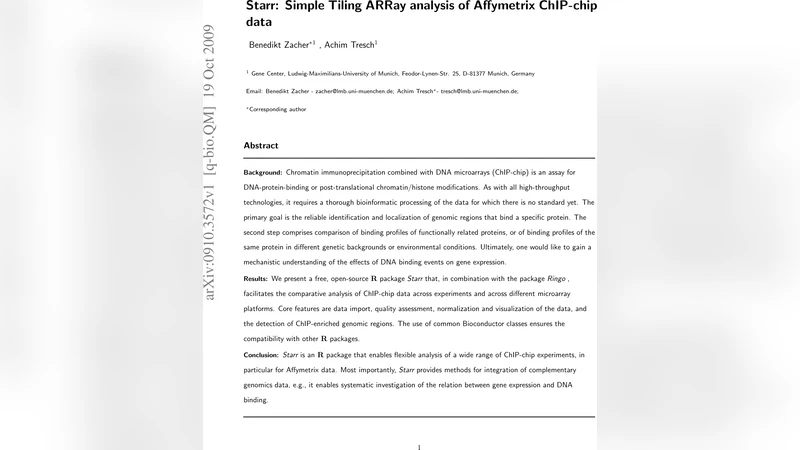
Chromatin immunoprecipitation combined with DNA microarrays (ChIP-chip) is an assay for DNA-protein-binding or post-translational chromatin/histone modifications. As with all high-throughput technologies, it requires a thorough bioinformatic processing of the data for which there is no standard yet. The primary goal is the reliable identification and localization of genomic regions that bind a specific protein. The second step comprises comparison of binding profiles of functionally related proteins, or of binding profiles of the same protein in different genetic backgrounds or environmental conditions. Ultimately, one would like to gain a mechanistic understanding of the effects of DNA binding events on gene expression. We present a free, open-source R package Starr that, in combination with the package Ringo, facilitates the comparative analysis of ChIP-chip data across experiments and across different microarray platforms. Core features are data import, quality assessment, normalization and visualization of the data, and the detection of ChIP-enriched genomic regions. The use of common Bioconductor classes ensures the compatibility with other R packages. Most importantly, Starr provides methods for integration of complementary genomics data, e.g., it enables systematic investigation of the relation between gene expression and dna binding.
💡 Research Summary
The paper introduces Starr, an open‑source R/Bioconductor package designed to streamline the analysis of ChIP‑chip data, with a particular focus on Affymetrix tiling arrays but also supporting other platforms. ChIP‑chip experiments generate large, complex datasets that require careful preprocessing, normalization, quality control, peak detection, and downstream integration with complementary genomic data such as gene expression. Prior to Starr, researchers often assembled ad‑hoc pipelines from disparate tools, leading to reproducibility challenges and inconsistent handling of multi‑experiment comparisons.
Starr builds on the existing Ringo package, inheriting its core capabilities for handling tiling array data while adding a comprehensive suite of functions that cover the entire analytical workflow. Data import is performed by reading Affymetrix CEL files into an AffyBatch object, which is then coerced into an ExpressionSet. This standard Bioconductor container carries both assay data and sample metadata, ensuring seamless compatibility with downstream packages (e.g., limma, edgeR).
Quality assessment is automated: Starr generates probe‑level intensity histograms, MA plots, and evaluates spike‑in controls to compute signal‑to‑noise ratios. Users can quickly identify outlier arrays or systematic biases before proceeding. Normalization options include loess (spatial and GC‑content bias correction) and quantile scaling; the choice is left to the analyst, and visual diagnostics (post‑normalization MA and density plots) are provided to verify the effectiveness of the chosen method.
Peak detection follows a window‑based smoothing strategy. After smoothing, windows whose mean intensity exceeds a user‑defined multiple of the global mean are flagged as candidate enriched regions. Statistical significance is assessed via permutation testing, and the Benjamini‑Hochberg procedure controls the false discovery rate. Significant peaks are exported in BED format for visualization in genome browsers, and an annotation module maps peaks to genes, transcription factor binding sites, or histone modification annotations using Bioconductor’s GenomicRanges infrastructure.
A standout feature of Starr is its ability to handle multiple ChIP‑chip experiments simultaneously. By applying identical normalization parameters and peak‑calling thresholds across conditions (e.g., wild‑type vs mutant, treated vs untreated), technical variability is minimized, allowing genuine biological differences to emerge. Starr also provides the integrateExpression function, which imports parallel gene expression microarray data and correlates expression changes with ChIP enrichment. Users can fit linear models, compute Spearman rank correlations, or apply logistic regression to test hypotheses about the relationship between DNA binding intensity and transcriptional regulation.
The package is fully open‑source, hosted on GitHub and distributed through Bioconductor, with continuous integration testing and versioned releases. Comprehensive vignettes and step‑by‑step tutorials guide both novice and experienced users through typical workflows, from raw data to publication‑ready figures. Because Starr relies on standard Bioconductor classes (AffyBatch, ExpressionSet, GRanges), it interoperates smoothly with a wide ecosystem of downstream analysis tools, facilitating further integration with RNA‑seq, ATAC‑seq, or Hi‑C datasets in future extensions.
In summary, Starr delivers a unified, reproducible, and extensible solution for the end‑to‑end analysis of ChIP‑chip experiments. By consolidating data import, quality control, normalization, peak detection, annotation, and multi‑omics integration into a single package, it reduces the technical overhead for researchers and enables more rigorous, comparative studies of protein‑DNA interactions and their functional consequences on gene expression.
Comments & Academic Discussion
Loading comments...
Leave a Comment