Comment: Citation Statistics
Comment on “Citation Statistics” [arXiv:0910.3529]
💡 Research Summary
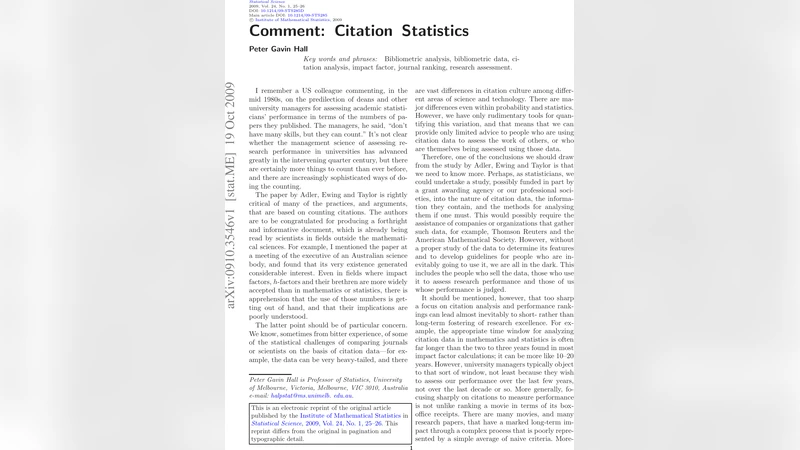
Peter Gavin Hall’s commentary on Adler, Ewing, and Taylor’s “Citation Statistics” provides a thorough critique of the growing reliance on citation‑based metrics—such as impact factors, h‑indices, and related indicators—for evaluating research performance. Hall begins by recalling a 1980s anecdote in which university administrators, lacking sophisticated expertise, reduced academic assessment to simple counts of publications. He observes that while modern bibliometrics have become far more sophisticated, the fundamental problem remains: counting citations does not capture the nuanced, field‑specific nature of scholarly impact.
A central technical point in Hall’s argument is the statistical nature of citation data. Citations are highly skewed, often following a heavy‑tailed distribution, and differ dramatically across disciplines. In mathematics and statistics, citations accrue slowly and over long periods, sometimes spanning a decade or more. Consequently, summary statistics that rely on the mean—such as the traditional impact factor calculated over a two‑ or three‑year window—are easily distorted by a few highly cited papers, while the majority of work receives modest attention. Hall stresses that more robust measures (median, percentiles, or full‑distribution modeling) are needed, yet the community currently lacks systematic tools to quantify this variation.
Hall illustrates the practical consequences of uncritical metric use through the Australian Research Council (ARC) journal‑ranking episode. The government asked academic societies to tier journals into four categories (top 5 %, next 15 %, next 30 %, and bottom 50 %). The revised rankings, however, were based largely on five‑year impact factors supplied by Thomson Reuters. In probability and statistics, this approach produced absurd outcomes: key probability journals were placed in the lowest tier because they publish fewer papers and receive fewer citations, while a medical statistics journal with a slightly higher impact factor was promoted to the top tier. The episode sparked intense debate, highlighted the inadequacy of impact factors for fields with distinct citation cultures, and demonstrated how policy decisions based on flawed metrics can affect funding allocations and academic reputations.
Beyond the immediate mis‑ranking, Hall points out a deeper issue: the time horizon used for citation analysis is mismatched with the reality of many disciplines. While impact factors typically consider citations within two or three years of publication, the true influence of a statistical or mathematical contribution may only become evident after ten to twenty years. University administrators, eager for short‑term performance indicators, resist extending the citation window, thereby incentivizing researchers to chase quick, highly citable results rather than pursuing foundational, long‑term work.
To address these problems, Hall proposes a coordinated research agenda. First, statisticians should lead a systematic study of citation data, examining distributional properties, field‑specific citation cultures, and appropriate statistical models. This effort would likely require collaboration with data providers such as Thomson Reuters and professional societies, possibly funded by grant‑making agencies. Second, citation metrics should be complemented by qualitative assessments—peer review, expert panels, and narrative impact statements—to provide a richer picture of scholarly contribution. Third, policy makers should adopt a multi‑dimensional evaluation framework that balances citation‑based indicators with other measures of research quality, teaching, mentorship, and societal impact.
Finally, Hall warns that an over‑reliance on citation counts can discourage young scholars from entering statistical science. If early‑career researchers are judged primarily by “bean‑counter” numbers, many may opt for alternative career paths, depriving the discipline of fresh talent. By acknowledging the limitations of citation statistics and investing in more nuanced, transparent evaluation practices, the academic community can foster a healthier research environment that rewards both short‑term productivity and long‑term intellectual breakthroughs.
Comments & Academic Discussion
Loading comments...
Leave a Comment