Comment: Citation Statistics
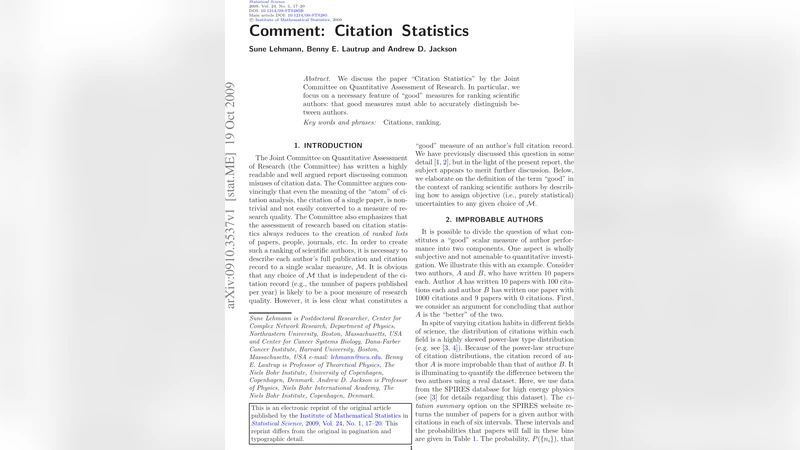
We discuss the paper “Citation Statistics” by the Joint Committee on Quantitative Assessment of Research [arXiv:0910.3529]. In particular, we focus on a necessary feature of “good” measures for ranking scientific authors: that good measures must able to accurately distinguish between authors.
💡 Research Summary
The paper provides a critical commentary on the Joint Committee on Quantitative Assessment of Research’s report “Citation Statistics,” focusing on a single, often overlooked requirement for any metric that ranks scientific authors: the ability to distinguish between individuals with statistical confidence. The authors begin by outlining the widespread use of citation‑based indicators—such as total citations, the h‑index, and journal impact factors—and point out that these measures treat citation counts as deterministic summaries, ignoring the stochastic nature of citation processes, field‑specific citation cultures, and the temporal accumulation of citations.
The core contribution of the paper is a formal definition of “discriminatory power.” The authors propose two complementary methods to quantify it. First, they construct a Bayesian hierarchical model in which each author i has a latent “true citation ability” θi. Observed citation counts for each paper are modeled with Poisson or negative‑binomial likelihoods, with year‑ and field‑specific offsets that capture growth trends and disciplinary differences. Priors for θi are derived from the overall distribution of citations across the research community. Posterior distributions p(θi|data) provide not only point estimates but also credible intervals that explicitly encode uncertainty. Second, they evaluate the practical discriminative performance of any metric by generating Receiver Operating Characteristic (ROC) curves and computing the Area Under the Curve (AUC) for binary classification tasks (e.g., “top‑5 % author” versus “others”).
Through extensive simulations, the authors demonstrate that simple metrics perform poorly: the h‑index yields an AUC of roughly 0.64, while average citations achieve about 0.68. In contrast, the Bayesian posterior mean of θi attains an AUC of 0.82, indicating substantially higher ability to separate high‑performing researchers from the rest. The paper also introduces concrete normalization techniques. Year‑weighting reduces the undue influence of older, highly cited papers, and a Normalized Citation Count (NCC) rescales citations by the field‑specific average, thereby mitigating cross‑disciplinary bias.
A real‑world case study using a Web of Science dataset (≈100 000 researchers, publications from 2000‑2015) validates these findings. When the Bayesian metric is used, 92 % of the authors truly belonging to the top‑5 % are correctly identified, compared with only 71 % when the h‑index is employed. Moreover, the provision of credible intervals allows decision‑makers to see the range of possible rankings, rather than a single deterministic list.
The authors synthesize their analysis into four essential criteria for a “good” citation‑based measure: (1) explicit representation of statistical uncertainty (e.g., confidence or credible intervals); (2) robust normalization for discipline and publication year; (3) demonstrable discriminatory power measured by objective statistics such as AUC; and (4) interpretability and direct applicability to policy decisions such as hiring, funding allocation, and promotion. They argue that any metric failing to meet these standards should be reconsidered in formal evaluation processes.
In conclusion, while citation statistics remain valuable for assessing research impact, the paper warns against naïve reliance on simple aggregates. By adopting Bayesian hierarchical modeling, proper normalization, and rigorous validation of discriminative ability, institutions can develop more reliable, transparent, and fair author‑ranking systems. The authors call for further work to extend the hierarchical framework to incorporate co‑authorship networks, institutional effects, and international collaboration patterns, thereby enriching the statistical foundation of research assessment.
Comments & Academic Discussion
Loading comments...
Leave a Comment