Citation Statistics
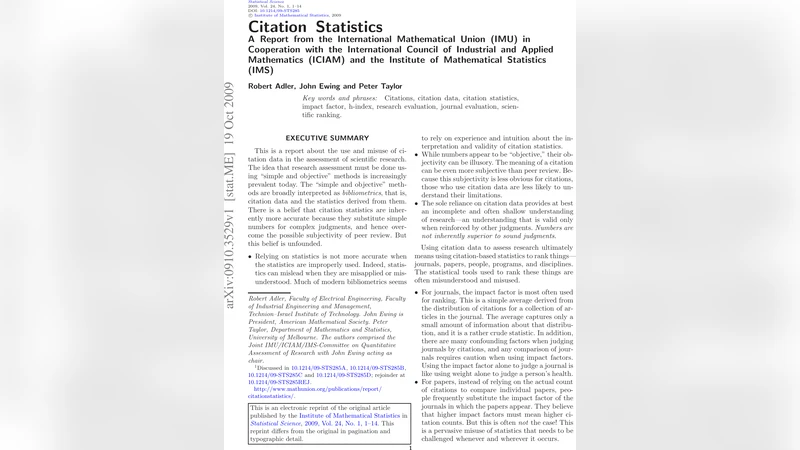
This is a report about the use and misuse of citation data in the assessment of scientific research. The idea that research assessment must be done using simple and objective'' methods is increasingly prevalent today. The simple and objective’’ methods are broadly interpreted as bibliometrics, that is, citation data and the statistics derived from them. There is a belief that citation statistics are inherently more accurate because they substitute simple numbers for complex judgments, and hence overcome the possible subjectivity of peer review. But this belief is unfounded.
💡 Research Summary
The paper provides a thorough critique of the growing reliance on citation statistics—such as total citation counts, journal impact factors, and the h‑index—as primary tools for evaluating scientific research. It begins by tracing the historical emergence of a “simple and objective” ethos in research assessment, noting that funding competition, university ranking pressures, and the desire for rapid policy decisions have driven administrators toward quantitative metrics. The authors define bibliometrics and explain how each indicator is calculated, emphasizing that these numbers are aggregates of citation behavior rather than direct measures of scientific quality.
Through a series of case studies, the authors demonstrate how these metrics distort evaluation outcomes. In the natural sciences, papers published in high‑impact journals are often over‑valued because the impact factor reflects an average citation rate that does not capture the influence of individual articles. In the social sciences and humanities, citation cultures differ markedly, and non‑English language scholarship is systematically under‑cited, leading to biased assessments that favor anglophone research. The paper also documents the behavioral side effects of metric‑driven evaluation: researchers engage in citation stacking, excessive self‑citation, and salami‑slicing of results to inflate their numbers, practices that undermine the integrity of scholarly communication.
A central argument is that citation statistics are not inherently more objective than peer review; rather, they are simplified representations of complex social processes. Peer review, despite its subjectivity, provides qualitative judgments about methodological rigor, theoretical novelty, reproducibility, and overall contribution—dimensions that citation counts cannot capture. By substituting numbers for expert judgment, institutions risk creating perverse incentives that prioritize metric optimization over genuine scientific advancement.
The authors critique current policy frameworks that place citation metrics at the core of funding allocation, tenure decisions, and departmental rankings. They argue that such policies exacerbate inequities across disciplines, geographic regions, and language groups, and they can lead to a homogenization of research topics that are more likely to attract citations. To address these issues, the paper proposes a multi‑dimensional assessment model. In this model, citation data serve only as a supplementary indicator, while primary evaluation criteria include peer review outcomes, societal and economic impact, contributions to education and training, and adherence to open‑science practices.
In conclusion, the paper calls for a cultural shift within the scientific community and among policymakers. Researchers, administrators, and funding agencies must recognize the limitations of bibliometric indicators and develop transparent, balanced evaluation systems that combine quantitative data with robust qualitative review. By doing so, the scientific enterprise can avoid the pitfalls of metric‑driven assessment and foster a more equitable, innovative, and trustworthy research environment.
Comments & Academic Discussion
Loading comments...
Leave a Comment