Iterators, Recursors and Interaction Nets
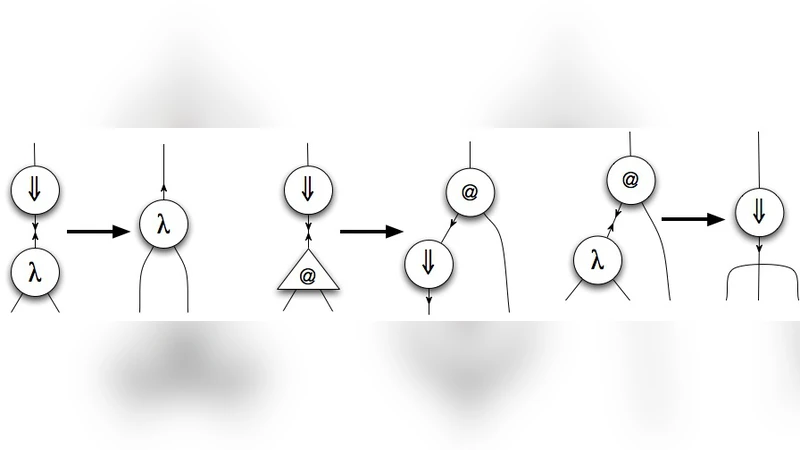
We propose a method for encoding iterators (and recursion operators in general) using interaction nets (INs). There are two main applications for this: the method can be used to obtain a visual nota- tion for functional programs; and it can be used to extend the existing translations of the lambda-calculus into INs to languages with recursive types.
💡 Research Summary
The paper introduces a systematic method for encoding iterators and, more generally, recursion operators within the framework of Interaction Nets (INs). Interaction Nets are a graph‑based computational model where agents (nodes) interact according to local rewrite rules, offering a visual and inherently parallel execution semantics. While previous work has shown how to translate the pure λ‑calculus into INs, those translations handle only first‑order function application and simple data constructors; they lack a native treatment of recursive constructs that are central to functional programming.
The authors address this gap by defining dedicated agents for each iterator (e.g., fold, map, iterate) and for each recursion operator (e.g., fix, rec). An iterator agent is paired with an accumulator agent; when the iterator meets a data constructor (such as cons or nil for lists) it rewrites by producing a new accumulator that incorporates the current element, then proceeds to the remainder of the structure. This is realized through a set of interaction rules that explicitly duplicate the accumulator agent, thereby visualizing the accumulation process as a growing sub‑graph. For example, the rule “Iter‑Cons” consumes a cons node, creates a new accumulator node by applying the folding function, and forwards the iterator to the tail. The nil case terminates the iteration by delivering the final accumulator as the result.
Recursion operators are modeled by a “Rec” agent that contains a self‑reference edge. When a Rec agent interacts with its argument, it spawns a fresh copy of itself, mirroring the unfolding of a recursive call. This self‑replication captures the potentially infinite unfolding of a fixpoint while keeping the net finite: each step creates a new instance, and the graph grows only as far as the computation proceeds. To support recursive types (μ‑types), the authors introduce a co‑inductive linking discipline that restricts how a type‑agent may point back to itself, ensuring that type‑level cycles do not cause uncontrolled graph expansion. This disciplined self‑reference aligns with the theoretical notion of guarded recursion and preserves confluence of the net reduction.
The paper then demonstrates the approach on a small functional language reminiscent of Haskell. Several case studies are presented: (1) a list sum using fold, (2) a map over a binary tree, (3) the classic Fibonacci definition via fix, and (4) stream generation with iterate. For each example the authors provide the source code, the corresponding IN representation, and a step‑by‑step reduction trace. The visual traces reveal how the accumulator propagates in the fold example, how map creates parallel sub‑nets for each subtree, and how the recursive fixpoint generates a cascade of Rec agents that mirror the call stack. These visualizations make the control flow and data flow simultaneously observable, a property that is difficult to achieve with textual reduction sequences.
Beyond illustration, the authors argue that the method extends the existing λ‑calculus → IN compilation pipeline without breaking its correctness guarantees. By treating iterators and recursion operators as first‑class agents, the translation preserves the semantics of the original program while enriching the net with additional structure that can be exploited for analysis. The authors discuss potential applications: (a) educational tools where students can watch functional programs “run” as evolving graphs; (b) debugging aids that pinpoint where an unexpected duplication or non‑termination occurs; (c) optimization passes that identify independent sub‑nets and schedule them for parallel execution, leveraging the intrinsic parallelism of INs; and (d) formal verification, because the interaction rules remain local and confluent, allowing reasoning about termination and resource usage.
In conclusion, the paper makes a substantive contribution by bridging the gap between high‑level functional recursion and low‑level graph rewriting. It provides a concrete, formally grounded encoding of iterators and recursion operators, demonstrates that the encoding yields intuitive visualizations, and shows that it integrates smoothly with established λ‑calculus translations. This work opens avenues for richer visual programming environments, more powerful static analyses, and efficient parallel implementations of functional languages built on the Interaction Nets model.
Comments & Academic Discussion
Loading comments...
Leave a Comment