Open and other kinds of extensions over local compactifications
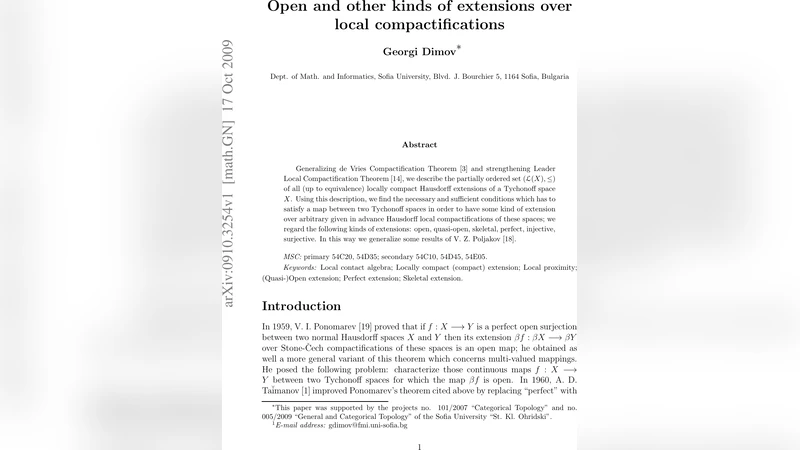
Generalizing de Vries Compactification Theorem and strengthening Leader Local Compactification Theorem, we describe the partially ordered set $(\LL(X),\le)$ of all (up to equivalence) locally compact Hausdorff extensions of a Tychonoff space $X$. Using this description, we find the necessary and sufficient conditions which has to satisfy a map between two Tychonoff spaces in order to have some kind of extension over arbitrary given in advance Hausdorff local compactifications of these spaces; we regard the following kinds of extensions: open, quasi-open, skeletal, perfect, injective, surjective. In this way we generalize some results of V. Z. Poljakov.
💡 Research Summary
The paper develops a comprehensive theory of local compactifications of Tychonoff spaces, extending two classical results: de Vries’ compactification theorem and Leader’s local compactification theorem. The authors first reinterpret de Vries’ algebraic description of compact Hausdorff extensions in terms of proximity algebras, then augment it with a “locality” condition to obtain a local proximity algebra. This structure captures precisely which elements can be realized as open sets in a given locally compact Hausdorff extension.
Using this algebraic framework, the authors refine Leader’s theorem. They introduce the partially ordered set ℒ(X) consisting of all locally compact Hausdorff extensions of a Tychonoff space X, taken up to equivalence. An element of ℒ(X) is a pair (Y,i) where i:X→Y is a dense embedding and Y\i(X) is compact. The order (Y₁,i₁) ≤ (Y₂,i₂) holds iff there exists a continuous map f:Y₂→Y₁ with f∘i₂=i₁; thus (Y₂,i₂) is “finer” than (Y₁,i₁). The authors prove that ℒ(X) is a complete lattice, with the trivial extension (X,identity) as the bottom element and the maximal extension (the Stone–Čech compactification of X with the point at infinity removed) as the top.
The central contribution concerns the extension of a given continuous map φ:X→X′ between two Tychonoff spaces to a map between prescribed local compactifications (Y,i) of X and (Y′,i′) of X′. For each of the following properties—open, quasi‑open, skeletal, perfect, injective, surjective—the paper derives necessary and sufficient conditions expressed entirely in terms of the local proximity algebras of X and X′. In brief:
- Open extension: φ must be an open map and must preserve the algebraic notion of openness in the local proximity algebras; equivalently, φ sends every locally open element of X to a locally open element of X′.
- Quasi‑open extension: φ must satisfy the quasi‑openness condition φ⁻¹(Cl′U′)⊆Cl(φ⁻¹U′) for every open U′⊆Y′, which translates into preservation of a certain quasi‑open filter in the algebra.
- Skeletal extension: φ must preserve the skeletal filter (the family of closed sets whose interior is non‑empty), guaranteeing that the induced map does not collapse non‑trivial interiors.
- Perfect extension: φ must be perfect with respect to the compact‑proximity relation; i.e., the preimage of every compact set is compact, which again can be read off from the algebraic structure.
- Injective / Surjective extensions: Injectivity requires φ to be one‑to‑one on the level of the local proximity algebra, while surjectivity demands that φ’s image be dense enough to cover the whole target compactification, expressed as a surjectivity condition on the corresponding algebraic homomorphism.
All these criteria are unified under the local proximity algebra, showing that the classical results of V. Z. Poljakov (which dealt mainly with perfect and injective extensions) are special cases of the present theory.
Finally, exploiting the lattice structure of ℒ(X), the authors describe how to locate the least and greatest extensions of φ that satisfy a given property. By constructing order‑preserving maps between ℒ(X) and ℒ(X′) induced by φ, one can compute the meet (infimum) and join (supremum) of all admissible extensions, thereby obtaining canonical minimal or maximal extensions. This provides a powerful tool for solving extension problems in topology: one can either add the smallest possible amount of “compactification” needed to achieve a desired property, or, conversely, work with the most extensive compactification that still respects the property.
In summary, the paper offers a unified algebraic‑topological framework for describing all locally compact Hausdorff extensions of a space, characterizes precisely when a map can be lifted to such extensions with a variety of topological properties, and generalizes earlier results of de Vries, Leader, and Poljakov. The lattice ℒ(X) and the local proximity algebra together form a robust machinery that is likely to influence further research in compactification theory, extension problems, and the interplay between topology and Boolean‑algebraic structures.
Comments & Academic Discussion
Loading comments...
Leave a Comment