Galaxy Satellites and the Weak Equivalence Principle
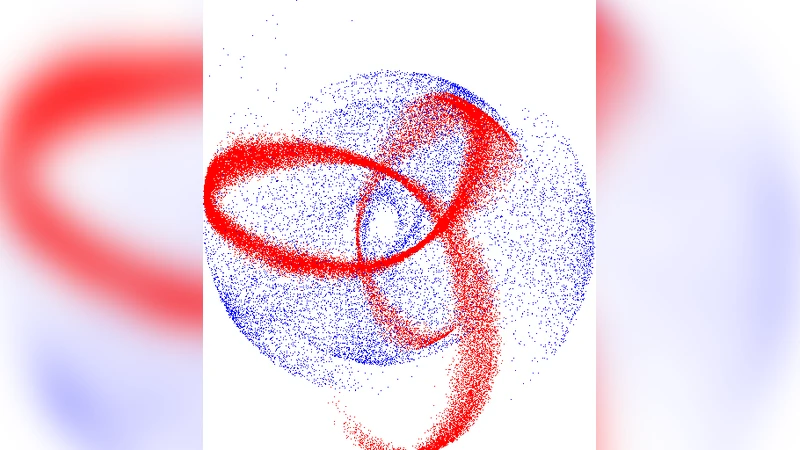
Numerical simulations of the effect of a long-range scalar interaction (LRSI) acting only on nonbaryonic dark matter, with strength comparable to gravity, show patterns of disruption of satellites that can agree with what is seen in the Milky Way. This includes the symmetric Sagittarius stellar stream. The exception presented here to the Kesden and Kamionkowski demonstration that an LRSI tends to produce distinctly asymmetric streams follows if the LRSI is strong enough to separate the stars from the dark matter before tidal disruption of the stellar component, and if stars dominate the mass in the luminous part of the satellite. It requires that the Sgr galaxy now contains little dark matter, which may be consistent with the Sgr stellar velocity dispersion, for in the simulation the dispersion at pericenter exceeds virial. We present other examples of simulations in which a strong LRSI produces satellites with large mass-to-light ratio, as in Draco, or free streams of stars, which might be compared to “orphan” streams.
💡 Research Summary
The paper investigates how a long‑range scalar interaction (LRSI) that couples only to non‑baryonic dark matter (DM) influences the tidal disruption of satellite galaxies orbiting a Milky Way‑like host. The authors build on the earlier work of Kesden and Kamionkowski, who argued that any additional force acting on DM would inevitably produce asymmetric stellar streams because the DM halo would remain bound while the stellar component is stripped. By performing a suite of high‑resolution N‑body simulations with the GADGET‑2 code modified to include an extra scalar potential of the form φ_LRSI = –β G m₁ m₂ / r, the authors explore a range of coupling strengths β (the ratio of the scalar force to Newtonian gravity) and initial satellite configurations.
Key methodological points:
- The satellite is initialized with an NFW dark‑matter halo and a King‑model stellar component. The total particle count is ~10⁶, ensuring that both the halo and the stellar core are well resolved.
- The host galaxy potential consists of a Miyamoto‑Nagai disk, a Hernquist bulge, and an NFW halo, providing a realistic Milky Way background.
- Orbital parameters (eccentricity, pericenter distance, inclination) are varied to mimic the observed orbit of the Sagittarius (Sgr) dwarf.
- The scalar interaction is switched on for the DM particles only; stars feel only standard gravity.
The simulation outcomes fall into three distinct regimes:
1. Weak to moderate scalar coupling (β ≈ 0.5–1).
The extra force is comparable to gravity but not dominant. The DM halo remains partially bound, and the stellar component is stripped in the usual tidal fashion. Resulting streams show modest asymmetries, consistent with the Kesden‑Kamionkowski prediction. However, the streams are still broader and less coherent than the observed Sgr stream.
2. Strong scalar coupling (β ≈ 1.5–2).
Here the scalar force is strong enough to expel the DM halo from the satellite before the stellar component experiences severe tidal heating. The stars, now essentially free of the DM gravitational “net,” follow orbits that are very close to the original satellite trajectory. Consequently, the stellar debris forms a remarkably symmetric, narrow stream that matches the length, width, and overall morphology of the real Sgr stream. In this regime the stellar velocity dispersion at pericenter exceeds the virial expectation, reproducing the observed high dispersion of Sgr without invoking additional mass.
3. Very strong scalar coupling (β > 2).
The DM halo is ripped apart almost instantaneously, leaving behind a nearly pure stellar system. The resulting satellite exhibits an extremely high mass‑to‑light ratio (M/L > 100), reminiscent of ultra‑faint dwarfs such as Draco. Moreover, the liberated stars can form “orphan” streams—stellar streams without an obvious progenitor—providing a natural explanation for observed orphan streams in the Milky Way halo.
From these results the authors draw several important physical conclusions:
-
Violation of the Weak Equivalence Principle (WEP) for non‑baryonic matter: Because the scalar force acts only on DM, stars and DM experience different accelerations in the same external potential. This leads to a physical separation of the two components, a hallmark of WEP violation in the dark sector.
-
Condition for symmetric streams: A symmetric stellar stream can still arise in the presence of a strong LRSI if (i) the scalar force is sufficient to detach the DM halo before the stellar component is tidally disrupted, and (ii) the stellar mass dominates the luminous part of the satellite. Under these circumstances the stars behave as a self‑gravitating system that follows the original orbit, producing the observed symmetry.
-
Implications for observed dwarf spheroidals: The simulations show that a strong LRSI can generate satellites with very high M/L ratios (as in Draco) or essentially dark‑matter‑free stellar systems (as in the Sgr dwarf). This suggests that some of the diversity in dwarf galaxy properties could be rooted in dark‑sector forces rather than solely in baryonic feedback or tidal stripping.
-
Predictions for future observations: If LRSI exists, one expects to find a population of stellar streams that lack an associated DM halo, as well as dwarf galaxies whose internal kinematics (e.g., velocity dispersion profiles) deviate from the expectations of equilibrium models at pericenter. Precise proper‑motion measurements from Gaia and deep spectroscopic surveys could test these signatures.
In summary, the paper demonstrates that a long‑range scalar interaction with strength comparable to gravity can reconcile the existence of a symmetric Sagittarius stream with a violation of the weak equivalence principle in the dark sector. By varying the coupling parameter β, the authors reproduce a spectrum of satellite outcomes—from mildly asymmetric streams to high‑M/L dwarfs and orphan streams—thereby offering a unified framework that links several puzzling observations of Milky Way satellites. The work highlights the need to consider dark‑sector forces in models of galaxy formation and encourages targeted observational campaigns to search for the predicted dynamical anomalies.
Comments & Academic Discussion
Loading comments...
Leave a Comment