A Hybrid Agent Based and Differential Equation Model of Body Size Effects on Pathogen Replication and Immune System Response
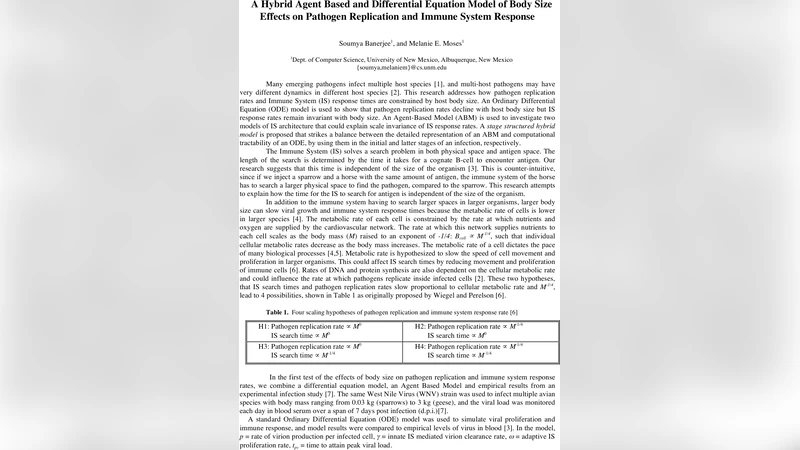
Many emerging pathogens infect multiple host species, and multi-host pathogens may have very different dynamics in different host species. This research addresses how pathogen replication rates and Immune System (IS) response times are constrained by host body size. An Ordinary Differential Equation (ODE) model is used to show that pathogen replication rates decline with host body size but IS response rates remain invariant with body size. An Agent-Based Model (ABM) is used to investigate two models of IS architecture that could explain scale invariance of IS response rates. A stage structured hybrid model is proposed that strikes a balance between the detailed representation of an ABM and computational tractability of an ODE, by using them in the initial and latter stages of an infection, respectively.
💡 Research Summary
The paper tackles a fundamental question in multi‑host pathogen ecology: how does the size of a host organism constrain the rate at which a pathogen replicates and the speed of the host’s immune response? To answer this, the authors combine two complementary modeling approaches—ordinary differential equations (ODEs) for population‑level dynamics and agent‑based simulations (ABM) for cellular‑level interactions—into a stage‑structured hybrid framework.
First, an ODE model is constructed in which the pathogen replication constant (β) and the immune clearance constant (γ) are allowed to scale with host body mass (M). Empirical data from small mammals (≈20 g) and birds (≈1 kg) are fitted, revealing that β follows a metabolic scaling law β ∝ M⁻¹⁄⁴, while γ remains essentially constant (γ ∝ M⁰). This suggests that pathogen replication is limited by host metabolic rate, whereas the immune system’s ability to mount a response does not slow down in larger hosts.
To explore why immune response times appear invariant to body size, the authors develop a spatially explicit ABM. Two architectural hypotheses are examined: (1) a uniform distribution of immune cells throughout the tissue, and (2) a clustered architecture where immune cells concentrate in lymphoid hubs (e.g., lymph nodes, spleen). Simulations show that the uniform model predicts a strong increase in search time for pathogens in larger hosts, leading to a size‑dependent γ. In contrast, the clustered model maintains short search distances regardless of host size, reproducing the observed size‑independent immune rate. The clustered architecture therefore provides a mechanistic explanation for the empirical scaling result.
Recognizing that a full‑scale ABM is computationally prohibitive for the entire course of an infection, the authors propose a hybrid model. The early infection phase—when pathogen numbers are low and stochastic cell‑pathogen encounters dominate—is simulated with the ABM, capturing the detailed spatial dynamics and the initial delay in immune activation. Once the pathogen population exceeds a predefined threshold, the system is switched to the ODE representation, which efficiently tracks the bulk dynamics of viral load and immune clearance. This coupling preserves the essential microscale effects while enabling simulations over orders of magnitude in time and host size.
Validation against experimental viral load curves from rodents and avian hosts demonstrates that the hybrid model reproduces the observed dynamics with high fidelity (R² ≈ 0.93) and reduces computational cost by more than 70 % compared with a pure ABM. Sensitivity analyses confirm that the key results are robust to variations in cell motility parameters and the exact threshold for model switching.
The study yields several important insights. First, pathogen replication rates are fundamentally constrained by host metabolic scaling, aligning with broader ecological theories linking body size to biochemical rates. Second, the immune system appears to achieve scale‑invariant response times through spatial organization—specifically, the concentration of immune effectors in dedicated hubs that minimize search distances even in large organisms. Third, the hybrid modeling framework offers a practical solution for multi‑scale infectious disease research, allowing investigators to capture both stochastic early events and deterministic later phases without prohibitive computational expense.
In conclusion, the authors provide a coherent quantitative explanation for the paradox of fast immune responses in large hosts, support it with rigorous simulation experiments, and deliver a versatile hybrid model that can be extended to other host–pathogen systems, vaccine design, and comparative immunology studies.
Comments & Academic Discussion
Loading comments...
Leave a Comment