Average sensitivity and noise sensitivity of polynomial threshold functions
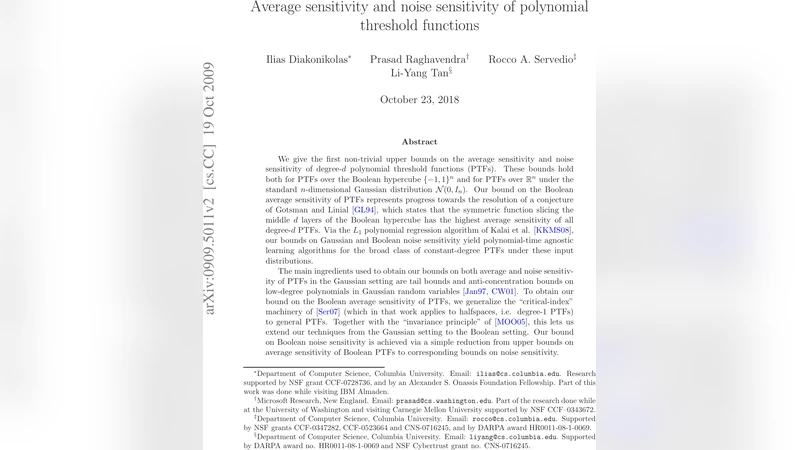
We give the first non-trivial upper bounds on the average sensitivity and noise sensitivity of degree-$d$ polynomial threshold functions (PTFs). These bounds hold both for PTFs over the Boolean hypercube and for PTFs over $\R^n$ under the standard $n$-dimensional Gaussian distribution. Our bound on the Boolean average sensitivity of PTFs represents progress towards the resolution of a conjecture of Gotsman and Linial \cite{GL:94}, which states that the symmetric function slicing the middle $d$ layers of the Boolean hypercube has the highest average sensitivity of all degree-$d$ PTFs. Via the $L_1$ polynomial regression algorithm of Kalai et al. \cite{KKMS:08}, our bounds on Gaussian and Boolean noise sensitivity yield polynomial-time agnostic learning algorithms for the broad class of constant-degree PTFs under these input distributions. The main ingredients used to obtain our bounds on both average and noise sensitivity of PTFs in the Gaussian setting are tail bounds and anti-concentration bounds on low-degree polynomials in Gaussian random variables \cite{Janson:97,CW:01}. To obtain our bound on the Boolean average sensitivity of PTFs, we generalize the ``critical-index’’ machinery of \cite{Servedio:07cc} (which in that work applies to halfspaces, i.e. degree-1 PTFs) to general PTFs. Together with the “invariance principle” of \cite{MOO:05}, this lets us extend our techniques from the Gaussian setting to the Boolean setting. Our bound on Boolean noise sensitivity is achieved via a simple reduction from upper bounds on average sensitivity of Boolean PTFs to corresponding bounds on noise sensitivity.
💡 Research Summary
The paper establishes the first non‑trivial upper bounds on two fundamental complexity measures of polynomial threshold functions (PTFs): average sensitivity (AS) and noise sensitivity (NS). A degree‑(d) PTF is a Boolean function of the form (f(x)=\operatorname{sgn}(p(x))) where (p) is a real polynomial of total degree (d). The authors treat both the Boolean hypercube ({-1,1}^{n}) and the standard (n)-dimensional Gaussian distribution, providing bounds that hold uniformly across these domains.
Gaussian setting.
The analysis begins with the Gaussian case. By invoking tail bounds for low‑degree polynomials (Janson, 1997) and anti‑concentration results due to Carbery and Wright (2001), the authors show that a degree‑(d) polynomial (p(G)) (with (G\sim N(0,I_n))) is unlikely to be very close to zero and also unlikely to be extremely large. Formally,
\
Comments & Academic Discussion
Loading comments...
Leave a Comment