Open and other kinds of extensions over zero-dimensional local compactifications
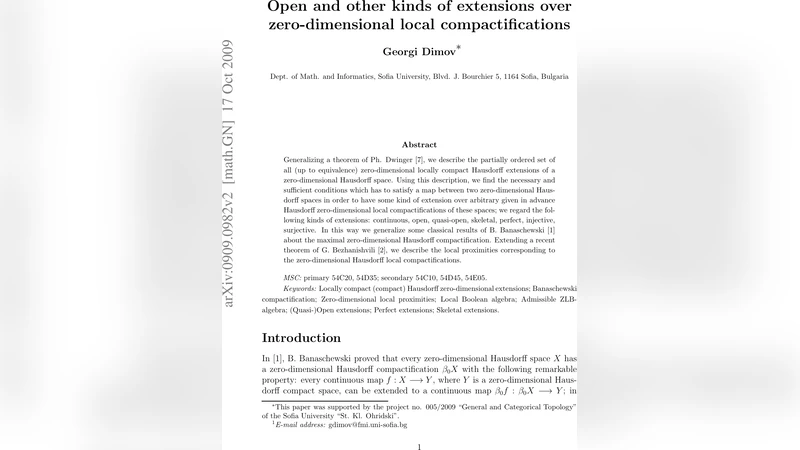
Generalizing a theorem of Ph. Dwinger, we describe the partially ordered set of all (up to equivalence) zero-dimensional locally compact Hausdorff extensions of a zero-dimensional Hausdorff space. Using this description, we find the necessary and sufficient conditions which has to satisfy a map between two zero-dimensional Hausdorff spaces in order to have some kind of extension over arbitrary given in advance Hausdorff zero-dimensional local compactifications of these spaces; we regard the following kinds of extensions: continuous, open, quasi-open, skeletal, perfect, injective, surjective. In this way we generalize some classical results of B. Banaschewski about the maximal zero-dimensional Hausdorff compactification. Extending a recent theorem of G. Bezhanishvili, we describe the local proximities corresponding to the zero-dimensional Hausdorff local compactifications.
💡 Research Summary
The paper investigates extensions of zero‑dimensional Hausdorff spaces within the framework of locally compact Hausdorff compactifications. Starting from Ph. Dwinger’s classical theorem on zero‑dimensional compactifications, the author first establishes a complete description of the partially ordered set (poset) of all zero‑dimensional locally compact Hausdorff extensions of a given zero‑dimensional Hausdorff space X. This description is achieved by identifying each extension with a regular clopen filter on X; the inclusion order of filters corresponds exactly to the natural order of extensions (one extension maps continuously onto another). Consequently, the collection of extensions forms a complete lattice that generalizes Dwinger’s result from compact to locally compact settings.
Having fixed two zero‑dimensional spaces X and Y together with arbitrary locally compact Hausdorff compactifications γX and γY, the paper turns to the problem of extending a map f : X → Y over these compactifications. Seven distinct types of extensions are considered: continuous, open, quasi‑open, skeletal, perfect, injective, and surjective. For each type the author derives necessary and sufficient conditions expressed in terms of the associated clopen filters. Roughly speaking:
- Continuous extension exists iff the image of every clopen set of X under f is a union of clopen sets of Y whose filter is contained in the filter defining γY.
- Open extension requires that f maps each clopen set of X to an open set of Y and that the induced filter on Y coincides with the filter of γY.
- Quasi‑open extension is characterized by preservation of interior points of clopen sets.
- Skeletal extension is equivalent to f preserving nowhere‑dense sets (the skeletal condition) and to a compatibility condition between the filters.
- Perfect extension demands that f be closed, that preimages of compact clopen sets remain compact, and that the filter of γY be respected.
- Injective and surjective extensions are described by filter‑inclusion and filter‑surjectivity conditions respectively.
These results simultaneously generalize B. Banaschewski’s classical description of the maximal zero‑dimensional compactification (the Stone–Čech compactification in the zero‑dimensional case) and provide a unified framework for all the above extension types.
In the final part of the paper the author connects the topological picture with the recent theory of local proximities introduced by G. Bezhanishvili. For each locally compact zero‑dimensional compactification γX a unique local proximity relation δγX is constructed; the correspondence between clopen filters and local proximities is shown to be bijective. Moreover, each of the seven extension notions translates into a natural preservation property of the associated proximity relations (e.g., an open extension corresponds to a proximity map that sends proximate pairs to proximate pairs). This proximity viewpoint yields an alternative, algebraic description of the extension problem and demonstrates that the topological conditions derived earlier are exactly the conditions ensuring the existence of a proximity morphism between (X,δγX) and (Y,δγY).
The paper concludes with several examples (discrete spaces, the Cantor set, and countable Boolean algebras) illustrating the theory, and it suggests further research directions such as extending the results to non‑zero‑dimensional spaces and exploring deeper connections between local proximities, Boolean algebras, and categorical frameworks for compactifications.
Comments & Academic Discussion
Loading comments...
Leave a Comment