Abstract Scalars, Loops, and Free Traced and Strongly Compact Closed Categories
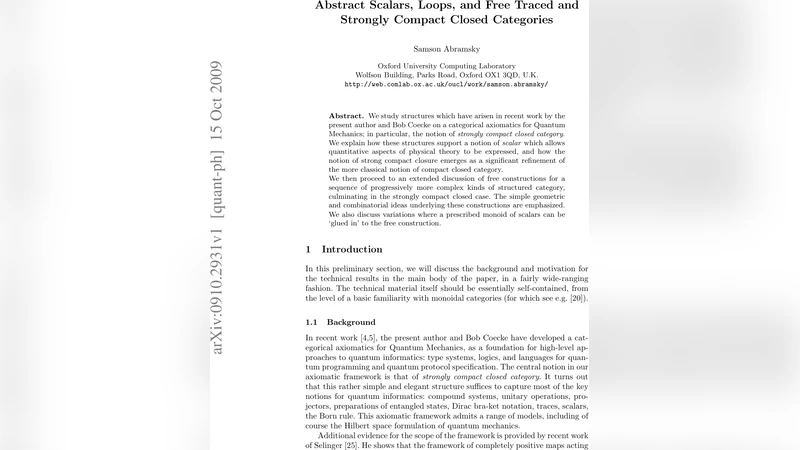
We study structures which have arisen in recent work by the present author and Bob Coecke on a categorical axiomatics for Quantum Mechanics; in particular, the notion of strongly compact closed category. We explain how these structures support a notion of scalar which allows quantitative aspects of physical theory to be expressed, and how the notion of strong compact closure emerges as a significant refinement of the more classical notion of compact closed category. We then proceed to an extended discussion of free constructions for a sequence of progressively more complex kinds of structured category, culminating in the strongly compact closed case. The simple geometric and combinatorial ideas underlying these constructions are emphasized. We also discuss variations where a prescribed monoid of scalars can be “glued in” to the free construction.
💡 Research Summary
The paper investigates categorical structures that have emerged from recent work on a categorical axiomatization of quantum mechanics, focusing on the notion of a strongly compact closed (SCC) category. It begins by addressing a fundamental shortcoming of ordinary compact closed categories: while they provide evaluation and co‑evaluation morphisms linking an object A with its dual A*, they lack an intrinsic way to represent the quantitative scalars (complex amplitudes, probabilities) that are essential in quantum theory. To remedy this, the authors introduce an abstract scalar object I together with its endomorphism monoid End(I). This monoid is taken as the “scalar” of the category; every morphism can be multiplied by an element of End(I), and the usual algebraic laws (associativity, unit) hold automatically. In this way, scalar multiplication becomes a native categorical operation rather than an external adornment.
The second conceptual innovation is the “loop”. In diagrammatic terms a loop is a closed wire that connects an output port of a morphism back to one of its input ports. When a morphism is traced around such a loop, a scalar from End(I) is automatically inserted, reflecting the physical idea that a closed quantum process contributes a global phase or probability factor. Loops therefore provide the categorical mechanism for defining a trace: the trace of a morphism f : A⊗X → B⊗X is obtained by wiring the X‑output back to the X‑input, forming a loop whose scalar contribution is precisely the traced value. This construction makes the trace operation purely combinatorial, based on the topology of the diagram rather than on any external analytic definition.
Having equipped compact closed categories with scalars and loops, the authors turn to the definition of a strongly compact closed category. An SCC is a compact closed category equipped with a dagger functor (†) that is involutive (f†† = f) and satisfies two compatibility conditions: (i) the dagger of a tensor product is the tensor product of the daggers, and (ii) the evaluation ε : A⊗A* → I and co‑evaluation η : I → A*⊗A are each other’s daggers (ε = η†). These conditions capture the conjugate‑transpose operation on Hilbert spaces, making SCCs the exact categorical analogue of finite‑dimensional Hilbert spaces with inner products. Consequently, morphisms in an SCC can be interpreted as linear maps, the dagger as the adjoint, and the trace as the usual partial trace of quantum states.
The core technical contribution of the paper is a step‑by‑step construction of the free SCC category generated by a given set of objects and a prescribed scalar monoid M. The construction proceeds through three increasingly rich intermediate categories:
-
Free category without trace – Objects are finite lists (or multisets) of generators; morphisms are generated by elementary “wire” diagrams (permutations, identities) composed by concatenation. This stage captures the pure tensor structure.
-
Free traced category – The previous diagrams are enriched with loops. A formal equivalence relation identifies diagrams that differ only by the insertion or removal of a contractible loop, and each loop contributes a scalar from M. The trace operation is defined diagrammatically as the closure of a wire.
-
Free SCC category – A dagger is added to the traced category. For each diagram there is a reflected diagram representing its adjoint; the dagger is required to be involutive and to satisfy the compatibility with evaluation and co‑evaluation. Additional equations enforce that the dagger of a loop is the same loop (up to scalar conjugation if M carries an involution).
Throughout the construction the authors emphasize geometric intuition: objects are points, morphisms are edges, tensor product is parallel placement, composition is sequential connection, loops are circles, and the dagger is a reversal of arrow direction. This visual language makes the otherwise intricate algebraic identifications transparent and lends itself to computer implementation (e.g., graph‑rewriting systems for automated reasoning about quantum circuits).
A notable flexibility is the ability to “glue in” an arbitrary scalar monoid M at the outset. By fixing End(I) ≅ M, one can obtain free SCC categories over the complex numbers, the real numbers, or even a finite Boolean monoid, depending on the physical or logical setting. This modularity is valuable for modeling different quantum‑like theories (e.g., real‑valued quantum mechanics, categorical probabilistic models).
In summary, the paper accomplishes three major goals: (1) it clarifies how abstract scalars and loops endow compact closed categories with the quantitative structure needed for quantum theory; (2) it shows that strong compact closure is a natural refinement that captures the adjoint operation intrinsic to Hilbert spaces; and (3) it provides an explicit, combinatorial recipe for building the free SCC category over any chosen set of generators and scalar monoid. The work bridges categorical logic, quantum physics, and computer science, offering both deep theoretical insight and a practical framework for implementing categorical quantum mechanics in software tools.
Comments & Academic Discussion
Loading comments...
Leave a Comment