The correlation of UHECRs with nearby galaxies in the Local Volume
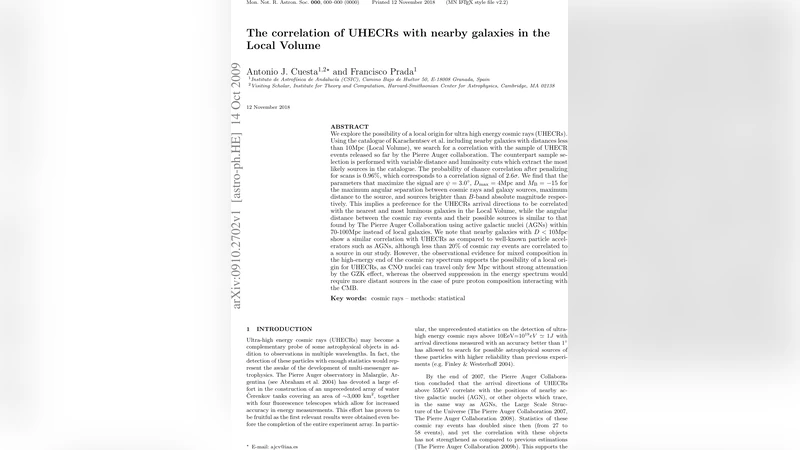
We explore the possibility of a local origin for ultra high energy cosmic rays (UHECRs). Using the catalogue of Karachentsev et al. including nearby galaxies with distances less than 10Mpc (Local Volume), we search for a correlation with the sample of UHECR events released so far by the Pierre Auger collaboration. The counterpart sample selection is performed with variable distance and luminosity cuts which extract the most likely sources in the catalogue. The probability of chance correlation after penalizing for scans is 0.96%, which corresponds to a correlation signal of 2.6\sigma. We find that the parameters that maximize the signal are \psi=3.0deg, D_{max}=4Mpc and M_B=-15 for the maximum angular separation between cosmic rays and galaxy sources, maximum distance to the source, and sources brighter than B-band absolute magnitude respectively. This implies a preference for the UHECRs arrival directions to be correlated with the nearest and most luminous galaxies in the Local Volume. We note that nearby galaxies with D<10Mpc show a similar correlation with UHECRs as compared to that found by The Pierre Auger Collaboration using active galactic nuclei (AGNs) within 70-100Mpc instead of local galaxies, although less than 20% of cosmic ray events are correlated to a source in our study. However, the observational evidence for mixed composition in the high-energy end of the cosmic ray spectrum supports the possibility of a local origin for UHECRs, as CNO nuclei can travel only few Mpc without strong attenuation by the GZK effect, whereas the observed suppression in the energy spectrum would require more distant sources in the case of pure proton composition interacting with the CMB.
💡 Research Summary
The paper investigates whether ultra‑high‑energy cosmic rays (UHECRs) could originate from sources within the Local Volume, i.e., galaxies at distances < 10 Mpc. The authors use the Karachentsev et al. catalogue of nearby galaxies and cross‑match it with the set of UHECR events released by the Pierre Auger Collaboration up to the time of writing. Their methodology consists of a three‑parameter scan: (i) the maximum angular separation ψ between a cosmic‑ray arrival direction and a candidate galaxy, (ii) the maximum distance Dmax allowed for a galaxy to be considered, and (iii) an absolute B‑band magnitude cut M_B that selects the most luminous galaxies. For each combination they count the number of “correlated” pairs in the real data and compare it with the expectation from isotropic simulations. Because scanning many parameter combinations inflates the chance probability, they apply a trial‑factor (penalty) correction to obtain a post‑scan p‑value.
The scan identifies a peak at ψ = 3.0°, Dmax = 4 Mpc, and M_B = ‑15. Under these conditions the probability that the observed correlation arises by chance is 0.96 %, corresponding to a 2.6σ excess over isotropy. Roughly 20 % of the Auger events fall within 3° of a galaxy satisfying the distance and luminosity cuts, a fraction smaller than the ≈30 % correlation reported previously with active galactic nuclei (AGNs) out to 70–100 Mpc. Nevertheless, the result is statistically significant after accounting for the scan penalty.
The authors discuss the astrophysical implications. Recent composition measurements suggest that the highest‑energy cosmic rays are not pure protons but contain a substantial fraction of intermediate‑mass nuclei (C, N, O). Such nuclei suffer strong energy losses via photodisintegration on the cosmic microwave background (the GZK effect) and can only travel a few megaparsecs before being attenuated. Consequently, a local origin within a few Mpc becomes plausible for a mixed composition scenario, whereas a pure‑proton interpretation would require sources at tens of megaparsecs to explain the observed suppression in the spectrum. The correlation with the nearest, most luminous galaxies therefore supports the mixed‑composition hypothesis.
The paper also examines how the correlation strength depends on the chosen cuts. Reducing Dmax below 4 Mpc quickly erodes the signal because too few galaxies remain; increasing Dmax beyond ≈6 Mpc dilutes the correlation with background. Similarly, tightening the luminosity cut (e.g., M_B < ‑18) reduces the sample size and weakens the statistical power, while a fainter cut (M_B > ‑13) adds many low‑luminosity galaxies that do not improve the signal. This sensitivity analysis demonstrates that the optimal region of parameter space is narrowly confined, suggesting that only a subset of nearby, relatively bright galaxies could act as UHECR accelerators.
Strengths of the work include a systematic scan of physically motivated parameters, proper accounting for trial factors, and a clear connection to composition measurements. Limitations are the modest number of UHECR events currently available (tens of events), uncertainties in galaxy distances and magnitudes, and the lack of a detailed treatment of the cosmic‑ray energies and individual event composition. The authors acknowledge that with larger data sets from AugerPrime and future observatories, as well as improved distance measurements (e.g., from Gaia and JWST), the statistical significance of any local‑source correlation can be tested more robustly.
In conclusion, the study provides evidence—at the ≈2.6σ level—that a fraction of UHECRs may be linked to the nearest, most luminous galaxies within 4 Mpc. This finding aligns with a mixed‑composition picture in which intermediate‑mass nuclei dominate the highest energies and can only survive over short extragalactic distances. While not yet definitive, the result motivates further observational campaigns and multi‑messenger analyses to pinpoint the true origins of the most energetic particles in the Universe.
Comments & Academic Discussion
Loading comments...
Leave a Comment