Superintegrability on N-dimensional curved spaces: Central potentials, centrifugal terms and monopoles
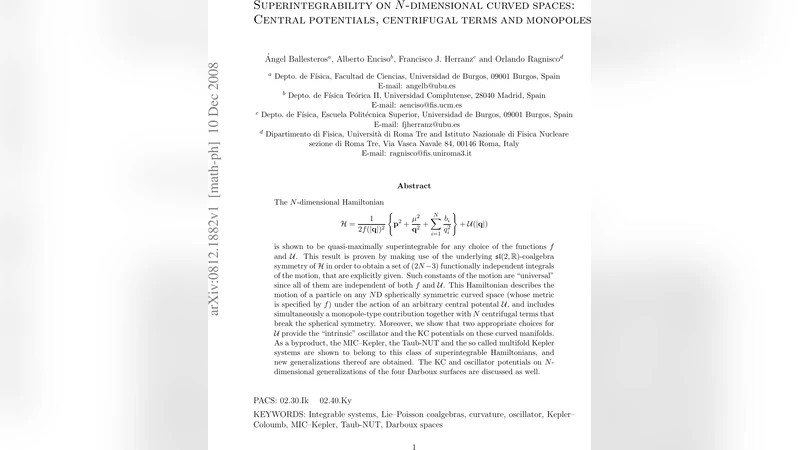
The N-dimensional Hamiltonian H formed by a curved kinetic term (depending on a function f), a central potential (depending on a function U), a Dirac monopole term, and N centrifugal terms is shown to be quasi-maximally superintegrable for any choice of the functions f and U. This result is proven by making use of the underlying sl(2,R)-coalgebra symmetry of H in order to obtain a set of (2N-3) functionally independent integrals of the motion, that are explicitly given. Such constants of the motion are “universal” since all of them are independent of both f and U. This Hamiltonian describes the motion of a particle on any ND spherically symmetric curved space (whose metric is specified by a function f) under the action of an arbitrary central potental U, and includes simultaneously a monopole-type contribution together with N centrifugal terms that break the spherical symmetry. Moreover, we show that two appropriate choices for U provide the “intrinsic” oscillator and the KC potentials on these curved manifolds. As a byproduct, the MIC-Kepler, the Taub-NUT and the so called multifold Kepler systems are shown to belong to this class of superintegrable Hamiltonians, and new generalizations thereof are obtained. The Kepler and oscillator potentials on N-dimensional generalizations of the four Darboux surfaces are discussed as well.
💡 Research Summary
The paper addresses the most general class of N‑dimensional Hamiltonian systems describing a particle moving on a spherically symmetric curved manifold. The geometry of the manifold is encoded in a single radial function f(r) which determines the kinetic term, while an arbitrary central potential U(r) is added. On top of these, the authors incorporate a Dirac‑type monopole term (characterized by a coupling α) and N centrifugal terms of the form c_i/q_i², which break the full spherical symmetry but preserve enough structure to allow superintegrability.
The central result is that, for any choice of the functions f and U, the Hamiltonian
H = ½ f(r) ∑{i=1}^{N} p_i² + U(r) + α · (monopole) + ∑{i=1}^{N} c_i/q_i²
is quasi‑maximally superintegrable. The proof relies on an underlying sl(2,ℝ)‑coalgebra symmetry. By constructing the three sl(2,ℝ) generators (J₊, J₀, J₋) as specific functions of the phase‑space variables and exploiting the coalgebra coproduct, the authors generate a hierarchy of conserved quantities. In total they obtain 2N‑3 functionally independent integrals of motion, all of which are universal: they do not depend on the particular form of f or U.
These integrals split into two families. The first consists of generalized angular momenta, modified to accommodate the centrifugal terms. The second family comprises higher‑order polynomial invariants that arise directly from the sl(2,ℝ) coalgebra structure; they are the hallmark of the quasi‑maximal superintegrability, providing the extra constants needed beyond the usual N + (N‑1) = 2N‑1 of a maximally superintegrable system.
Two special choices of U(r) reproduce the intrinsic oscillator and Kepler (Coulomb) potentials on the curved manifold. The “intrinsic oscillator” corresponds to U(r) ∝ f(r) r², while the “intrinsic Kepler” potential is U(r) ∝ −1/(f(r) r). In the flat limit f(r) → 1 these reduce to the familiar Euclidean harmonic oscillator and Kepler problems, confirming that the construction genuinely generalizes the classical cases.
The framework naturally encompasses several well‑known models. Setting f = 1, α ≠ 0 and c_i = 0 yields the MIC‑Kepler system (a Kepler problem with a monopole). Choosing f(r)=1+4m/r and an appropriate U reproduces the Taub‑NUT dynamics, which can be interpreted as a gravitational monopole. By allowing non‑zero, possibly distinct, centrifugal coefficients c_i, the authors generate multifold Kepler systems that extend the standard Kepler problem to higher dimensions with anisotropic “centrifugal barriers.” Moreover, the paper presents new families of superintegrable Hamiltonians obtained by varying the centrifugal coefficients or by selecting non‑standard curvature functions f(r).
A particularly interesting application concerns the four Darboux surfaces (D₁–D₄), each characterized by a specific curvature function f_D(r). By promoting these two‑dimensional metrics to N dimensions, the authors construct curved Kepler and oscillator potentials on the generalized Darboux manifolds. The sl(2,ℝ) coalgebra symmetry survives this extension, guaranteeing the same set of 2N‑3 universal integrals. This demonstrates that even on highly non‑trivial curved backgrounds the quasi‑maximal superintegrability persists.
In summary, the authors have identified a broad class of N‑dimensional Hamiltonians—curved kinetic term, arbitrary central potential, monopole, and centrifugal terms—that are universally quasi‑maximally superintegrable thanks to an sl(2,ℝ) coalgebra symmetry. The explicit construction of the conserved quantities, the identification of intrinsic oscillator and Kepler potentials, and the inclusion of known models (MIC‑Kepler, Taub‑NUT, multifold Kepler) together with new generalizations, provide a powerful and unifying algebraic framework. This work opens avenues for further exploration of superintegrable dynamics on curved spaces, with potential implications for quantum mechanics on manifolds, higher‑dimensional gravity, and the systematic design of exactly solvable models.
Comments & Academic Discussion
Loading comments...
Leave a Comment