Applying physical layer network coding in wireless networks
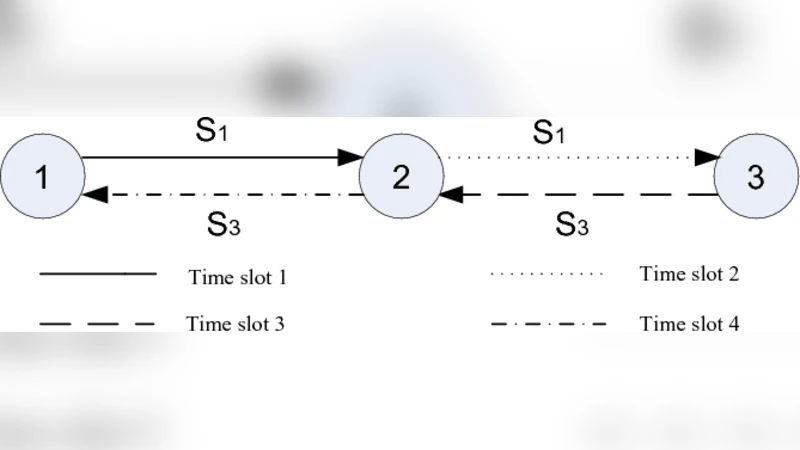
A main distinguishing feature of a wireless network compared with a wired network is its broadcast nature, in which the signal transmitted by a node may reach several other nodes, and a node may receive signals from several other nodes, simultaneously. Rather than a blessing, this feature is treated more as an interference-inducing nuisance in most wireless networks today (e.g., IEEE 802.11). This paper shows that the concept of network coding can be applied at the physical layer to turn the broadcast property into a capacity-boosting advantage in wireless ad hoc networks. Specifically, we propose a physical-layer network coding (PNC) scheme to coordinate transmissions among nodes. In contrast to “straightforward” network coding which performs coding arithmetic on digital bit streams after they have been received, PNC makes use of the additive nature of simultaneously arriving electromagnetic (EM) waves for equivalent coding operation. And in doing so, PNC can potentially achieve 100% and 50% throughput increases compared with traditional transmission and straightforward network coding, respectively, in 1-D regular linear networks with multiple random flows. The throughput improvements are even larger in 2-D regular networks: 200% and 100%, respectively.
💡 Research Summary
The paper tackles a fundamental characteristic of wireless communication – its broadcast nature – and turns what is traditionally viewed as interference into a source of capacity gain. The authors introduce Physical‑layer Network Coding (PNC), a scheme that exploits the additive property of simultaneously arriving electromagnetic waves to perform coding directly in the analog domain, rather than after digital demodulation as in conventional network coding.
In the system model, nodes are placed on either a one‑dimensional linear chain or a two‑dimensional regular grid. Multiple independent flows are generated at random, and whenever two flows intersect, the two corresponding transmitters are scheduled to send their symbols at exactly the same time, frequency, and phase. With BPSK (or QPSK) modulation, the received signal at the intermediate node is a linear superposition y = h₁x₁ + h₂x₂ + n, where h₁ and h₂ are channel gains and n is Gaussian noise. By estimating the channel gains beforehand, the receiver can directly map the summed waveform to the XOR of the two transmitted bits, thereby obtaining the network‑coded packet without any separate digital decoding and re‑encoding step.
The authors provide a rigorous throughput analysis. In a 1‑D regular network, traditional hop‑by‑hop forwarding requires two time slots per packet pair, while PNC reduces this to a single slot, yielding a 100 % throughput increase over the baseline. Compared with “straightforward” digital network coding (which still needs two transmissions to deliver the XORed packet), PNC offers a 50 % additional gain. In a 2‑D grid, the number of intersecting points grows, and the same reasoning leads to a 200 % improvement over conventional forwarding and a 100 % improvement over digital network coding. Simulations across a range of flow densities and signal‑to‑noise ratios confirm that the theoretical gains are realized in practice.
Implementation challenges are discussed in depth. Precise time and phase synchronization between the cooperating transmitters is essential; the paper suggests using dedicated preambles, GPS timing, or distributed consensus protocols to achieve sub‑microsecond alignment. Accurate channel estimation is also critical because any error directly corrupts the XOR mapping; iterative estimation and adaptive power control are proposed to mitigate this. The scheme is naturally suited to linear modulations; extending PNC to higher‑order constellations or to multi‑antenna (MIMO) systems introduces additional complexity in the demapping stage. Moreover, in dynamic topologies where flow patterns change, a real‑time scheduler must decide when PNC is beneficial and allocate resources accordingly. The authors outline a preliminary matching algorithm that pairs intersecting flows based on priority and channel quality.
In conclusion, the paper demonstrates that by embracing the physical superposition of electromagnetic waves, PNC can dramatically increase spectral efficiency in dense wireless ad‑hoc networks. The technique is especially promising for scenarios such as massive IoT deployments, vehicle‑to‑infrastructure communications, and swarms of unmanned aerial vehicles, where many simultaneous transmissions are the norm. Future work is directed toward robust synchronization protocols, integration with MIMO and higher‑order modulation, and hardware‑level prototyping to validate the concept under real‑world channel conditions.
Comments & Academic Discussion
Loading comments...
Leave a Comment