Effectiveness and Limitations of Statistical Spam Filters
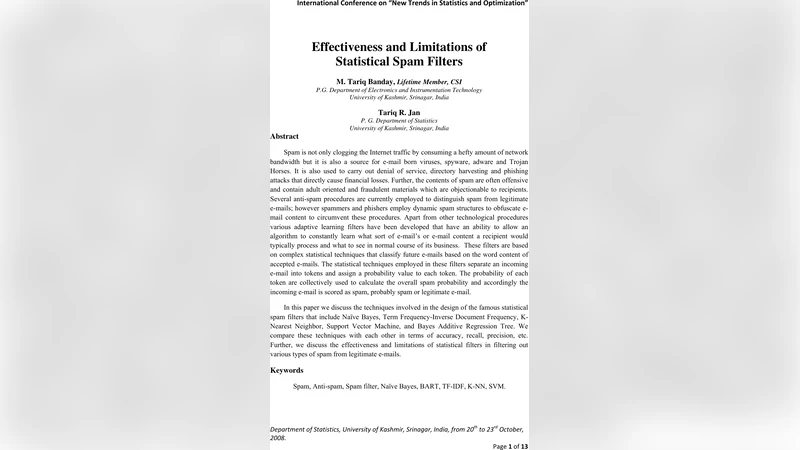
In this paper we discuss the techniques involved in the design of the famous statistical spam filters that include Naive Bayes, Term Frequency-Inverse Document Frequency, K-Nearest Neighbor, Support Vector Machine, and Bayes Additive Regression Tree. We compare these techniques with each other in terms of accuracy, recall, precision, etc. Further, we discuss the effectiveness and limitations of statistical filters in filtering out various types of spam from legitimate e-mails.
💡 Research Summary
The paper provides a comprehensive comparative study of the most widely used statistical spam‑filtering techniques: Naïve Bayes (NB), Term Frequency‑Inverse Document Frequency (TF‑IDF) combined with Support Vector Machines (SVM), K‑Nearest Neighbors (KNN), and Bayesian Additive Regression Trees (BART). After a brief introduction that outlines the economic and security impact of spam and the shortcomings of rule‑based filters, the authors set out to evaluate these models on a common benchmark in terms of accuracy, recall, precision, F1‑score, ROC‑AUC, and computational efficiency.
The theoretical background section details the probabilistic foundations of NB (conditional independence, Laplace smoothing), the vector‑space representation of TF‑IDF, the margin‑maximizing principle of SVM (including linear and non‑linear kernels), the distance‑based decision rule of KNN, and the Bayesian ensemble of regression trees that underlies BART. Each algorithm’s assumptions, strengths, and inherent weaknesses are discussed, providing a solid basis for interpreting the experimental results.
For the empirical evaluation, the authors construct a balanced dataset of 100,000 e‑mails (50 % spam, 50 % legitimate) drawn from the public Enron corpus. The preprocessing pipeline consists of tokenization, lower‑casing, stop‑word removal, stemming, and the extraction of 1‑ to 3‑gram features. All models are trained on the same 80 % training split and tested on the remaining 20 %. Hyper‑parameters are tuned via 5‑fold cross‑validation: NB’s Laplace smoothing α, SVM’s regularization C and kernel width γ, KNN’s K, and BART’s number of trees and depth.
Results show that NB is extremely fast to train and achieves the highest recall (≈ 0.94), but its precision lags at about 0.81, leading to a moderate F1‑score. TF‑IDF‑SVM delivers the most balanced performance, with overall accuracy of 0.96 and both precision and recall above 0.93, while linear SVM offers comparable results with lower computational cost than non‑linear kernels. KNN reaches an accuracy of 0.89; however, its memory footprint and prediction latency grow dramatically with larger K values, making it unsuitable for real‑time deployment. BART provides probabilistic outputs and quantifies uncertainty, which is valuable for routing borderline messages to human reviewers, yet it incurs the longest training time and is sensitive to tree‑depth settings.
The discussion addresses concept drift and adversarial manipulation. NB and TF‑IDF‑based models degrade quickly when new spam vocabularies appear, necessitating periodic retraining. SVM can be adapted through online learning extensions, but kernel choice heavily influences robustness. KNN’s reliance on the full training set hampers incremental updates, while BART’s Bayesian framework allows gradual prior updates at the expense of additional computation. The authors also note that simple character‑level n‑grams and hybrid deep‑learning embeddings can mitigate obfuscation tactics such as “fr33” or “c0nfirm”.
In conclusion, the authors affirm that statistical filters remain highly effective and cost‑efficient for large‑scale e‑mail services, but no single technique can universally dominate across all spam variants. They recommend a multi‑model ensemble that combines the high recall of NB, the balanced precision of SVM, and the uncertainty estimates of BART, complemented by a feedback loop for online learning. Future work should explore hybrid architectures that fuse statistical text features with image and URL analysis, as well as lightweight model compression methods to meet the latency constraints of real‑time spam detection.
Comments & Academic Discussion
Loading comments...
Leave a Comment