Universal Dephasing of Many-Body Rabi Oscillations of Atoms in One-Dimensional Traps
We study a quantum quench in a system of two coupled one-dimensional tubes of interacting atoms. After the quench the system is out of equilibrium and oscillates between the tubes with a frequency determined by microscopic parameters. Despite the high energy at which the system is prepared we find an emergent long time scale responsible for the dephasing of the oscillations and a transition at which this time scale diverges. We show that the universal properties of the dephasing and the transition arise from an infrared orthogonality catastrophe. Furthermore, we show how this universal behavior is realized in a realistic model of fermions with attractive interactions.
💡 Research Summary
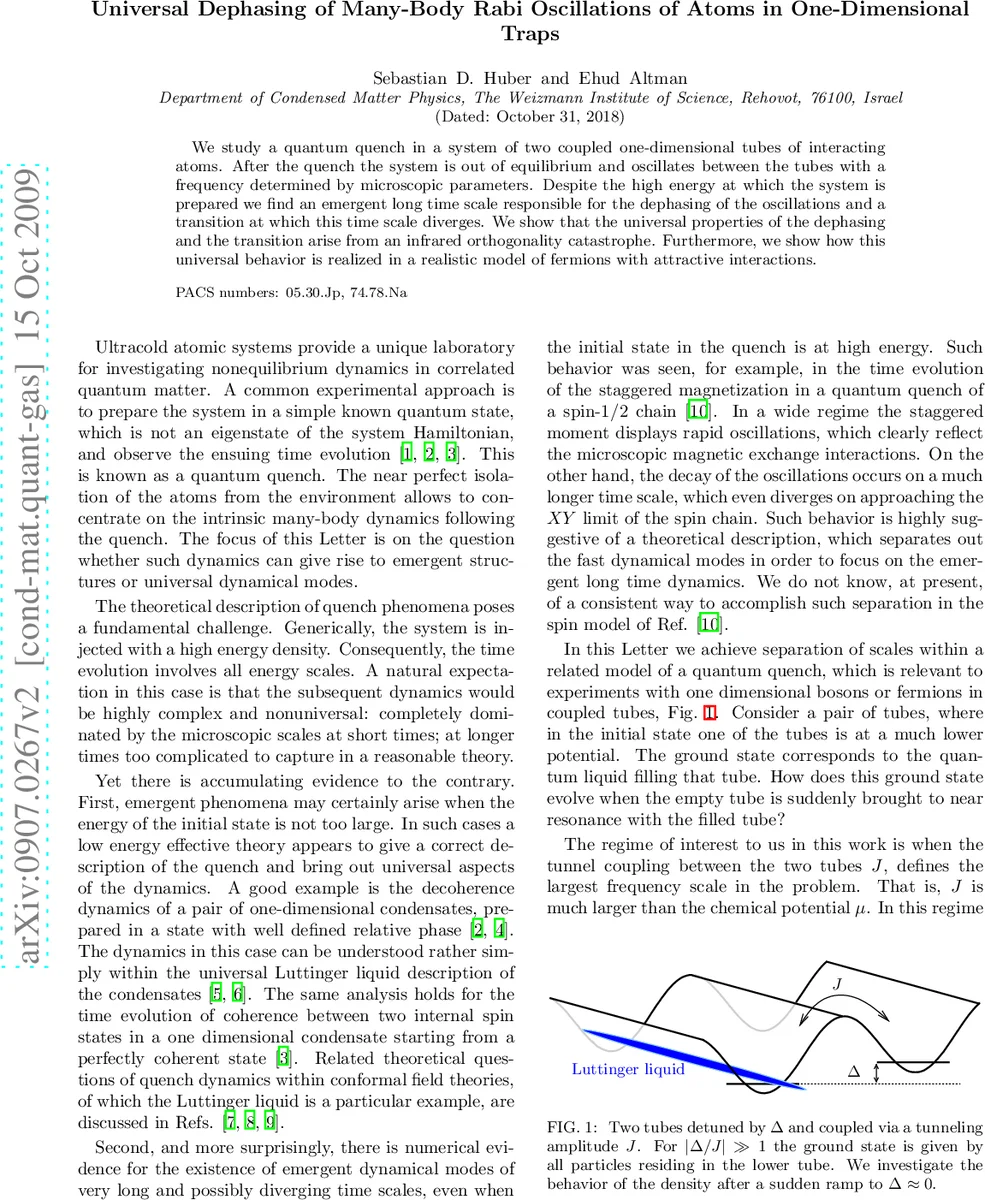
The authors investigate a quantum‑quench protocol in a system consisting of two parallel one‑dimensional (1D) tubes populated by interacting atoms. Initially the inter‑tube tunneling amplitude (t_{\perp}) is set to zero, so that all particles reside in a single tube. At time (t=0) the tunneling is suddenly switched on, placing the system far from equilibrium. As a result the particle number oscillates coherently between the tubes with a frequency (\omega_{0}\approx 2t_{\perp}/\hbar), i.e. a many‑body Rabi oscillation.
In a non‑interacting picture such oscillations would decay rapidly due to dephasing from the spread of single‑particle energies. However, the authors demonstrate that in a 1D interacting fluid a distinct, emergently long time scale (\tau_{\phi}) governs the decay of the oscillations. This dephasing time is not set by microscopic parameters such as the tunneling strength or the bare interaction energy, but rather by the low‑energy collective excitations of the Luttinger liquid that describes the 1D tubes.
Using bosonization, they derive an effective action where the high‑frequency Rabi mode couples non‑linearly to the gapless density (plasmon) modes. The coupling produces an infrared orthogonality catastrophe: the overlap between the many‑body wavefunction before and after a single tunneling event scales as a power law (\langle\Psi_i|\Psi_f\rangle\propto (\Delta/\Lambda)^{K-1}), where (\Delta) is the detuning between the tubes, (\Lambda) a high‑energy cutoff, and (K) the Luttinger parameter that encodes interaction strength. Consequently the dephasing rate follows a universal scaling form
\