There are many resources useful for processing images, most of them freely available and quite friendly to use. In spite of this abundance of tools, a study of the processing methods is still worthy of efforts. Here, we want to discuss the possibilities arising from the use of fractional differential calculus. This calculus evolved in the research field of pure mathematics until 1920, when applied science started to use it. Only recently, fractional calculus was involved in image processing methods. As we shall see, the fractional calculation is able to enhance the quality of images, with interesting possibilities in edge detection and image restoration. We suggest also the fractional differentiation as a tool to reveal faint objects in astronomical images.
Deep Dive into Fractional differentiation based image processing.
There are many resources useful for processing images, most of them freely available and quite friendly to use. In spite of this abundance of tools, a study of the processing methods is still worthy of efforts. Here, we want to discuss the possibilities arising from the use of fractional differential calculus. This calculus evolved in the research field of pure mathematics until 1920, when applied science started to use it. Only recently, fractional calculus was involved in image processing methods. As we shall see, the fractional calculation is able to enhance the quality of images, with interesting possibilities in edge detection and image restoration. We suggest also the fractional differentiation as a tool to reveal faint objects in astronomical images.
The fractional differentiation has started to play a very important role in various research fields, also for image and signal processing. In image processing, the fractional calculus can be rather interesting for filtering and edge detection, giving a new approach to enhance the quality of images. Fractional calculus is generalizing derivative and integration of a function to noninteger order [1][2][3]. As discussed by many researchers, probably a name as "generalized calculus" would be better than "fractional", which is actually used. We are in fact familiar with notations D 1 f (x) and D 2 f (x) for first and second order derivatives, but many people can be in doubt about the meaning of the notation D 1/2 f (x), describing the 1/2-order derivative. People, to which notation looks rather unfamiliar, could gain a misleading idea that this is a calculus just recently developed. In fact, the problem of fractional derivatives is rather old. Leibnitz already discussed it in eighteenth century and other famous names of the past studied and contributed to the development of fractional calculus in the field of pure mathematics [4]. We see the first applications of fractional calculus in 1920 and only recently, it was applied to image processing [5]. This paper discusses how the fractional calculus can provide benefits to image processing. In particular, we will see that it is useful in edge detection and for enhancing the image quality. The paper ends with examples on astronomical images.
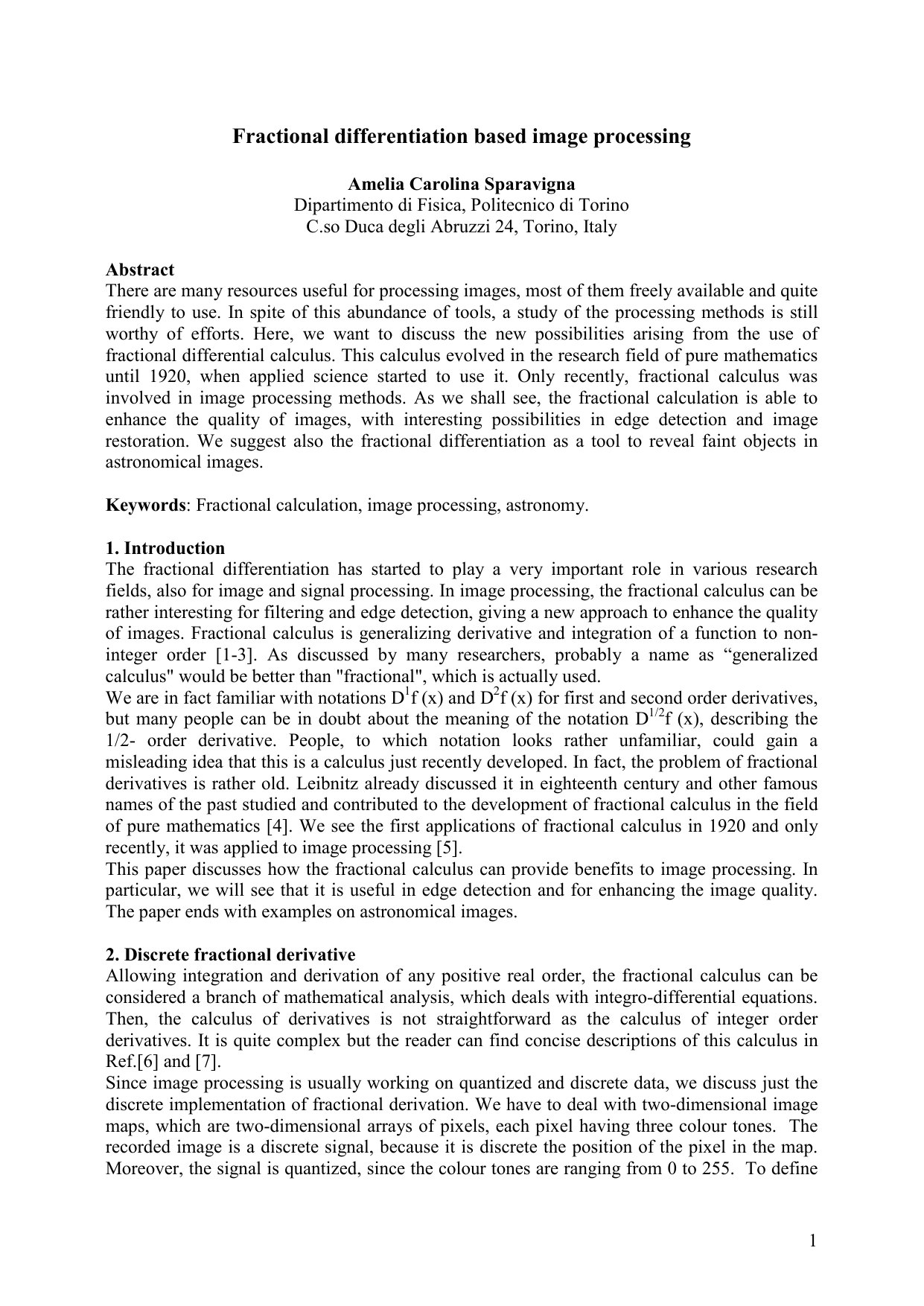
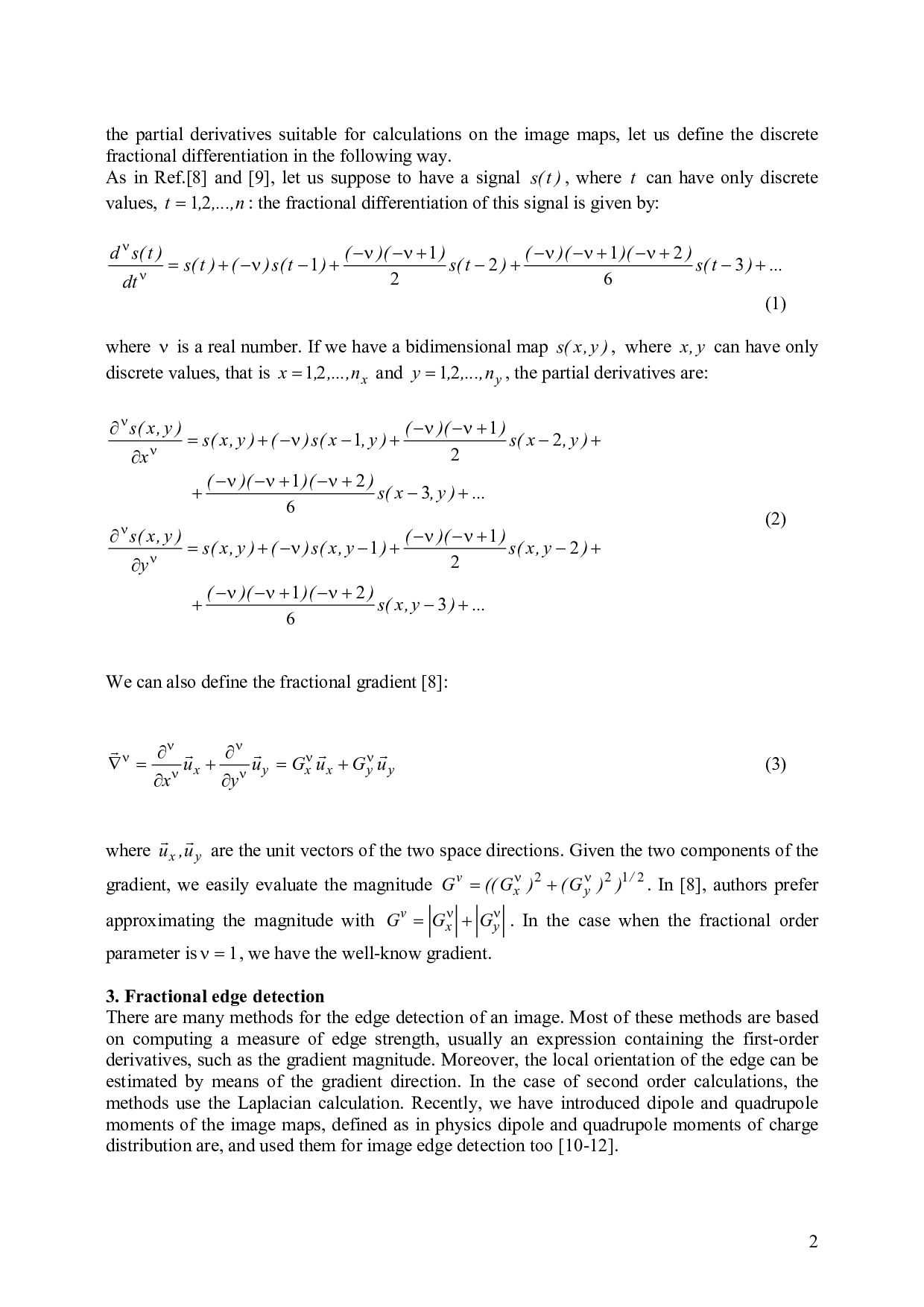
Allowing integration and derivation of any positive real order, the fractional calculus can be considered a branch of mathematical analysis, which deals with integro-differential equations. Then, the calculus of derivatives is not straightforward as the calculus of integer order derivatives. It is quite complex but the reader can find concise descriptions of this calculus in Ref. [6] and [7]. Since image processing is usually working on quantized and discrete data, we discuss just the discrete implementation of fractional derivation. We have to deal with two-dimensional image maps, which are two-dimensional arrays of pixels, each pixel having three colour tones. The recorded image is a discrete signal, because it is discrete the position of the pixel in the map. Moreover, the signal is quantized, since the colour tones are ranging from 0 to 255. To define the partial derivatives suitable for calculations on the image maps, let us define the discrete fractional differentiation in the following way. As in Ref. [8] and [9] : the fractional differentiation of this signal is given by:
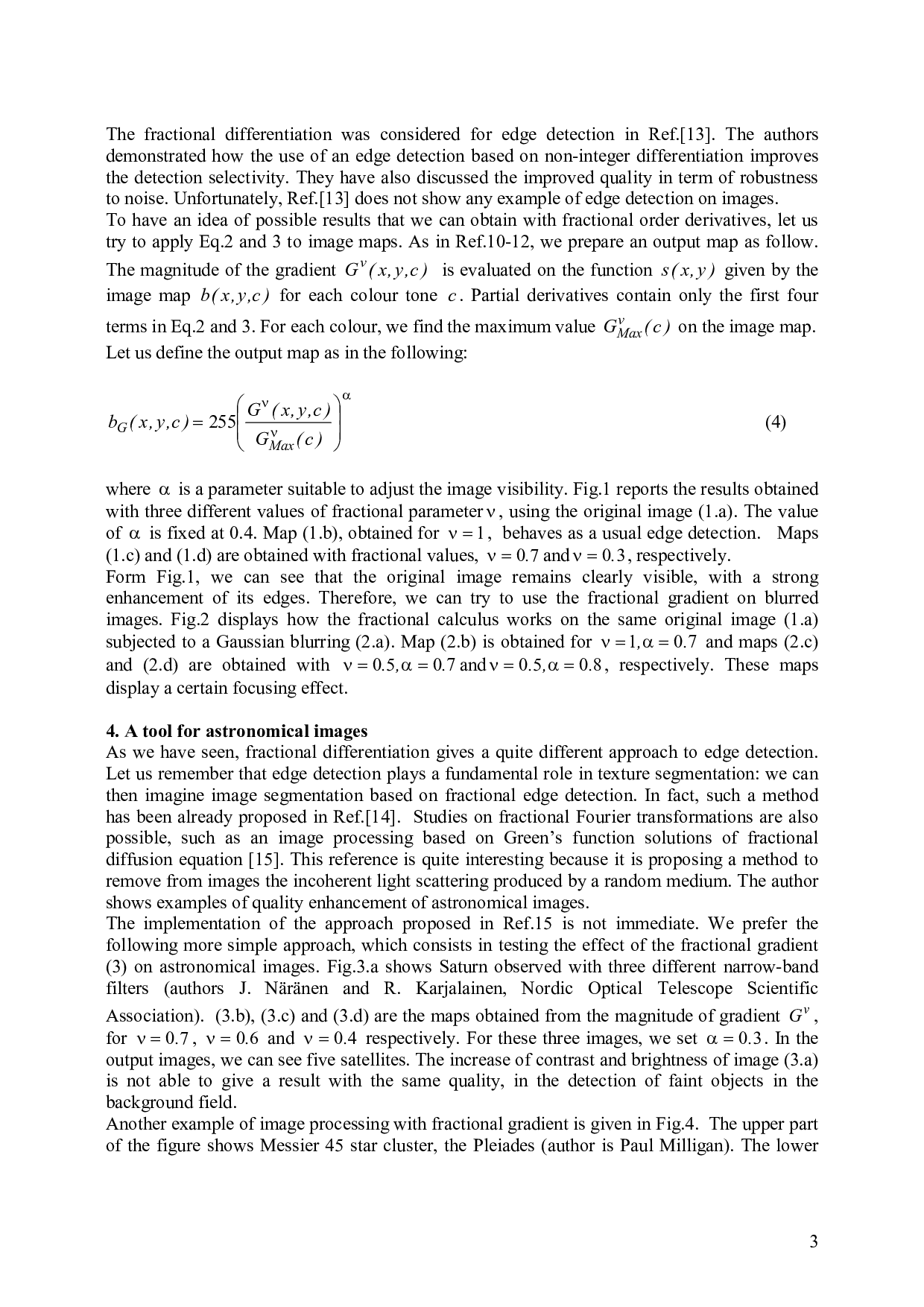
where ν is a real number. If , the partial derivatives are:
We can also define the fractional gradient [8]:
where
are the unit vectors of the two space directions. Given the two components of the gradient, we easily evaluate the magnitude
. In [8], authors prefer approximating the magnitude with
. In the case when the fractional order parameter is 1 = ν , we have the well-know gradient.
There are many methods for the edge detection of an image. Most of these methods are based on computing a measure of edge strength, usually an expression containing the first-order derivatives, such as the gradient magnitude. Moreover, the local orientation of the edge can be estimated by means of the gradient direction. In the case of second order calculations, the methods use the Laplacian calculation. Recently, we have introduced dipole and quadrupole moments of the image maps, defined as in physics dipole and quadrupole moments of charge distribution are, and used them for image edge detection too [10][11][12].
The fractional differentiation was considered for edge detection in Ref. [13]. The authors demonstrated how the use of an edge detection based on non-integer differentiation improves the detection selectivity. They have also discussed the improved quality in term of robustness to noise. Unfortunately, Ref. [13] does not show any example of edge detection on images.
To have an idea of possible results that we can obtain with fractional order derivatives, let us try to apply Eq.2 and 3 to image maps. As in Ref.10-12, we prepare an output map as follow.
The
where α is a parameter suitable to adjust the image visibility. , respectively. Form Fig. 1, we can see that the original image remains clearly visible, with a strong enhancement of its edges. Therefore, we can try to use the fractional gradient on blurred images. Fig. 2 , respectively. These maps display a certain focusing effect.
As we have seen, fractional differentiation gives a quite different approach to edge detection. Let us remember that edge detection plays a fundamental role in texture segmentation: we can then imagine image segmentation based on fractional edge detection. In fact, such a method has been already proposed in Ref. [14]. Studies on fractional Fourier transformations are also possible, such as an image processing based on Green’s function solutions of fractional diffusion
…(Full text truncated)…
This content is AI-processed based on ArXiv data.