Consistency on cubic lattices for determinants of arbitrary orders
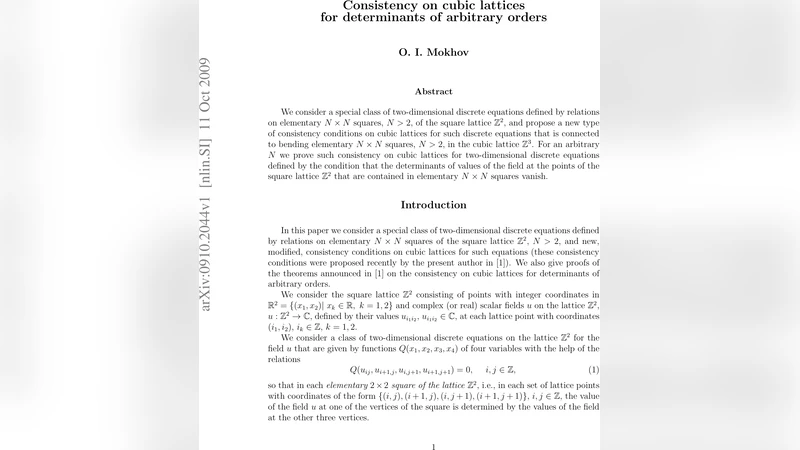
We consider a special class of two-dimensional discrete equations defined by relations on elementary NxN squares, N>2, of the square lattice Z^2, and propose a new type of consistency conditions on cubic lattices for such discrete equations that is connected to bending elementary NxN squares, N>2, in the cubic lattice Z^3. For an arbitrary N we prove such consistency on cubic lattices for two-dimensional discrete equations defined by the condition that the determinants of values of the field at the points of the square lattice Z^2 that are contained in elementary NxN squares vanish.
💡 Research Summary
The paper addresses a fundamental problem in the theory of discrete integrable systems: how to extend consistency conditions, traditionally formulated for equations defined on elementary 2 × 2 squares of the planar lattice ℤ², to equations that involve larger N × N squares with N > 2. The authors introduce a novel “bending” construction on the three‑dimensional cubic lattice ℤ³ and prove that a wide class of two‑dimensional discrete equations—those for which the determinant of the field values taken over any elementary N × N block of ℤ² vanishes—are consistent on the cubic lattice for every integer N ≥ 2.
The work begins by recalling the well‑known Consistency‑Around‑the‑Cube (CAC) property, which guarantees that a discrete equation defined on a face of a cube can be extended to the whole cube without contradiction. CAC has been extensively studied for equations that involve only four lattice points (the vertices of a 2 × 2 square). When one tries to replace the 2 × 2 block by a larger N × N block, the number of points grows quadratically, and the usual CAC framework no longer applies directly.
To overcome this obstacle the authors define a “determinant‑vanishing” equation: for a scalar field u : ℤ² → ℂ, every elementary N × N square S ⊂ ℤ² satisfies
det
Comments & Academic Discussion
Loading comments...
Leave a Comment