Compression bounds for Lipschitz maps from the Heisenberg group to $L_1$
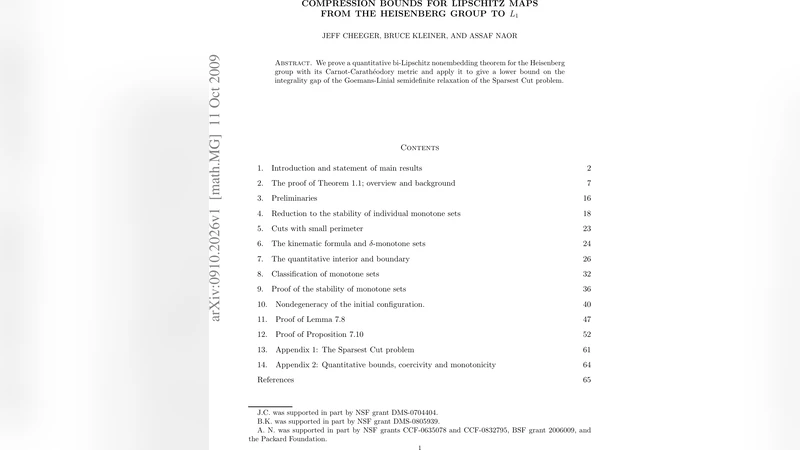
We prove a quantitative bi-Lipschitz nonembedding theorem for the Heisenberg group with its Carnot-Carath'eodory metric and apply it to give a lower bound on the integrality gap of the Goemans-Linial semidefinite relaxation of the Sparsest Cut problem.
💡 Research Summary
The paper establishes a quantitative non‑embedding theorem for the Heisenberg group equipped with its Carnot‑Carathéodory metric, and uses this result to derive a new lower bound on the integrality gap of the Goemans‑Linial semidefinite programming (SDP) relaxation for the Sparsest Cut problem.
The authors begin by recalling that the three‑dimensional Heisenberg group (H) (viewed as (\mathbb{R}^3) with the non‑commutative group law) carries a sub‑Riemannian distance (d_{CC}) that is intrinsically anisotropic: vertical motion (in the (z)‑direction) scales quadratically compared to horizontal motion. While Cheeger and Kleiner previously proved that no bi‑Lipschitz embedding of ((H,d_{CC})) into (L_1) exists, this work strengthens the statement by providing an explicit compression exponent.
The central technical tool is a “quantitative differentiation” theorem for Lipschitz maps (f:H\to L_1). For any scale (r) and any small parameter (\varepsilon>0), the theorem asserts that on a large proportion of points (x\in H) the restriction of (f) to the ball (B(x,r)) is almost linear, with distortion bounded by a power (r^{\alpha}) where (\alpha\approx 1/6). The proof blends Pansu differentiability, metric measure theory, and a careful analysis of the cut measure (\mu_f) associated with (f).
A second key ingredient is a stability result for “monotone sets” in the Heisenberg group. A monotone set is one that either contains or avoids every vertical line segment; its boundary consists of vertical planes. The authors show that if the cut measure (\mu_f) places a non‑negligible amount of mass on sets that are not approximately monotone, then the map (f) must incur a distortion of at least (c,r^{\alpha}) on the corresponding region. This quantitative version of the Cheeger‑Kleiner monotonicity argument yields a lower bound on the compression exponent (\beta(H)\ge c(\log n)^{-\alpha}) for any finite subset of size (n).
With the compression bound in hand, the paper turns to algorithmic implications. The Goemans‑Linial SDP provides an (L_1) relaxation for Sparsest Cut: it computes a metric that can be embedded into (L_1) with distortion equal to the SDP value. By constructing a family of graphs whose metric structure mimics that of a finite Heisenberg lattice, the authors prove that the SDP optimum can be a factor of (\Omega((\log n)^{\alpha})) smaller than the true sparsest cut value. In concrete terms, the integrality gap is at least on the order of ((\log n)^{1/6}), improving upon the previously known (\Omega(\log\log n)) lower bound.
The paper concludes with a discussion of broader impact. The quantitative differentiation and monotone‑set stability techniques are not limited to the Heisenberg group; they are expected to extend to other Carnot groups and more general sub‑Riemannian spaces. Consequently, similar compression‑exponent bounds could be derived for a wide class of non‑abelian metric spaces, potentially leading to stronger integrality‑gap results for SDP relaxations of other cut‑type problems such as Multi‑Cut or Balanced Separator. The work thus bridges deep geometric analysis with concrete computational complexity questions, highlighting how subtle properties of non‑commutative geometry directly influence the performance limits of modern approximation algorithms.
Comments & Academic Discussion
Loading comments...
Leave a Comment