Observing collapse in two colliding dipolar Bose-Einstein condensates
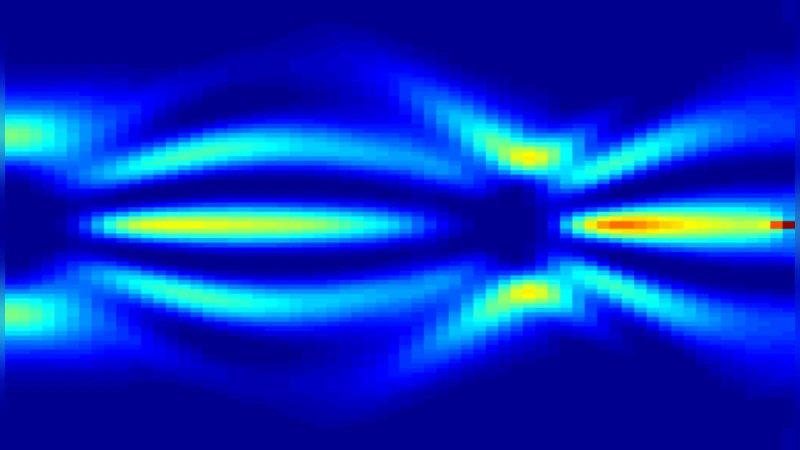
We study the collision of two Bose-Einstein condensates with pure dipolar interaction. A stationary pure dipolar condensate is known to be stable when the atom number is below a critical value. However, collapse can occur during the collision between two condensates due to local density fluctuations even if the total atom number is only a fraction of the critical value. Using full three-dimensional numerical simulations, we observe the collapse induced by local density fluctuations. For the purpose of future experiments, we present the time dependence of the density distribution, energy per particle and the maximal density of the condensate. We also discuss the collapse time as a function of the relative phase between the two condensates.
💡 Research Summary
The paper investigates the dynamical collapse that can occur when two Bose‑Einstein condensates (BECs) interacting solely through dipole‑dipole forces collide. In a static, harmonically trapped dipolar condensate, stability is guaranteed as long as the total atom number N remains below a critical value N_c; exceeding N_c leads to a global, mean‑field collapse. The authors ask whether a similar instability can be triggered dynamically even when the combined atom number is far below N_c, by exploiting the large local density fluctuations that naturally arise during a head‑on collision.
To answer this, they solve the three‑dimensional Gross‑Pitaevskii equation (GPE) with the full non‑local dipolar term. The initial state consists of two independent, ground‑state Gaussian wave packets, each containing N/2 atoms (with N ≪ N_c). The packets are accelerated toward each other in opposite directions, mimicking a controlled collision in free space. The GPE is integrated using a pseudo‑spectral method on a large cubic grid, ensuring that both the long‑range anisotropic dipolar interaction and the kinetic energy are accurately captured.
During the approach, the two wave functions overlap and generate an interference pattern. Where the interference is constructive, the local density can momentarily exceed the static critical density ρ_c associated with N_c, even though the total atom number is only a fraction of N_c. The dipolar mean‑field term, which scales as ρ, then becomes strongly attractive in those regions, precipitating a rapid, localized collapse. This collapse is not a uniform compression of the whole cloud; instead, it initiates in a small “hot spot” at the collision centre and then spreads outward, dramatically increasing the peak density ρ_max and the per‑particle energy just before the singularity forms.
A central finding is the pronounced dependence of the collapse time t_c on the relative phase φ between the two condensates. When φ = 0 (in‑phase), constructive interference maximizes the density spikes, leading to the earliest collapse (t_c ≈ 0.8 ms in the simulations). Conversely, φ = π (out‑of‑phase) produces destructive interference that suppresses the peak density, delaying collapse or preventing it altogether within the simulated time window. By scanning φ from 0 to 2π, the authors map out t_c(φ), which follows an approximately sinusoidal variation, confirming that phase control offers a practical knob for tuning the instability.
The authors also present time‑resolved diagnostics that would be directly accessible in experiments: (i) the spatial density distribution n(r,t), showing the emergence and growth of the high‑density filament; (ii) the total energy per particle E/N, which exhibits a sharp rise just before collapse due to the conversion of kinetic energy into interaction energy; and (iii) the maximal density ρ_max(t), which serves as a clear indicator of the onset of singular behavior. These quantities are plotted for several representative φ values, illustrating how the dynamical signatures differ with phase.
Beyond the immediate numerical results, the work carries broader implications. It demonstrates that the conventional static stability criterion based solely on total atom number is insufficient for dipolar gases in dynamical situations. Local density fluctuations can drive a system into an unstable regime even when the global parameters lie well within the stable domain. This insight is relevant for ongoing experiments with magnetic atoms (e.g., dysprosium, erbium) and polar molecules, where dipolar interactions dominate and controlled collisions are used to probe many‑body physics.
Finally, the paper outlines experimental pathways to verify the predictions. Time‑of‑flight imaging combined with phase‑contrast techniques could resolve the rapid density spikes, while phase imprinting via optical or microwave fields would allow precise setting of φ. The authors suggest that measuring the collapse time as a function of φ would provide a stringent test of the dipolar GPE model and could open routes to engineer controlled collapse for studies of quantum turbulence, droplet formation, or non‑equilibrium quantum phase transitions.
In summary, the study reveals that two colliding dipolar BECs can undergo a locally triggered collapse well below the static critical atom number, with the collapse timing exquisitely sensitive to the relative phase. The findings enrich our understanding of non‑local interactions in ultracold gases and propose concrete experimental diagnostics to observe and manipulate this intriguing dynamical instability.
Comments & Academic Discussion
Loading comments...
Leave a Comment