A topos for algebraic quantum theory
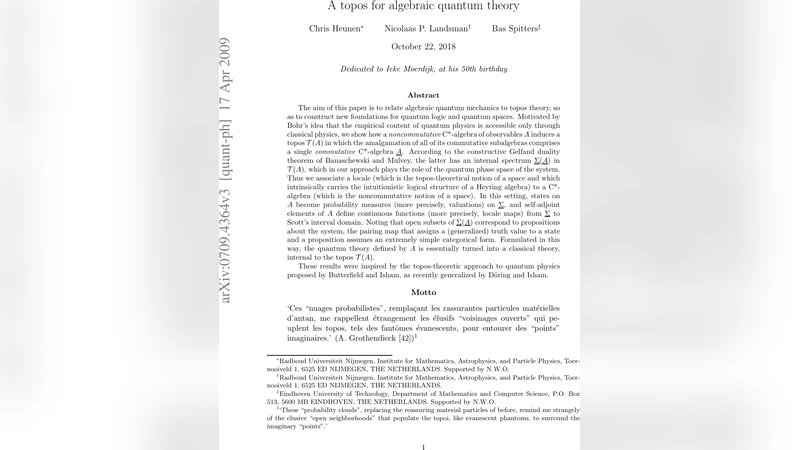
The aim of this paper is to relate algebraic quantum mechanics to topos theory, so as to construct new foundations for quantum logic and quantum spaces. Motivated by Bohr’s idea that the empirical content of quantum physics is accessible only through classical physics, we show how a C*-algebra of observables A induces a topos T(A) in which the amalgamation of all of its commutative subalgebras comprises a single commutative C*-algebra. According to the constructive Gelfand duality theorem of Banaschewski and Mulvey, the latter has an internal spectrum S(A) in T(A), which in our approach plays the role of a quantum phase space of the system. Thus we associate a locale (which is the topos-theoretical notion of a space and which intrinsically carries the intuitionistic logical structure of a Heyting algebra) to a C*-algebra (which is the noncommutative notion of a space). In this setting, states on A become probability measures (more precisely, valuations) on S(A), and self-adjoint elements of A define continuous functions (more precisely, locale maps) from S(A) to Scott’s interval domain. Noting that open subsets of S(A) correspond to propositions about the system, the pairing map that assigns a (generalized) truth value to a state and a proposition assumes an extremely simple categorical form. Formulated in this way, the quantum theory defined by A is essentially turned into a classical theory, internal to the topos T(A).
💡 Research Summary
The paper establishes a bridge between algebraic quantum mechanics and topos theory, offering a novel foundation for quantum logic and quantum spaces. Starting from a C*‑algebra A of observables, the authors consider the partially ordered set 𝒞(A) of all its commutative (unital) C*‑subalgebras, called “contexts”. By taking the presheaf topos 𝒯(A)=Set^{𝒞(A)^{op}} over this context category, they obtain a mathematical universe in which each context C is represented by the object C itself, yielding a single internal commutative C*‑algebra 𝔄 inside 𝒯(A).
Using the constructive Gelfand duality theorem of Banaschewski and Mulvey, the internal algebra 𝔄 is shown to be isomorphic to the algebra of continuous complex‑valued functions on an internal locale 𝕊(A). This locale, called the internal spectrum of A, plays the role of a quantum phase space. Unlike classical spectra, 𝕊(A) need not have points; its structure is entirely captured by its lattice of opens, which forms a Heyting algebra and thus carries intuitionistic logic.
States on A, traditionally positive linear functionals ω: A→ℂ, are reinterpreted as valuations ν_ω on the locale 𝕊(A). A valuation is a map from the Heyting algebra of opens L(𝕊(A)) to the subobject classifier Ω_{𝒯(A)} of the topos, assigning to each proposition (open set) a truth‑value that lives in the internal logic of 𝒯(A). Self‑adjoint elements a∈A correspond to internal continuous maps â: 𝕊(A)→𝕀, where 𝕀 is Scott’s interval domain (the locale of real intervals). For any real interval U⊂ℝ, the proposition “the value of a lies in U” is represented by the open â^{-1}(U)⊂𝕊(A), and its truth‑value in a state ω is simply ν_ω(â^{-1}(U)).
Thus the pairing ⟨state, proposition⟩ reduces to the categorical composition ν_ω∘â^{-1}, a remarkably simple expression compared with the traditional quantum‑logic approach based on projection lattices. Because all logical operations are performed inside the Heyting algebra of 𝕊(A), the resulting logic is distributive and intuitionistic, avoiding the non‑distributive complications of the standard quantum logic. In this sense the non‑commutative quantum theory described by A is “internalised” as a classical theory within the topos 𝒯(A).
The authors discuss several implications: (i) the topos‑theoretic framework respects Bohr’s doctrine of classical concepts by making every classical context explicit; (ii) the internal spectrum provides a genuine “space” for quantum systems, amenable to geometric reasoning; (iii) the valuation picture aligns naturally with probabilistic interpretations, since valuations are the locale‑theoretic analogue of measures; (iv) the approach suggests a pathway to incorporate dynamics (via internal automorphisms) and to extend to quantum field theory by considering nets of contexts.
In conclusion, the paper demonstrates that by moving to the appropriate topos, one can recast the algebraic structure of quantum mechanics into a setting where the logical, spatial, and probabilistic aspects become classical‑like, yet remain fully faithful to the original non‑commutative theory. This opens new avenues for both foundational investigations and potential applications in quantum computation, quantum gravity, and the study of contextuality.
Comments & Academic Discussion
Loading comments...
Leave a Comment