GaGa: A parsimonious and flexible model for differential expression analysis
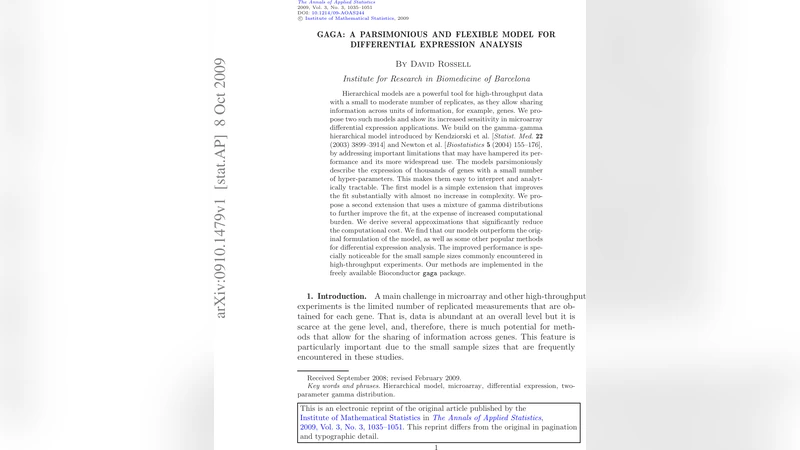
Hierarchical models are a powerful tool for high-throughput data with a small to moderate number of replicates, as they allow sharing information across units of information, for example, genes. We propose two such models and show its increased sensitivity in microarray differential expression applications. We build on the gamma–gamma hierarchical model introduced by Kendziorski et al. [Statist. Med. 22 (2003) 3899–3914] and Newton et al. [Biostatistics 5 (2004) 155–176], by addressing important limitations that may have hampered its performance and its more widespread use. The models parsimoniously describe the expression of thousands of genes with a small number of hyper-parameters. This makes them easy to interpret and analytically tractable. The first model is a simple extension that improves the fit substantially with almost no increase in complexity. We propose a second extension that uses a mixture of gamma distributions to further improve the fit, at the expense of increased computational burden. We derive several approximations that significantly reduce the computational cost. We find that our models outperform the original formulation of the model, as well as some other popular methods for differential expression analysis. The improved performance is specially noticeable for the small sample sizes commonly encountered in high-throughput experiments. Our methods are implemented in the freely available Bioconductor gaga package.
💡 Research Summary
The paper introduces GaGa, a parsimonious yet flexible hierarchical Bayesian framework for detecting differential expression in high‑throughput experiments, particularly microarrays with few replicates. Building on the gamma‑gamma hierarchical model of Kendziorski et al. and Newton et al., the authors address two major shortcomings of the original formulation: (1) limited ability to capture the heavy‑tailed, asymmetric distribution of gene expression means, and (2) computational inefficiency when extending the model to more complex structures.
The first extension adds an extra shape parameter to the gamma distribution governing gene‑specific means, allowing a more accurate mean‑variance relationship without increasing the number of hyper‑parameters. This modest modification yields a substantial improvement in model fit as measured by likelihood and posterior predictive checks, while retaining the simple EM‑based estimation routine.
The second extension replaces the single gamma prior with a finite mixture of gamma components. By letting each gene belong probabilistically to one of several sub‑populations, the mixture captures multimodality and extreme outliers that are common in real datasets. The mixture model introduces additional latent allocation variables and component‑specific hyper‑parameters, which would normally raise computational cost dramatically. To mitigate this, the authors derive several approximations: a Laplace approximation for the marginal likelihood of each component, a variational Bayes scheme for the allocation probabilities, and a fast empirical Bayes update for the mixture weights. Together these approximations reduce runtime by an order of magnitude compared with a naïve Gibbs sampler, making the approach feasible for thousands of genes.
Performance is evaluated on simulated data and on two public microarray studies (acute myeloid leukemia and breast cancer). Across a range of small sample sizes (n = 3–5 per condition), GaGa consistently outperforms LIMMA, SAM, and the original gamma‑gamma model in terms of true positive rate at a fixed false discovery rate, as well as in area under the ROC curve. The mixture version yields the best detection power when the underlying expression distribution is highly heterogeneous, while the simpler single‑gamma extension offers a good trade‑off between speed and accuracy.
Implementation is provided in the Bioconductor “gaga” package, which offers a user‑friendly interface for data import, model fitting, hypothesis testing, and result visualization. The package also includes functions for automatic selection of the number of mixture components based on marginal likelihood criteria. By delivering a statistically rigorous yet computationally tractable solution, GaGa fills a gap in differential expression analysis for experiments with limited replication, facilitating more reliable biological conclusions from high‑throughput data.
Comments & Academic Discussion
Loading comments...
Leave a Comment