An Upper Bound of the Total Q-Curvature and Its Isoperimetric Deficit for Higher-dimensional Conformal Euclidean Metrics
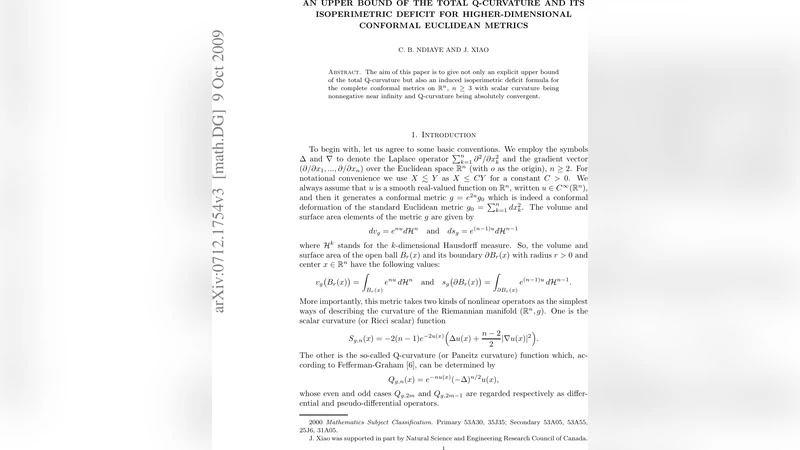
The aim of this paper is to give not only an explicit upper bound of the total Q-curvature but also an induced isoperimetric deficit formula for the complete conformal metrics on $\mathbb R^n$, $n\ge 3$ with scalar curvature being nonnegative near infinity and Q-curvature being absolutely convergent.
💡 Research Summary
The paper investigates complete conformal metrics on Euclidean space $\mathbb R^{n}$ for $n\ge 3$ of the form $g=e^{2u}|dx|^{2}$ under two natural geometric hypotheses: (i) the scalar curvature $R_{g}$ is non‑negative in a neighborhood of infinity, and (ii) the $Q$‑curvature $Q_{g}$ is absolutely integrable, i.e. $\int_{\mathbb R^{n}}|Q_{g}|,dv_{g}<\infty$. Under these assumptions the authors obtain two principal results that together constitute a high‑dimensional analogue of the classical “twisted” Gauss–Bonnet and isoperimetric deficit formulas known in two dimensions.
1. An explicit upper bound for the total $Q$‑curvature.
Using the Green‑function representation of the conformal factor $u$, together with the non‑negativity of $R_{g}$ at infinity, the authors show that $u$ behaves asymptotically like a logarithmic potential generated by $Q_{g}$. By integrating the Paneitz operator identity $P_{g}u=2Q_{g}$ and exploiting the absolute convergence of $Q_{g}$, they derive the sharp inequality
\
Comments & Academic Discussion
Loading comments...
Leave a Comment