Dynamics of Enzyme Digestion of a Single Elastic Fiber Under Tension: An Anisotropic Diffusion Model
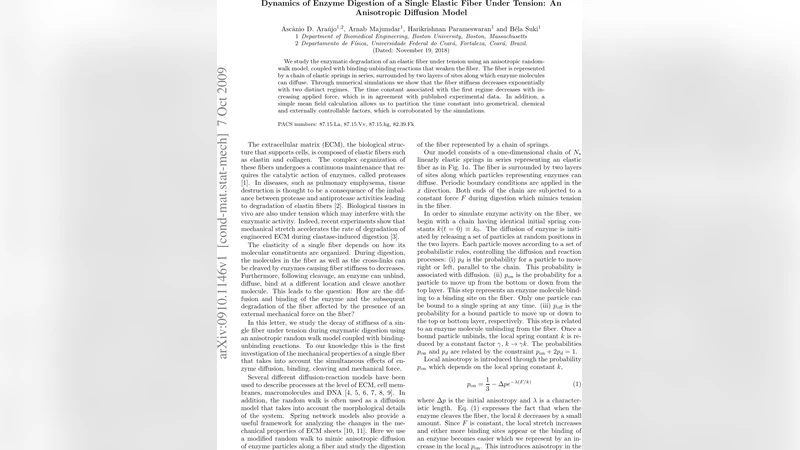
We study the enzymatic degradation of an elastic fiber under tension using an an isotropic random-walk model, coupled with binding-unbinding reactions that weaken the fiber. The fiber is represented by a chain of elastic springs in series, surrounded by two layers of sites along which enzyme molecules can diffuse. Through numerical simulations we show that the fiber stiffness decreases exponentially with two distinct regimes. The time constant associated with the first regime decreases with increasing applied force, which is in agreement with published experimental data. In addition, a simple mean field calculation allows us to partition the time constant into geometrical, chemical and externally controllable factors, which is corroborated by the simulations.
💡 Research Summary
The paper presents a mechanistic model for the enzymatic degradation of an elastic fiber that is subjected to a constant tensile load. The fiber is abstracted as a linear chain of identical elastic springs connected in series, each spring initially possessing the same stiffness k₀. Surrounding the fiber are two parallel layers of lattice sites that represent the extracellular space through which enzyme molecules diffuse. Enzyme motion on the lattice is implemented as a random walk; when an enzyme reaches a site adjacent to the fiber it may bind with probability proportional to the on‑rate constant k_on and the bulk enzyme concentration c. Once bound, the enzyme remains attached for a stochastic dwell time governed by an off‑rate k_off, after which it detaches and resumes diffusion. While bound, the enzyme reduces the stiffness of the underlying spring by a fixed fraction (k_decay), mimicking the local weakening caused by proteolytic cleavage of collagen or elastin fibers.
The authors perform kinetic Monte‑Carlo simulations in discrete time steps. At each step the positions of all enzymes are updated, binding/unbinding events are evaluated, and the stiffness of each spring is accordingly reduced. The global fiber stiffness K(t) is obtained by summing the inverse of the individual spring compliances (i.e., series combination). The simulation data reveal that K(t) decays as the sum of two exponentials: \
Comments & Academic Discussion
Loading comments...
Leave a Comment