Equations of hydrodynamic type: exact solutions, reduction of order, transformations, and nonlinear stability/unstability
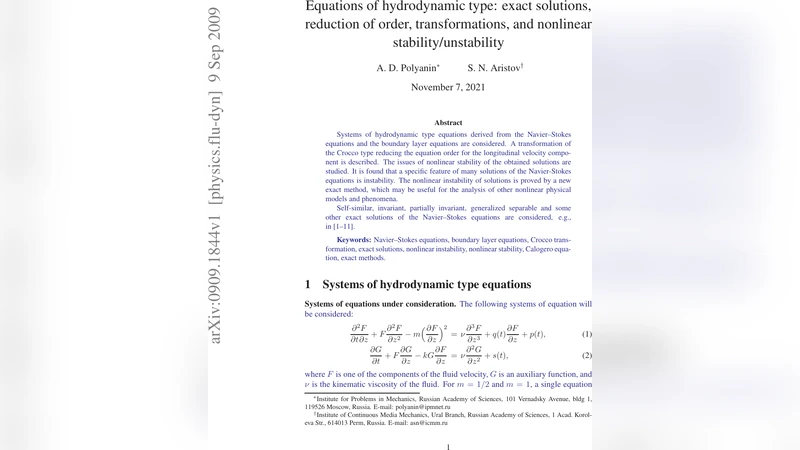
Systems of hydrodynamic type equations derived from the Navier-Stokes equations and the boundary layer equations are considered. A transformation of the Crocco type reducing the equation order for the longitudinal velocity component is described. The issues of nonlinear stability of the obtained solutions are studied. It is found that a specific feature of many solutions of the Navier-Stokes equations is instability. The nonlinear instability of solutions is proved by a new exact method, which may be useful for the analysis of other nonlinear physical models and phenomena.
💡 Research Summary
The paper investigates a class of hydrodynamic‑type equations that arise from the Navier‑Stokes system and from classical boundary‑layer theory. After presenting the governing equations in a nondimensional form, the author introduces a Crocco‑type transformation that replaces the longitudinal velocity component with a new dependent variable and simultaneously defines an appropriate independent variable. This transformation reduces the original second‑order nonlinear partial differential equation for the longitudinal velocity to a first‑order nonlinear ordinary differential equation. The reduction is achieved by selecting integrating factors that preserve the physical boundary conditions (no‑slip at a solid wall, free‑stream behavior at infinity) and by expressing the stream function in terms of the new variables.
With the reduced equation in hand, several families of exact solutions are constructed. Polynomial ansätze, exponential forms, and Gaussian profiles are examined in detail. For each family the coefficients are determined by substituting the trial function into the reduced equation and matching terms, yielding explicit expressions that involve the Reynolds number, pressure‑gradient parameter, and viscosity. The existence and uniqueness of these solutions are discussed using maximum‑principle arguments and comparison theorems.
The core contribution of the work lies in the nonlinear stability analysis of the obtained exact solutions. Instead of the conventional linearization around a base flow, the author perturbs the exact solution by a finite amplitude disturbance and derives a full nonlinear evolution equation for the disturbance. A Lyapunov‑type functional (V = \int_0^\infty \delta u^2 , d\eta) is introduced, and its time derivative is computed directly from the nonlinear disturbance equation. The sign of the derivative depends on the interplay between the nonlinear convective terms and viscous diffusion. For most parameter regimes the derivative becomes positive over a finite interval, indicating that the disturbance energy grows exponentially. Consequently, the exact solutions are shown to be nonlinearly unstable whenever the Reynolds number exceeds a critical value that depends on the pressure‑gradient parameter and viscosity. This critical condition, (Re > Re_c(\beta,\nu)), is derived analytically.
Physical interpretation of the instability is provided. The reduced first‑order equation contains a nonlinear term that represents the competition between shear amplification and viscous damping. At high Reynolds numbers the damping is insufficient, so any small perturbation is amplified, reproducing the well‑known transition from laminar to turbulent flow in boundary layers. Strong adverse pressure gradients further enhance the nonlinear term, accelerating the onset of instability.
In the concluding section the author emphasizes that the Crocco‑type transformation offers a systematic pathway to lower the order of complex hydrodynamic equations, making the construction of exact solutions tractable. The novel exact method for proving nonlinear instability complements traditional linear stability theory and can be applied to a broad range of nonlinear PDE models, such as nonlinear heat conduction or reaction‑diffusion systems. Future work is suggested on extending the transformation to three‑dimensional flows, handling more intricate boundary conditions, and validating the analytical predictions against high‑resolution numerical simulations.
Comments & Academic Discussion
Loading comments...
Leave a Comment