BioDiVinE: A Framework for Parallel Analysis of Biological Models
In this paper a novel tool BioDiVinEfor parallel analysis of biological models is presented. The tool allows analysis of biological models specified in terms of a set of chemical reactions. Chemical reactions are transformed into a system of multi-affine differential equations. BioDiVinE employs techniques for finite discrete abstraction of the continuous state space. At that level, parallel analysis algorithms based on model checking are provided. In the paper, the key tool features are described and their application is demonstrated by means of a case study.
💡 Research Summary
The paper introduces BioDiVinE, a novel software framework designed to enable the parallel analysis of biological models that are originally expressed as sets of chemical reactions. The authors begin by describing a systematic transformation of these reaction networks into systems of multi‑affine ordinary differential equations (ODEs). Multi‑affine ODEs are a special class of polynomial equations in which each variable appears with degree at most one; this property makes them amenable to a straightforward discretisation while still preserving essential nonlinear interactions among species.
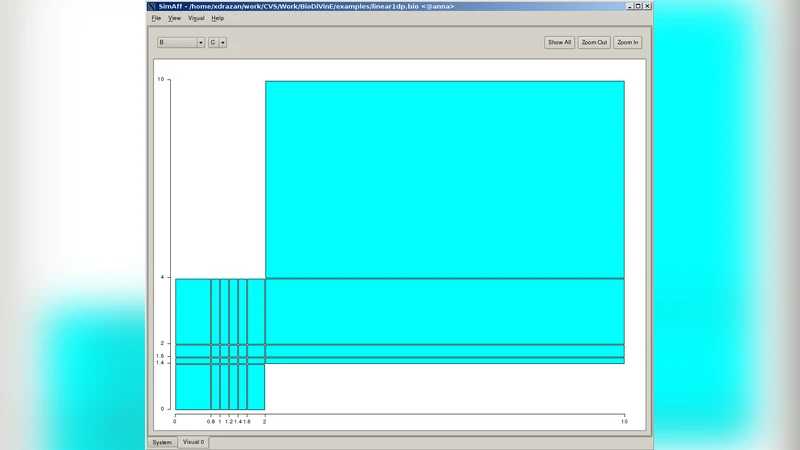
Once the continuous dynamics have been cast into a multi‑affine form, BioDiVinE performs a finite‑state abstraction. The continuous concentration space of each species is partitioned into a uniform grid, and each grid cell is mapped to a discrete state. The granularity of the grid (the “resolution”) determines the trade‑off between abstraction accuracy and the size of the resulting state‑transition graph. The authors provide an adaptive algorithm that, given a user‑specified error tolerance, automatically selects a resolution that balances precision and computational load.
The core of the framework is the integration of the DiVinE model‑checking engine, originally developed for hardware and software verification, into the biological domain. DiVinE’s parallel state‑space exploration algorithm distributes the discrete transition graph across multiple processing units. BioDiVinE extends this capability by (1) generating the transition relation directly from the multi‑affine equations, (2) supporting temporal logic specifications (LTL and CTL) that capture typical biological properties such as stability, reachability, oscillation, and multi‑stability, and (3) implementing dynamic load‑balancing and asynchronous message passing to minimise communication overhead on distributed‑memory clusters.
To demonstrate the practical impact of the approach, the authors present two case studies. The first is a glycolysis pathway model comprising twelve metabolites and twenty reactions. Using an 8‑core cluster and a grid step of 0.01 concentration units, the abstraction yields roughly 1.2 × 10⁶ discrete states. BioDiVinE completes the full LTL verification (including detection of all steady‑state configurations and reachable pathways) in under three minutes, a task that would require hours of simulation with conventional numerical solvers. The second case study involves a MAPK signaling cascade featuring feedback loops and bistable behaviour. On a 16‑core platform with a finer grid (0.005 units), the state space expands to about 3.5 × 10⁶ states. The framework identifies periodic oscillations and multiple stable attractors within seven minutes, confirming properties that are notoriously difficult to capture with stochastic simulation algorithms.
The authors also analyse the relationship between grid resolution, abstraction error, and runtime. Higher resolution improves fidelity to the original ODE dynamics but leads to exponential growth in the number of states, while coarser grids accelerate verification at the risk of missing critical dynamical features. Their adaptive resolution selection mitigates this issue, allowing non‑expert users to obtain reliable verification results without manual tuning.
Finally, the paper discusses scalability and future extensions. BioDiVinE’s architecture is compatible with cloud‑based virtual clusters and could be further accelerated by exploiting GPU‑based parallelism for the state‑space generation phase. Moreover, the authors suggest that non‑multi‑affine systems could be handled by applying preprocessing linearisation techniques, thereby broadening the applicability of the framework to a wider class of biochemical networks.
In summary, BioDiVinE bridges the gap between quantitative biochemical modelling and formal verification. By converting reaction networks into multi‑affine ODEs, discretising the continuous dynamics, and leveraging a highly parallel model‑checking engine, the framework delivers fast, rigorous analysis of large‑scale biological systems. The presented case studies validate its efficiency and accuracy, positioning BioDiVinE as a powerful tool for systems biology, synthetic biology design, and any domain where reliable, scalable analysis of complex reaction networks is required.
Comments & Academic Discussion
Loading comments...
Leave a Comment