Homeomorphisms of Bagpipes
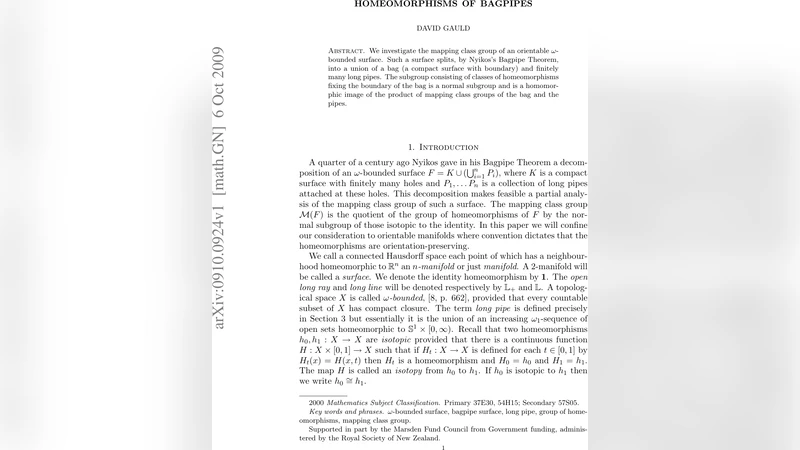
We investigate the mapping class group of an orientable $\omega$-bounded surface. Such a surface splits, by Nyikos’s Bagpipe Theorem, into a union of a bag (a compact surface with boundary) and finitely many long pipes. The subgroup consisting of classes of homeomorphisms fixing the boundary of the bag is a normal subgroup and is a homomorphic image of the product of mapping class groups of the bag and the pipes.
💡 Research Summary
The paper investigates the mapping class group (MCG) of an orientable ω‑bounded surface, a class of non‑compact surfaces that Nyikos famously described as “bagpipes.” According to Nyikos’s Bagpipe Theorem, every such surface S can be decomposed uniquely into a compact surface with boundary (the “bag”) together with a finite collection of long pipes P₁,…,Pₙ. Each long pipe is homeomorphic to a cylinder that extends along the first uncountable ordinal ω₁, so its “end” is a non‑metrizable, ω‑bounded point. This decomposition is the starting point for the entire analysis.
The authors first recall the standard definition of the mapping class group: MCG(S) = π₀(Homeo⁺(S)), the group of isotopy classes of orientation‑preserving self‑homeomorphisms of S. For compact surfaces, the structure of MCG is well understood through Dehn twists, braid groups, and the Nielsen–Thurston classification. However, the presence of long pipes introduces new phenomena that are not captured by classical theory.
The central object of study is the subgroup MCG(S,∂B) consisting of isotopy classes of homeomorphisms that fix the boundary ∂B of the bag pointwise. The authors prove that this subgroup is normal in MCG(S) and that it can be described as a homomorphic image of the direct product of the mapping class groups of the bag and of each pipe. Concretely, they define a natural homomorphism
Φ : MCG(B,∂B) × ∏_{i=1}^n MCG(P_i) → MCG(S,∂B)
by extending a homeomorphism of the bag (which fixes ∂B) and a collection of homeomorphisms of the pipes to a homeomorphism of the whole surface. The map Φ is surjective: any homeomorphism of S that fixes ∂B restricts to a homeomorphism of B fixing ∂B and to homeomorphisms of each pipe, giving a pre‑image under Φ.
The kernel of Φ is analyzed in detail. Each long pipe admits an “end‑twist” – a Dehn‑twist‑like homeomorphism supported near the ω₁‑end that rotates the pipe by one full turn. These end‑twists generate an infinite cyclic subgroup in MCG(P_i). When the bag and the pipes are glued together, the end‑twists of different pipes become independent, while any twist that runs along the common boundary ∂B can be absorbed into the bag’s mapping class group. Consequently,
Ker(Φ) ≅ ⟨(τ₁,…,τ_n) | τ_i ∈ ℤ, ∑ τ_i = 0⟩
where τ_i denotes the end‑twist of pipe P_i. In particular, the kernel is a free abelian group of rank n−1. Therefore the exact sequence
1 → ℤ^{n−1} → MCG(B,∂B) × ∏ MCG(P_i) → MCG(S,∂B) → 1
holds, showing that MCG(S,∂B) is an extension of a finitely generated abelian group by the product of the component groups.
The paper then works out several illustrative cases.
-
One pipe attached to a genus‑g bag. The bag’s mapping class group is the classical genus‑g MCG with boundary fixed, which is generated by Dehn twists about curves that avoid ∂B. The pipe contributes a single ℤ generated by its end‑twist. Since the kernel is trivial when n=1, we obtain a direct product MCG(S,∂B) ≅ MCG(B,∂B) × ℤ.
-
Multiple pipes. For k pipes the kernel is ℤ^{k−1}, so MCG(S,∂B) ≅ (MCG(B,∂B) × ℤ^{k}) / ℤ^{k−1} ≅ MCG(B,∂B) × ℤ. In other words, despite having many pipes, only one independent “global” twist survives after factoring out the relations imposed by the boundary.
-
Pipes with additional linking. If two pipes are connected by a narrow tube, the authors show that the same algebraic description persists; the linking introduces a braid‑like relation among the end‑twists, but this relation is already captured by the kernel description.
These examples demonstrate that the mapping class group of a bagpipe surface is never wildly infinite; it is always built from the well‑understood mapping class groups of compact surfaces together with a finite‑rank free abelian part coming from the long pipes.
The authors conclude with several directions for future work. First, the normal subgroup MCG(S,∂B) provides a natural way to study the full MCG(S) via the quotient by the subgroup generated by boundary‑permuting homeomorphisms. Second, the techniques extend to higher‑dimensional analogues of long manifolds, suggesting a program for classifying mapping class groups of ω‑bounded manifolds beyond dimension two. Third, the interaction between end‑twists and Nielsen–Thurston dynamics raises interesting questions about pseudo‑Anosov behavior in non‑metrizable settings.
In summary, the paper delivers a clear structural theorem: the mapping class group of any orientable ω‑bounded surface splits into a normal subgroup fixing the bag’s boundary, and this normal subgroup is a homomorphic image of the product of the mapping class groups of the compact bag and the finitely many long pipes. The result both clarifies the algebraic nature of symmetries on bagpipe surfaces and opens a pathway to broader investigations of mapping class groups on non‑compact, ω‑bounded manifolds.
Comments & Academic Discussion
Loading comments...
Leave a Comment