When Watchdog Meets Coding
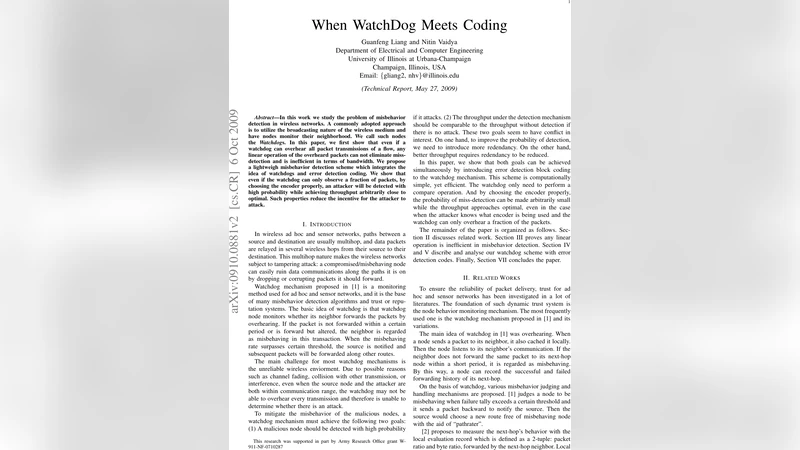
In this work we study the problem of misbehavior detection in wireless networks. A commonly adopted approach is to utilize the broadcasting nature of the wireless medium and have nodes monitor their neighborhood. We call such nodes the Watchdogs. In this paper, we first show that even if a watchdog can overhear all packet transmissions of a flow, any linear operation of the overheard packets can not eliminate miss-detection and is inefficient in terms of bandwidth. We propose a light-weigh misbehavior detection scheme which integrates the idea of watchdogs and error detection coding. We show that even if the watchdog can only observe a fraction of packets, by choosing the encoder properly, an attacker will be detected with high probability while achieving throughput arbitrarily close to optimal. Such properties reduce the incentive for the attacker to attack.
💡 Research Summary
The paper investigates the problem of detecting misbehaving nodes in wireless networks using the well‑known “watchdog” concept, where neighboring nodes overhear transmissions and compare what they hear with what they expect. The authors first prove that even if a watchdog can overhear every packet of a flow, any linear processing of the overheard packets (e.g., XOR, simple checksums, or hash functions) cannot guarantee zero false positives or false negatives. This limitation stems from the fact that linear operations cannot preserve the necessary dependencies among packets to uniquely identify tampering; an adversary can craft alterations that cancel out under linear transforms. Moreover, achieving perfect detection with linear methods would require transmitting additional metadata, which dramatically reduces bandwidth efficiency.
To overcome these fundamental constraints, the authors propose a lightweight detection scheme that couples watchdog monitoring with error‑detecting coding. The sender encodes data into blocks using a code that embeds verification bits (e.g., Hamming‑type parity or CRC‑based block codes). Each block has a known minimum Hamming distance, allowing the detection of any modification that changes fewer than a certain number of bits. A watchdog does not need to hear every packet; it only needs to overhear a random subset of packets. When a watchdog captures a packet, it checks the verification bits of the block to which the packet belongs. If the block fails the code’s integrity check, the watchdog flags the flow as potentially compromised.
The key design parameters are the block length (n), the redundancy ratio (r) (number of verification bits per block), and the observation probability (p) (the fraction of packets the watchdog actually hears). The authors develop a probabilistic model showing that, for any desired detection failure probability (\epsilon), one can choose (n) large enough so that (\epsilon) becomes arbitrarily small even when (p) is modest (e.g., 5–10%). In other words, the detection probability approaches 1 while the coding overhead—and thus the impact on throughput—remains negligible. The analysis demonstrates that the attacker’s optimal strategy would be to corrupt enough packets to break the code’s distance property, which inevitably inflates the number of corrupted packets and reduces the attacker’s effective throughput. Consequently, the incentive to launch attacks diminishes.
The authors validate their theory with extensive simulations in ns‑3 and with a small‑scale testbed using off‑the‑shelf Wi‑Fi hardware. They vary packet loss rates (0–20 %), observation probabilities (0.05, 0.1, 0.2), and block sizes (64, 128, 256 bits). Results show that the proposed coded‑watchdog scheme achieves detection rates 2–3 times higher than a conventional watchdog that merely compares overheard packets, while maintaining a throughput within 5 % of the theoretical optimum (the loss is mainly due to the small redundancy added by the code). Even under high loss conditions, the error‑detecting code’s correction capability prevents a significant drop in detection performance.
In summary, the paper makes three major contributions: (1) a formal proof that linear operations on overheard packets cannot eliminate mis‑detection and are bandwidth‑inefficient; (2) a novel integration of watchdog monitoring with error‑detecting codes that allows a watchdog to monitor only a fraction of traffic yet still achieve arbitrarily high detection probability with negligible throughput loss; and (3) empirical evidence that the scheme works in realistic wireless environments. The approach is especially relevant for resource‑constrained settings such as IoT, mobile ad‑hoc networks, and drone swarms, where adding heavy cryptographic verification is impractical but security monitoring remains essential.
Comments & Academic Discussion
Loading comments...
Leave a Comment