A new method for the construction of classical integrable systems, that we call loop coproduct formulation, is presented. We show that the linear r-matrix formulation, the Sklyanin algebras and the reflection algebras can be obtained as particular subcases of this framework. We comment on the possible generalizations of the r-matrix formalism introduced through this approach.
Deep Dive into Generalization of the linear r-matrix formulation through Loop coproducts.
A new method for the construction of classical integrable systems, that we call loop coproduct formulation, is presented. We show that the linear r-matrix formulation, the Sklyanin algebras and the reflection algebras can be obtained as particular subcases of this framework. We comment on the possible generalizations of the r-matrix formalism introduced through this approach.
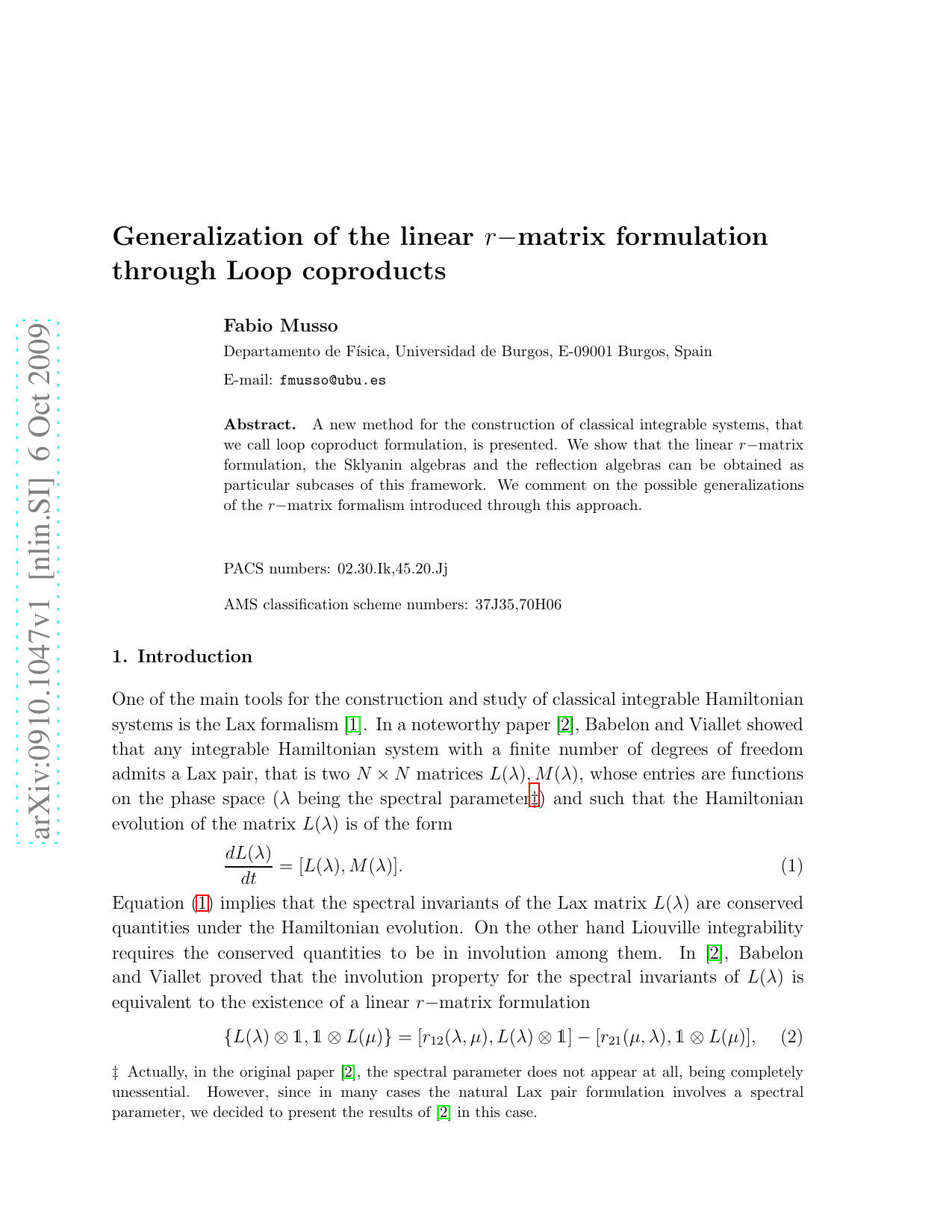
One of the main tools for the construction and study of classical integrable Hamiltonian systems is the Lax formalism [1]. In a noteworthy paper [2], Babelon and Viallet showed that any integrable Hamiltonian system with a finite number of degrees of freedom admits a Lax pair, that is two N × N matrices L(λ), M(λ), whose entries are functions on the phase space (λ being the spectral parameter ‡) and such that the Hamiltonian evolution of the matrix L(λ) is of the form
Equation (1) implies that the spectral invariants of the Lax matrix L(λ) are conserved quantities under the Hamiltonian evolution. On the other hand Liouville integrability requires the conserved quantities to be in involution among them. In [2], Babelon and Viallet proved that the involution property for the spectral invariants of L(λ) is equivalent to the existence of a linear r-matrix formulation
‡ Actually, in the original paper [2], the spectral parameter does not appear at all, being completely unessential. However, since in many cases the natural Lax pair formulation involves a spectral parameter, we decided to present the results of [2] in this case.
where L(λ) is an N × N matrix, r 12 (λ, µ) is an N 2 × N 2 matrix, 1 is the N × N identity matrix and r 21 (λ, µ) = Π r 12 (λ, µ)Π, with Π being the permutation operator Π(x ⊗ y) = y ⊗ x, ∀x, y ∈ C N . Moreover, they showed that if the Lax matrix satisfies the equation ( 2), then the equation of motions associated with any of the spectral invariants of L(λ) admits a Lax representation of the form (1).
In this paper we present a generalization (in a sense that we will make more precise later) of the linear r-matrix formalism that we call loop coproduct formulation. A preliminary version of this approach has been presented in [3], as a generalization of both the Gaudin algebras (see [4] and references therein) and the coproduct method [5], (see [6] for a recent review on the subject). Here we present a more general formulation encompassing the linear r-matrix formulation [2], the Sklyanin algebras [7] and also the reflection equation algebra [8]. While all these cases emerge as examples of the loop coproduct formulation applied to the Lie-Poisson algebra F (gl(N) * ), the loop coproduct formalism is defined for arbitrary Poisson algebras. We think that the implementation of this approach to non-linear Poisson algebras could lead to new examples of integrable systems and represents an interesting open problem in the field of classical finite-dimensional integrable systems.
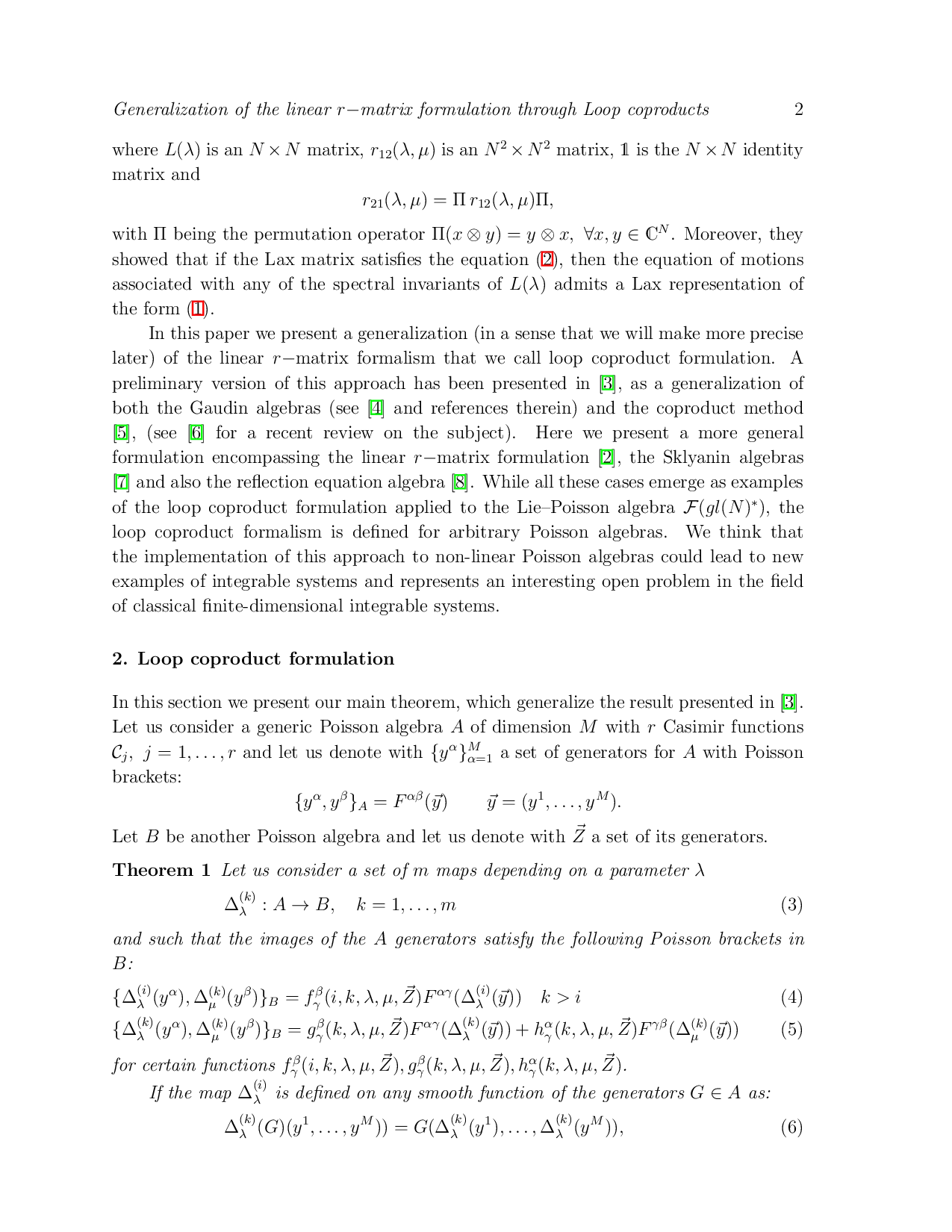
In this section we present our main theorem, which generalize the result presented in [3]. Let us consider a generic Poisson algebra A of dimension M with r Casimir functions C j , j = 1, . . . , r and let us denote with {y α } M α=1 a set of generators for A with Poisson brackets:
Let B be another Poisson algebra and let us denote with Z a set of its generators.
Theorem 1 Let us consider a set of m maps depending on a parameter λ
and such that the images of the A generators satisfy the following Poisson brackets in B:
for certain functions
λ is defined on any smooth function of the generators G ∈ A as:
then:
Proof:
Let us prove first the equation (7). We fix an arbitrary Casimir C j of A. Since C j is a Casimir function, for any β we must have:
Now we use this equation together with (4) to prove equation (7):
From equation
so that only the case k = i remains to be proven. In this case:
By using equation ( 5) and (9), we have:
since the terms in parentheses vanish, which completes the proof.
We will call the maps (3) satisfying equations ( 4) and ( 5) “loop coproducts” and we will say that the integrable systems that can be obtained from equations (7),( 8) “admit a loop coproduct formulation”.
Let us now show that the linear r-matrix formulation ( 2) is a subcase of the loop coproduct formulation. In order to prove this result, let us take A as the Lie-Poisson algebra F (gl(N) * ), with the standard set of generators {e ij }, i, j = 1, . . . , N:
The Poisson algebra B will be the one on which the r-matrix formulation (2) is defined.
The map ∆ λ : A → B is defined on the A generators as
and is extended to an arbitrary element of A through equation ( 6). Let us denote with E ij the canonical gl(N) matrix generators
and let us compute the Poisson bracket (5) in this case:
On the other hand, the right hand side of the equation ( 5), with the choices (10) and (11), is given by:
and ( 13) coincides with the last line of (12) when
Let us stress that the r-matrix in equation ( 14) can be of dynamical type, since the functions g kl ab and h ij ab are arbitrary functions of the B manifold coordinates. We also point out that the images of the F (gl(N) * ) Casimirs C i , i = 1, . . . , N under the loop coproduct (11) coincide with the spectral invariants of the Lax matrix L(λ):
When the r-matrix is non-dynamical and unitary (r 12 (λ, µ) = r(λµ) = -r 21 (µ, λ)), then equation ( 2) reduces to
and defines the
…(Full text truncated)…
This content is AI-processed based on ArXiv data.