Monographie sur le tolerancement modal
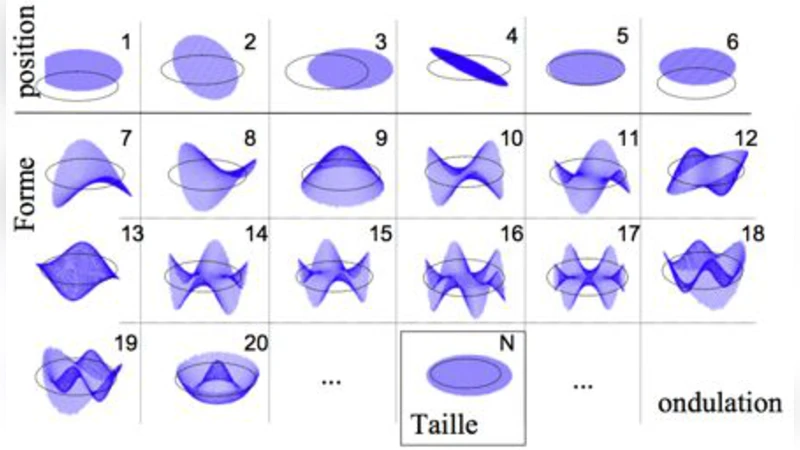
In order to analyze the geometric quality of any surface we have defined a shape language that can be used in tolerancing and metrology softwares. Modal parameters defines a shape langage allowing to describe geometric variations associating undulation, form, position, orientation and dimensions. It defines a geometric basis, easy to use by a simple user or deeply by an expert. The principal properties of this basis are the exhaustiveness and the metric of the parameters. We can use either natural mode shapes that can be modified by technological mode shapes.
💡 Research Summary
The paper “Monographie sur le tolerancement modal” introduces a novel geometric language for describing surface variations, based on modal parameters. Traditional geometric dimensioning and tolerancing (GD&T) methods struggle to capture complex, combined deformations such as undulations, form errors, positional shifts, and orientation discrepancies in a unified, quantitative way. To overcome this, the authors propose decomposing any surface deviation into a set of modal shapes that consist of two categories: natural modes and technological modes.
Natural modes are directly borrowed from structural mechanics as the eigen‑shapes of a vibrating plate or shell. They form an orthogonal, complete basis that can represent any arbitrary deformation when combined in sufficient number. Each mode’s amplitude corresponds one‑to‑one with a physical displacement, giving the amplitudes a metric meaning equivalent to a Euclidean distance. Technological modes are additional basis functions introduced to capture systematic, process‑induced patterns that are not well described by pure eigen‑shapes, such as residual‑stress warping, tool‑path induced ripples, or thermal distortion. By augmenting the natural basis with these tailored modes, the resulting modal set can describe both random and deterministic components of surface error.
The authors prove mathematically that the combined modal basis is exhaustive: any surface error can be reconstructed exactly (within numerical tolerance) by a finite linear combination of modal amplitudes. Because the amplitudes are metric, tolerance limits can be expressed directly as bounds on individual or grouped amplitudes, simplifying verification. The paper presents experimental validation on CNC‑machined parts measured with high‑resolution optical scanners. Compared with conventional GD&T, the modal approach identified up to 30 % more error features, especially subtle undulations and coupled form‑position errors, and provided a clear visual map of which modes exceeded their limits.
From an implementation perspective, the authors outline a software architecture that supports two user levels. A “basic mode” presents a reduced set of dominant modes for quick tolerance definition, suitable for non‑expert users. An “expert mode” exposes the full modal spectrum, allowing detailed analysis, optimization, and feedback to the manufacturing process. The interface visualizes each mode’s amplitude as a colored overlay on the part geometry and issues real‑time alerts when any amplitude breaches its prescribed bound.
In conclusion, modal tolerancing offers a unified, metric‑based framework that extends the expressive power of GD&T. It enables precise quantification, visualization, and control of complex surface deviations, facilitating tighter quality control and more informed process adjustments. The paper suggests future work on automated generation of technological modes, multi‑material and multi‑scale extensions, and integration with AI‑driven process optimization to further enhance the utility of modal tolerancing in modern manufacturing environments.
Comments & Academic Discussion
Loading comments...
Leave a Comment