On perturbations of continuous maps
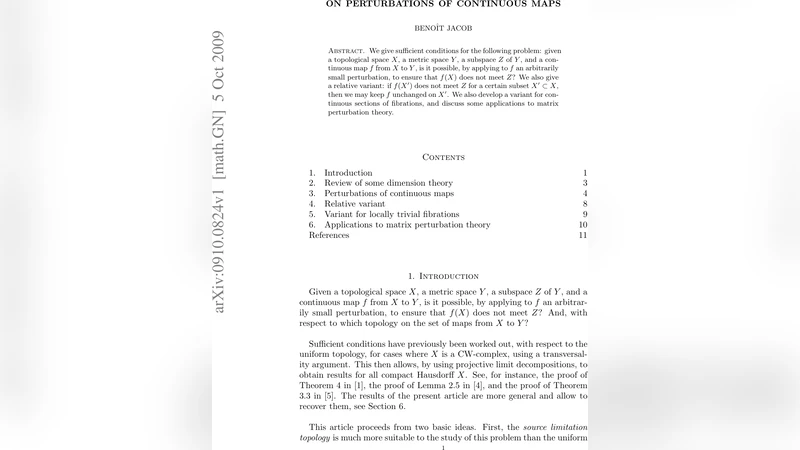
We give sufficient conditions for the following problem: given a topological space X, a metric space Y, a subspace Z of Y, and a continuous map f from X to Y, is it possible, by applying to f an arbitrarily small perturbation, to ensure that f(X) does not meet Z? We also give a relative variant: if f(X’) does not meet Z for a certain subset X’ of X, then we may keep f unchanged on X’. We also develop a variant for continuous sections of fibrations, and discuss some applications to matrix perturbation theory.
💡 Research Summary
The paper addresses a classical problem in topology and analysis: given a continuous map f from a topological space X to a metric space Y, and a distinguished closed subset Z ⊂ Y, can one perturb f by an arbitrarily small amount so that the perturbed map g avoids Z (i.e., g(X)∩Z=∅)? The authors develop a comprehensive set of sufficient conditions, a relative version that keeps the map fixed on a prescribed subset of X, and an extension to continuous sections of fibrations. They also illustrate how the abstract results translate into concrete statements in matrix perturbation theory.
The main setting assumes that X is a normal (i.e., T4) topological space, Y is a complete metric space, and Z is a closed subset of Y. The key technical tool is the distance function d_Z(y)=dist(y,Z), which is continuous on Y. For a given f, the composition d_Z∘f measures how close the image of f gets to Z. The central theorem (Theorem 3.1) states that if Z has empty interior in Y (or, more generally, is nowhere dense), then for any ε>0 there exists a continuous map g:X→Y with sup_{x∈X} dist(f(x),g(x))<ε and g(X)∩Z=∅. The proof proceeds by covering X with a locally finite family of open sets on which f is slightly “pushed away” from Z using small bump functions. Normality provides a partition of unity that glues the local modifications together while preserving continuity and the ε‑closeness. Completeness of Y ensures that the distance function behaves well under these perturbations.
A relative version (Theorem 4.2) is proved: if a closed (or open) subset X’⊂X already satisfies f(X’)∩Z=∅, then the perturbation can be performed entirely on X\X’ so that g|{X’}=f|{X’}. The construction introduces a “buffer” function that interpolates between the unchanged part and the perturbed part, again relying on normality.
The authors then turn to fibrations p:E→B with a continuous section s:B→E. For a closed sub‑section Z⊂E, Theorem 5.1 shows that one can ε‑perturb s to a new section s’ that avoids Z, while optionally keeping s’ identical to s on a prescribed sub‑base B’⊂B. The argument applies the previous pointwise perturbation fiberwise and uses the continuity of the fibration to assemble a global section. This result has immediate implications for vector bundles: it yields conditions under which a bundle admits a nowhere‑zero continuous section after an arbitrarily small adjustment.
In the final substantive section the abstract theory is applied to matrix perturbation. Let M_n(ℂ) be equipped with the operator norm, and let Z be the set of singular matrices (determinant zero). For any continuous map A:X→M_n(ℂ) and any ε>0, the authors construct a continuous map B:X→M_n(ℂ) with sup_{x}‖A(x)−B(x)‖<ε such that B(x) is invertible for all x. This provides a topological justification for the common practice of adding a tiny perturbation to avoid singularities in numerical linear algebra, control theory, and quantum mechanics. The paper also discusses limitations: if Z is dense in Y (e.g., the set of matrices with a prescribed eigenvalue is dense), the general perturbation result fails, and counterexamples are presented.
The concluding section outlines possible extensions. The normality hypothesis could be weakened to complete regularity or metacompactness, and one might replace the metric on Y by a more general uniform structure. Dynamic scenarios where Z varies with time, stochastic perturbations, and applications to infinite‑dimensional Banach bundles are suggested as promising directions.
Overall, the work provides a unified framework for “avoiding” closed subsets via arbitrarily small continuous perturbations, bridging abstract topological methods with concrete problems in matrix analysis and bundle theory.
Comments & Academic Discussion
Loading comments...
Leave a Comment