Self-similarity properties in a queuing network model
In this paper a model of subscriber telephone network based on the concept of cellular automata is elaborated. Some fractal properties inherent in the model are revealed that vary depending on parameters assigning its operation rules. The main advantage of the model in question is its compatibility with algorithmic methods - a finite set of formal rules, assigned on a finite set of elements (cells), allows precise realization in the form of algorithms.
💡 Research Summary
The paper presents a cellular automaton (CA) model of a subscriber telephone network and investigates the presence of self‑similar (fractal) properties in the dynamics of the number of active (busy) cells. Each cell represents a telephone subscriber who, at random times governed by an exponential inter‑call interval with rate λ, attempts to call one of its eight Moore‑neighbour cells. If the called subscriber is idle, a connection is established and lasts for a random duration drawn from an exponential distribution with rate µ; otherwise the call is rejected and the caller retries in the next CA cycle. The model is implemented on a 15 × 15 lattice, but experiments show that increasing the lattice size does not materially affect the observed dynamics, indicating scale‑independence.
The primary output of the simulation is Z(t), the number of cells in the busy state at each discrete time step. Time series of Z exhibit fluctuations around a mean value that do not decay, suggesting a form of deterministic chaos rather than simple stochastic noise. To test for self‑similarity, the authors apply the rescaled range (R/S) analysis originally introduced by Hurst. For each series they compute the cumulative deviation Xₙ, the range R = max Xₙ – min Xₙ, and the standard deviation S, then examine the scaling relationship R/S ∝ Nᴴ, where N is the series length and H is the Hurst exponent. A log‑log plot of R/S versus N yields a straight line, confirming power‑law scaling.
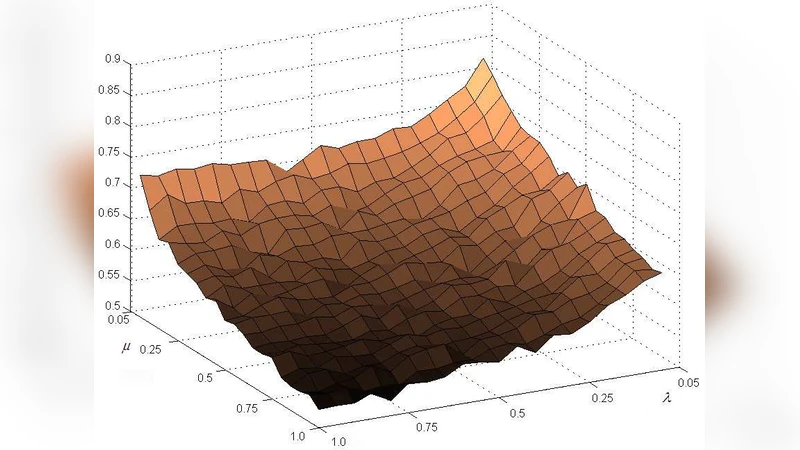
For the parameter set λ = 0.07, µ = 0.03 the estimated Hurst exponent is H ≈ 0.69, indicating persistent behavior (H > 0.5). When λ is increased or µ decreased—i.e., when calls occur more frequently and last longer—the Hurst exponent rises further, reflecting stronger long‑range dependence. Conversely, for some parameter combinations H approaches 0.5, suggesting near‑random behavior. The authors repeat the experiments over 40 independent realizations for each (λ, µ) pair, obtaining stable averages of H and confirming the systematic dependence on the model parameters.
These findings provide a simple, algorithmic explanation for the self‑similarity observed in real teletraffic, especially in modern networks where multimedia sessions increase average call duration. The CA framework reproduces the increase of the Hurst exponent with longer average holding times, mirroring empirical studies of Ethernet and web traffic. Moreover, the model’s simplicity—finite rules applied to a finite set of cells—makes it attractive for rapid prototyping and for exploring the impact of different routing or call‑generation policies without resorting to heavyweight queueing simulations.
In conclusion, the study demonstrates that a minimal CA representation of a telephone network can generate time series with clear fractal characteristics, and that the degree of self‑similarity is controllable via the fundamental traffic parameters λ and µ. This insight bridges the gap between microscopic call dynamics and macroscopic traffic patterns, offering a valuable tool for network designers and researchers interested in long‑range dependence, capacity planning, and quality‑of‑service analysis.
Comments & Academic Discussion
Loading comments...
Leave a Comment