Inverse scattering transform for the Toda hierarchy with steplike finite-gap backgrounds
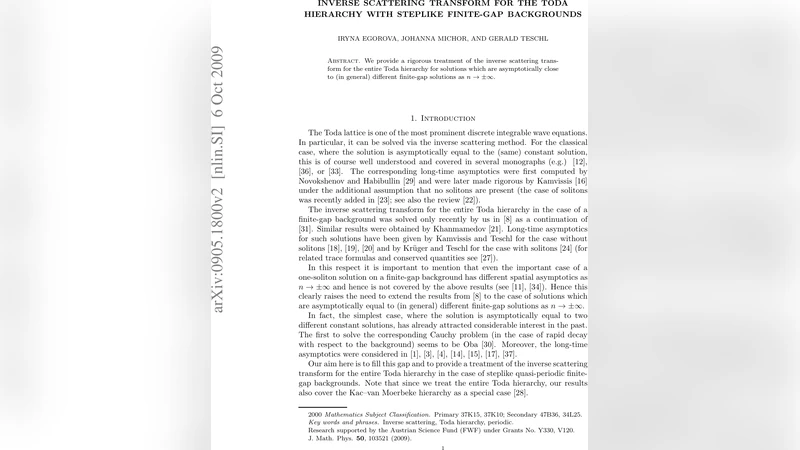
We provide a rigorous treatment of the inverse scattering transform for the entire Toda hierarchy for solutions which are asymptotically close to (in general) different finite-gap solutions as $n\to\pm\infty$.
💡 Research Summary
The paper presents a rigorous formulation of the inverse scattering transform (IST) for the full Toda hierarchy in the setting where the lattice variables approach, as the site index n tends to plus or minus infinity, two generally distinct finite‑gap quasi‑periodic solutions. This “steplike” configuration extends the classical IST, which has traditionally been limited to either constant backgrounds or a single finite‑gap background, and thereby addresses a class of problems that naturally arise in physical applications where different asymptotic media are present on the left and right of a lattice.
The authors begin by recalling the Lax pair (L, B) for the Toda hierarchy on the doubly‑infinite lattice ℤ. For each asymptotic end they construct the associated hyperelliptic Riemann surface, the corresponding Baker‑Akhiezer function, and the Jost solutions that match the finite‑gap background at +∞ and –∞ respectively. These Jost solutions satisfy a Wronskian relation that yields a transmission matrix T(z) linking the two Riemann surfaces and reflection coefficients R±(z) defined on the continuous spectrum. Because the two backgrounds generally have different band structures, the continuous spectrum consists of overlapping and non‑overlapping intervals, leading to a transmission matrix that encodes a non‑trivial monodromy across multiple branch cuts.
A detailed spectral analysis shows that the scattering data—reflection coefficients, transmission coefficient, and norming constants for any discrete eigenvalues—obey the expected symmetries (complex conjugation on the real axis) and the unitarity relation |T(z)|² + |R±(z)|² = 1 on each part of the continuous spectrum. The authors prove that the reflection coefficients acquire phase shifts determined by the differing finite‑gap backgrounds, while the transmission coefficient remains analytic across the whole spectrum except at the branch points.
The core of the IST is the Marchenko integral equation adapted to the steplike situation. The kernel splits naturally into contributions from the left and right backgrounds, each expressed in terms of the corresponding Baker‑Akhiezer functions and the scattering data. By solving this coupled system the authors reconstruct the lattice variables aₙ(t) and bₙ(t) from the scattering data at any fixed time. The reconstruction formula explicitly contains the phase‑correction terms that arise from the mismatch of the two Riemann surfaces, thereby generalizing the classical Gel’fand‑Levitan theory to the steplike finite‑gap case.
Time evolution is handled via the Lax equation ∂ₜL =
Comments & Academic Discussion
Loading comments...
Leave a Comment