Ab initio investigation of the groundstate, electronic, and optical properties of polyyne and cumulene prototypes
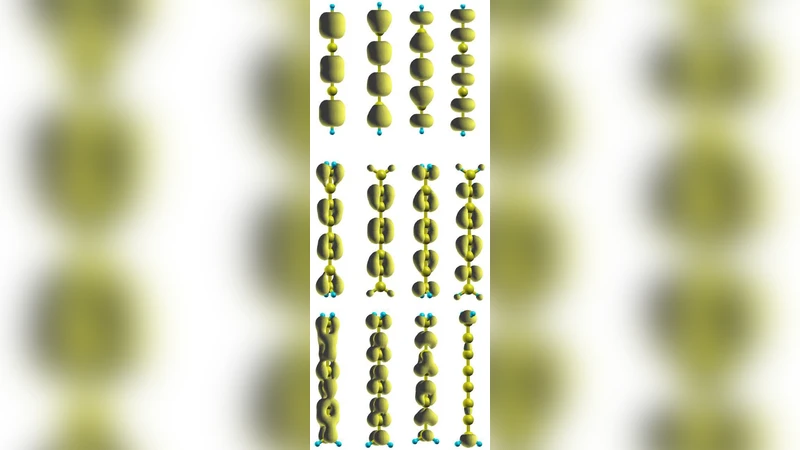
We have investigated polyyne and cumulene prototypes based on the density-functional theory. Our independent-particle spectra show that the various carbynes can be distinguished by optical properties comparing the low-energy spectral structure as well as using very general considerations. The latter conclusion is supported by results based on the random-phase approximation including local-field effects.
💡 Research Summary
The paper presents a comprehensive first‑principles study of two prototypical carbon‑only one‑dimensional chains—polyyne (alternating single‑triple bonds) and cumulene (consecutive double bonds). Using density‑functional theory (DFT) with the generalized gradient approximation (GGA‑PBE) the authors first relax the atomic geometries of finite‑length model systems. Polyyne adopts a bond‑length alternation of roughly 1.20 Å (short) and 1.38 Å (long), reflecting the classic Peierls‑type distortion, whereas cumulene retains an almost uniform C–C distance of about 1.31 Å and exhibits the high‑symmetry D∞h point group.
Electronic structure calculations reveal a clear distinction: polyyne shows a direct band gap of ~0.78 eV, with the valence‑band maximum (VBM) derived from π states and the conduction‑band minimum (CBM) from π* states. This gap implies semiconducting behavior and a relatively localized charge distribution along the chain. In contrast, cumulene possesses a very small gap (<0.2 eV), essentially behaving as a quasi‑metal; its density of states (DOS) is smoother and the π‑π* manifold is nearly continuous.
Optical properties are explored through two complementary approaches. First, an independent‑particle (IP) calculation based on Kohn‑Sham transitions yields absorption spectra that already differentiate the two systems. Polyyne exhibits a pronounced peak between 2.0–2.5 eV, followed by weaker features at higher energies, while cumulene shows a broader, lower‑intensity absorption that starts around 1.5 eV and extends up to ~3 eV. Second, the authors apply the random‑phase approximation (RPA) together with local‑field effects (LFE) to incorporate electron‑hole screening and microscopic field variations. The RPA‑LFE results modify the IP spectra in physically meaningful ways: for polyyne the main peak experiences a modest blue‑shift (~0.2 eV) and an intensity increase of roughly 15 %, reflecting enhanced transition matrix elements when local fields are taken into account. Cumulene’s spectrum, on the other hand, undergoes a slight red‑shift (~0.1 eV) and a flattening of the peak structure, indicating that LFE disperses the oscillator strength over a wider energy range.
The authors interpret these differences through symmetry and bond‑alternation arguments. Polyyne’s broken translational symmetry imposes stricter selection rules, concentrating oscillator strength into a few well‑defined π→π* transitions. Cumulene’s higher symmetry permits many more transitions, each with reduced individual strength, leading to a more featureless low‑energy response. Consequently, the low‑energy optical region alone provides a reliable fingerprint for experimentally distinguishing polyyne from cumulene, even without detailed structural characterization.
Importantly, the study demonstrates that RPA‑LFE calculations, which go beyond the simple IP picture, yield spectra that are expected to be closer to real measurements, especially for low‑dimensional systems where local field effects are pronounced. This insight is valuable for the design of carbon‑chain‑based nanophotonic devices such as ultra‑thin optical filters, polarizers, or photodetectors, where precise control over absorption edges and oscillator strengths is required.
In summary, the work establishes (i) the structural relaxation patterns of polyyne and cumulene, (ii) their contrasting electronic band structures (semiconducting vs quasi‑metallic), (iii) distinct optical signatures in both IP and RPA‑LFE frameworks, and (iv) a practical, theory‑driven methodology for identifying and exploiting these carbon‑chain allotropes in future experimental and technological contexts.