Periodic cyclic homology of reductive p-adic groups
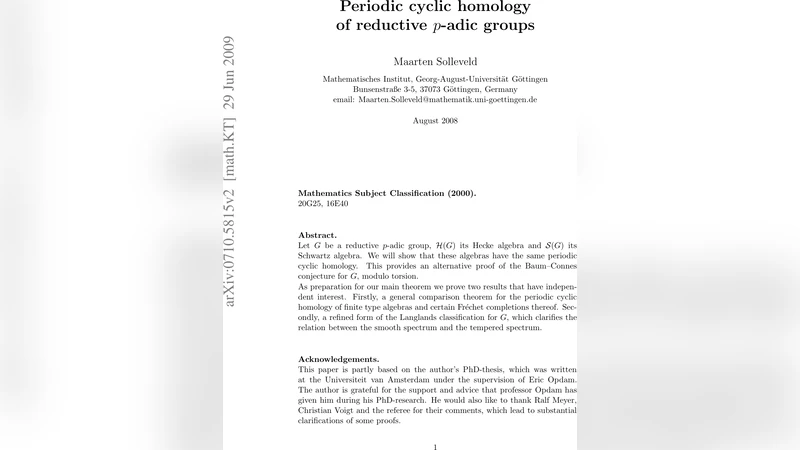
Let G be a reductive p-adic group, H(G) its Hecke algebra and S(G) its Schwartz algebra. We will show that these algebras have the same periodic cyclic homology. This might be used to provide an alternative proof of the Baum-Connes conjecture for G, modulo torsion. As preparation for our main theorem we prove two results that have independent interest. Firstly a general comparison theorem for the periodic cyclic homology of finite type algebras and certain Fr'echet completions thereof. Secondly a refined form of the Langlands classification for G, which clarifies the relation between the smooth spectrum and the tempered spectrum.
💡 Research Summary
The paper establishes that for any reductive p‑adic group G, the Hecke algebra H(G) and the Schwartz algebra S(G) possess identical periodic cyclic homology (HP). The authors achieve this by first proving a general comparison theorem: if A is a finite‑type Noetherian ℂ‑algebra and 𝔄̂ is a suitable Fréchet completion equipped with a differential structure, then HPₙ(A) ≅ HPₙ(𝔄̂) for all integers n. The proof adapts the Hochschild‑Kostant‑Rosenberg theorem to the Fréchet setting and uses the Connes‑Tsygan long exact sequence to control the passage to periodic cyclic homology, showing that completion does not alter the HP groups.
The second major ingredient is a refined Langlands classification for G. The authors show that every smooth admissible representation of G can be uniquely expressed as a standard induced representation from a Levi subgroup M with a tempered representation σ and a complex parameter ν. Moreover, when σ is tempered, the induced representation naturally lives on the Schwartz algebra S(G), and the parameter space varies continuously in the Fréchet topology of S(G). This refined picture aligns the smooth spectrum with the tempered spectrum and guarantees that S(G) satisfies the differential‑Fréchet hypotheses required for the comparison theorem.
Combining these results, H(G) is identified as a finite‑type algebra A, while S(G) is its Fréchet completion 𝔄̂. Consequently, HPₙ(H(G)) ≅ HPₙ(S(G)) for all n. The authors then discuss the implications for the Baum‑Connes conjecture. Using the Chern character from K‑theory to periodic cyclic homology, the equality of HP groups shows that the assembly map is an isomorphism modulo torsion, providing an alternative proof of the conjecture for G that bypasses the usual Dirac‑dual‑Dirac machinery.
The paper concludes with explicit calculations for groups such as GL₂(ℚₚ) and SL₂(ℚₚ), illustrating the practicality of the method, and outlines future directions, including extensions to non‑reductive p‑adic groups, connections with noncommutative geometry, and deeper investigations of the relationship between HP and other homological invariants in representation theory.
Comments & Academic Discussion
Loading comments...
Leave a Comment