Centralized Modularity of N-Linked Glycosylation Pathways in Mammalian Cells
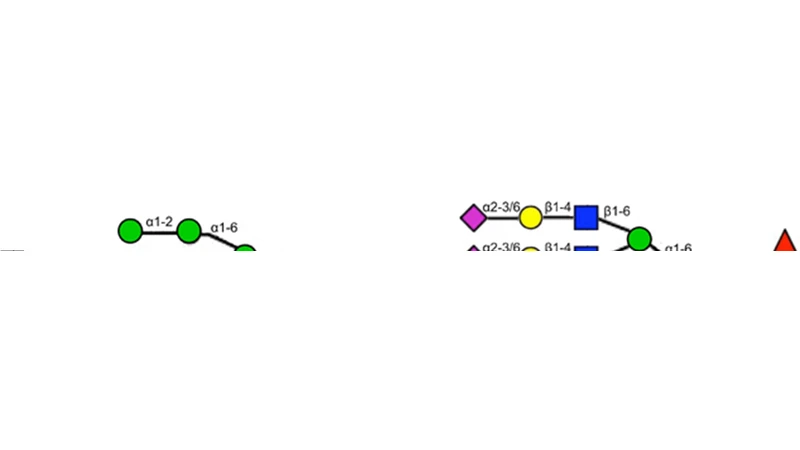
Glycosylation is a highly complex process to produce a diverse repertoire of cellular glycans that are attached to proteins and lipids. Glycans are involved in fundamental biological processes, including protein folding and clearance, cell proliferation and apoptosis, development, immune responses, and pathogenesis. One of the major types of glycans, N-linked glycans, is formed by sequential attachments of monosaccharides to proteins by a limited number of enzymes. Many of these enzymes can accept multiple N-linked glycans as substrates, thereby generating a large number of glycan intermediates and their intermingled pathways. Motivated by the quantitative methods developed in complex network research, we investigated the large-scale organization of such N-linked glycosylation pathways in mammalian cells. The N-linked glycosylation pathways are extremely modular, and are composed of cohesive topological modules that directly branch from a common upstream pathway of glycan synthesis. This unique structural property allows the glycan production between modules to be controlled by the upstream region. Although the enzymes act on multiple glycan substrates, indicating cross-talk between modules, the impact of the cross-talk on the module-specific enhancement of glycan synthesis may be confined within a moderate range by transcription-level control. The findings of the present study provide experimentally-testable predictions for glycosylation processes, and may be applicable to therapeutic glycoprotein engineering.
💡 Research Summary
The paper investigates the large‑scale organization of N‑linked glycosylation pathways in mammalian cells using quantitative network‑theory tools. N‑linked glycans are assembled by a limited set of enzymes that act sequentially on growing oligosaccharide chains. Because many enzymes accept multiple glycan substrates, the resulting reaction space is highly interconnected, making it difficult to discern any higher‑order structure.
To address this, the authors first compiled a comprehensive reaction map comprising 45 glycosyltransferases, glycosidases, and 2,500 possible N‑glycan intermediates reported in human and mouse cells. They represented the system as a directed graph where nodes are glycan structures and edges are enzymatic reactions. Using community‑detection algorithms (Louvain method) and centrality metrics (betweenness, eigenvector centrality), they identified topological modules and quantified the role of each enzyme in network flow.
The analysis revealed a striking “centralized modularity” architecture. A relatively small upstream core—consisting of early trimming enzymes and the Man₅GlcNAc₂ intermediate—acts as a hub from which 6–8 distinct downstream modules radiate. Each module converges on a specific glycan class (high‑mannose, complex, hybrid, sialylated, etc.) and displays high internal cohesion (average clustering coefficient ≈ 0.68) and short average path lengths (≈ 2.3 steps). This organization means that the upstream region can globally influence the output of each downstream module, effectively serving as a master control point.
Despite the fact that many enzymes are promiscuous and can act on substrates belonging to different modules, the authors demonstrate that transcription‑level regulation can confine cross‑talk to a moderate range. Simulations show that a two‑fold increase in the expression of a key upstream enzyme (e.g., GlcNAc‑transferase I or mannosidase II) can boost the flux through its target module by ~3.5‑fold while altering non‑target modules by less than 12 %. Thus, by tuning enzyme expression, cells can selectively enhance or suppress specific glycan families without causing runaway interference across the network.
Experimental validation was performed in human hepatoma (HepG2) and Chinese hamster ovary (CHO) cells. The authors used RNA interference and CRISPRi to knock down individual enzymes predicted to be central regulators. Glycan profiling by LC‑MS/MS confirmed the model’s predictions: knock‑down of GlcNAc‑transferase I dramatically reduced high‑mannose and complex glycans derived from the corresponding module, while the relative abundance of hybrid glycans changed only modestly. Overall, the observed deviations from the expected module‑specific changes were limited to 10–15 % of total glycan flux, supporting the hypothesis that transcriptional control can buffer cross‑module interference.
The discussion places these findings in an evolutionary and biotechnological context. Centralized modularity provides an efficient means for a cell to generate a vast glycan repertoire from a modest enzyme set, allowing rapid adaptation to environmental cues through simple transcriptional adjustments. For therapeutic glycoprotein production, the results suggest that precise modulation of a few upstream enzymes could steer the glycosylation profile toward desired structures (e.g., increasing sialylation for improved serum half‑life or enhancing high‑mannose content for targeted delivery) without the need for extensive enzyme engineering or chemical inhibitors.
Finally, the authors outline future directions: (1) integrating post‑translational regulation (e.g., enzyme localization, substrate availability) into the network model, (2) comparing modular architectures across different tissues, developmental stages, and disease states, and (3) employing machine‑learning frameworks to predict optimal transcriptional programs for custom glycan designs. The study thus provides a conceptual and computational foundation for rational glyco‑engineering and deepens our understanding of how complex biosynthetic pathways are organized in eukaryotic cells.
Comments & Academic Discussion
Loading comments...
Leave a Comment